
Welcome to Point Reyes National Seashore
Here at the coordinates lies a peculiar formation that is hard to miss. What we see here is a prime example of the Point Reyes Conglomerate.
The Point Reyes Conglomerate is a classic conglomerate of rock, formed by an underwater landslide. Sedimentary conglomerate is a collection of larger stones and pebbles that are suspended within a fine sandstone matrix (think of chocolate chips in a cookie!). The underwater landslides are called turbidity currents, and the rock deposited by them are called turbidites. We will go more in-depth with turbidites later.
Geologists estimate that this formation is around 50 million years old, from the Eocene. However, this is not fact, and has been disputed in the geologic community. Some scientists believe the formation to be a tad older, from the Paleocene (66-56 million years ago). It is tougher to determine ages of formations like these because they are comprised of rock that was already in existence from long ago, just rearranged and deposited in this location due to turbidity currents. This exact formation occupies a very small area (only here at the tip of Point Reyes), yet it appears to be identical to the Carmelo Formation near Point Lobos.
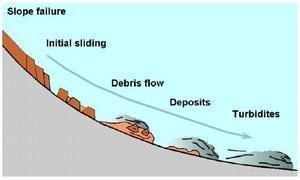
Turbidites are the deposited material from underwater landslides (turbidity currents). This process results in larger, coarser grains to reside on the bottom, with smaller, finer grains on top. These layers are not perfect, but the larger grains are heavier, which results in them sinking down and coming to a stop first in the submarine landslide. The lighter grains stay suspended in the water longer after the landslide reaches its stopping point, and then settle on top of the coarser gains. A fascinating video of a turbidity current in action in Mendocino Canyon off the coast of California can be viewed here. This process happened long ago, and this formation was deposited.
From NPS regarding this location: “Here you can see layers intersecting at different angles (cross bedding), and rounded cavities caused by the erosion of poorly cemented materials. Notice also that in any one layer the larger sand grains which sank first are at the bottom, while the finer ones lie on top (graded bedding).”
PLEASE DO NOT TOUCH, CHIP AT, OR OTHERWISE TAMPER WITH THE FORMATION.
To log this cache, please send over the answers to the following questions, with the name of this cache on the first line:
1. How many people are in your group?
2. Can you tell that coarser grains are lower then finer grains?
3. Observe where some pebbles are missing from the sandstone matrix. If this is the result of erosion, why do you think the sandstone around these particular stones eroded?
Sources:
-https://pubs.usgs.gov/of/2005/1127/chapter9.pdf
-https://s3.amazonaws.com/gs-geo-images/949c28d9-af79-4d2f-9e7c-059b3af6a8f8_l.jpg
-https://noc.ac.uk/news/will-sea-level-rise-lead-more-underwater-landslides
-https://www.sciencedirect.com/topics/earth-and-planetary-sciences/turbidite
-https://geo.libretexts.org/Courses/University_of_California_Davis/GEL_109%3A_Sediments_and_Strata_(Sumner)/Textbook_Construction/Turbidites