This earthcache can be grabbed without ever leaving your vehicle, or even slowing down along the 101! It may help to have a passenger in the car with you to do the observing so the driver doesn't have to take their eyes off the road at all. You assume all risks while attempting this earthcache. This earthcache, me (1962penny), geocaching.com, and Groundspeak are not liable for an accident if caused by the observations for this earthcache and the lack of awareness by the driver. Paying attention to the road is the sole priority of the driver, and this earthcache should NOT be attempted if there is no passenger in the car to make observations for the driver.


This Earthcache is a similar "drive-by" style cache to my original 70 mph Geology! cache, meant to point out neat formations and inspire some good geologic discussions on long drives.
This cache will focus on an ancient sea stack in the middle of the Highway 101! The sea stack can be seen from the 101 going both directions, so this cache is doable no matter which way you are going.
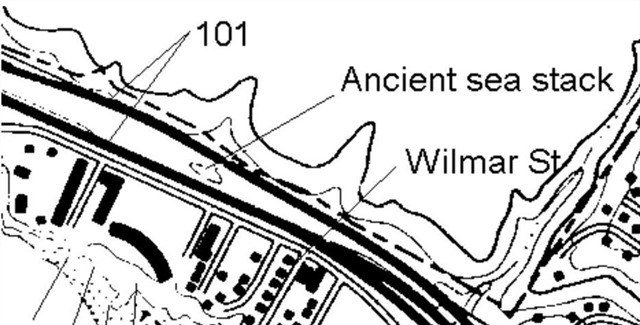
This sea stack is a geologic formation that’s known as a sea stack. Sea stacks come in all shapes and sizes. Sea stacks are the result of wind weathering and wave erosion formed over time. They are formed when a weak point of mainland is degraded by hydraulic action. Hydraulic action, in short, is the force of water crashing repeatedly into rock or other material. The constant barrage of the ocean eventually weakens the rocks, forming cracks and widening already existing cracks. This process can either form a stack outright, or form a natural arch (or “bridge”). These natural arches at last breakdown and collapse from gravity, leaving a gap between the mainland and the newly-formed stack. Just like the initial formation due to erosion, these natural processes continue with time, eroding the stacks themselves. When a sea stack finally topples, the base of rock left behind (often at or under the water level) is called a stump.
There are some types of rock that more easily fall victim to hydraulic action. This is usually sedimentary rock; cracks, gaps, and unconformities are common with sedimentary layers. The rock that makes up this sea stack is tuff belonging to the Obispo Formation. The rock is called tuff, which is a volcanic stone. However, the Obispo Formation is surrounded by and often mixed up in the Pismo and Monterey Formations, which are made of sedimentary sandstone.
Logging as a find:
Please send me a note with the following:
1) The name of this earthcache : GCA41DW More 70 mph Geology!
2) Number of people in your car
3) Explain why this sea stack is still standing, while the rock around it is completely eroded away.
4) As you drive by, do your best to get a glimpse of not only the ancient sea stack, but the hills directly to the north of Highway 101. Do you think these two areas are the same type of rock?
Thanks for visiting, and have fun! I hope this adds some fun to your drive up or down the 101, a drive that I have personally made many, many times. If you are on a roadtrip, please mention where you are heading if you are comfortable doing so!
Sources:
-https://www.jf2.com/geowalk/geowalk.html
-https://global.hurtigruten.com/destinations/iceland/inspiration/what-is-a-sea-stack/
-https://en.wikipedia.org/wiki/Stack_(geology)
-https://pubs.geoscienceworld.org/gsa/gsabulletin/article-abstract/77/4/443/6065/POTASSIUM-ARGON-AGE-OF-THE-OBISPO-FORMATION-WITH
-https://archives.datapages.com/data/meta/sepm_sp/fg2/Diagenesis_of_the_Miocene_firstpage.pdf
-https://scholarworks.calstate.edu/concern/theses/w95051399?locale=en
-https://www.sciencebase.gov/catalog/item/51dc1f86e4b0f81004b7868b
-https://www.osti.gov/servlets/purl/836047