The Crown Jewels
The Crown Jewels are a collection of royal ceremonial objects kept in the Tower of London, which include the coronation regalia and vestments worn by British monarchs.
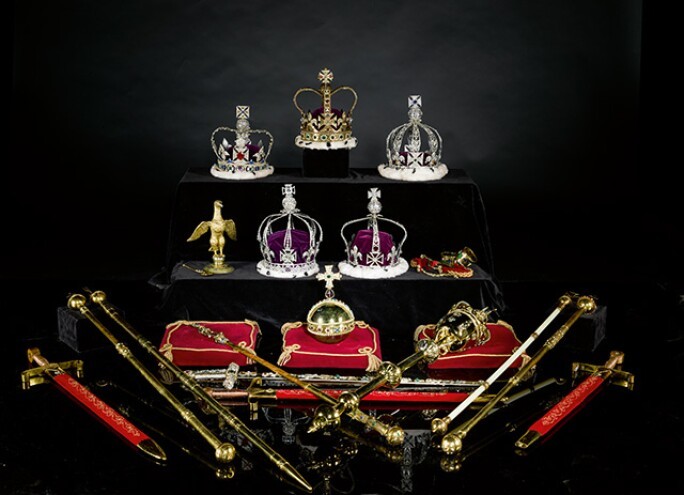
Most of the present collection dates from around 350 years ago when Charles II ascended the throne. The medieval and Tudor regalia had been sold or melted down after the monarchy was abolished in 1649 during the English Civil War. Only four original items predate the Restoration: a late 12th-century anointing spoon (the oldest object) and three early 17th-century swords.
At a coronation, the monarch is anointed using holy oil poured from an ampulla into the spoon, invested with robes and ornaments, and crowned with St Edward's Crown. Afterwards, it is exchanged for the lighter Imperial State Crown, which is also usually worn at State Openings of Parliament. Wives of kings, known as queens consort, are invested with a plainer set of regalia. Also regarded as crown jewels are state swords, trumpets, ceremonial maces, church plate, historical regalia, banqueting plate, and royal christening fonts.
The Coronation Spoon (Oldest of the Crown Jewels)
The silver-gilt spoon has an oval bowl, divided into two lobes, engraved with acanthus scrolls. The bowl is joined to the stem by a stylised monster's head, behind which the stem flattens into a roundel, flanked by four pearls, and a band of interlaced scrolling, with another monster's head; the end of the tapering stem is spirally twisted, and terminates in a flattened knop.
The spoon is first recorded in 1349 as preserved among St Edward's Regalia in Westminster Abbey. Already at this date it is described as a spoon of 'antique forme'. Stylistically it seems to relate to the twelfth century and is therefore a remarkable survival - the only piece of royal goldsmiths' work to survive from that century. It was possibly supplied to Henry II or Richard I.

The anointing is the most sacred part of the coronation ceremony, and takes place before the investiture and crowning. The Archbishop pours holy oil from the Ampulla (or vessel) into the spoon, and anoints the sovereign on the hands, breast and head. The tradition goes back to the Old Testament which describes the anointing of Solomon by Zadok the Priest and Nathan the Prophet. Anointing was one of the medieval holy sacraments and it emphasised the spiritual status of the sovereign.