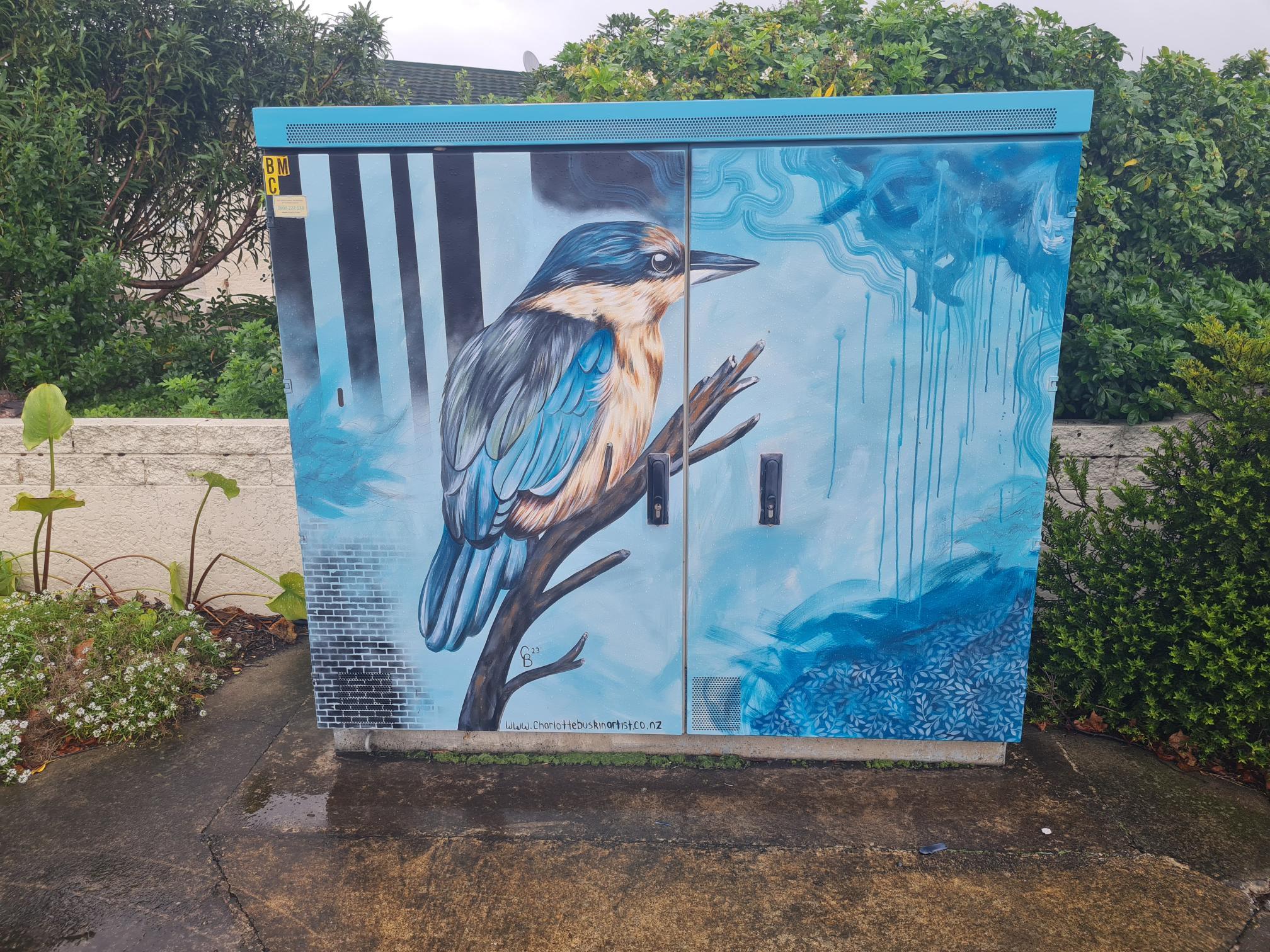
This is the latest cache in my (and now others) 'Chorus Cabinet Art' series which I have started to highlight the local artistic talent that Chorus have commissioned to brighten up their otherwise boring public utility boxes. This cabinet has been painted by a new name on the Chorus Cabinet Art scene, Charlotte Buskin.
The Kotare (Kingfisher) is a distinctive bird with a green-blue back, buff to yellow undersides and a large black bill. It has a broad black eye-stripe, and a white collar in adults. The females are slightly greener and duller. Kingfishers have a wide range of unmusical calls, the most distinctive of which is the staccato ‘kek-kek-kek’ territorial call. In New Zealand their status is 'Native, Not Threatened'.
Habitats
Kingfishers are found throughout the country in both coastal and inland freshwater habitats. They live in a wide range of habitats, including forest, river margins, farmland, lakes, estuaries and rocky coastlines.
Diet
Their diet in estuarine mudflats is mainly small crabs, with a range of tadpoles, freshwater crayfish and small fish in freshwater habitats. In open country they eat insects, spiders, lizards, mice and small birds.
Nesting and breeding
Nest sites are in cavities in trees, cliffs and banks with breeding from September to February. After leaving the nest chicks are fed by both parents for 7–10 days before they start to catch food for themselves.
Kingfishers appear to have high fidelity to breeding sites. The same burrow has been reported in use for 20 consecutive years, but it is not known how many birds were involved.
The cache
The cache can be found by plotting a bearing from the cabinet of 166 degrees for 27 metres.
B.Y.O.P