DE:
... und Gesicht des Poseidon.
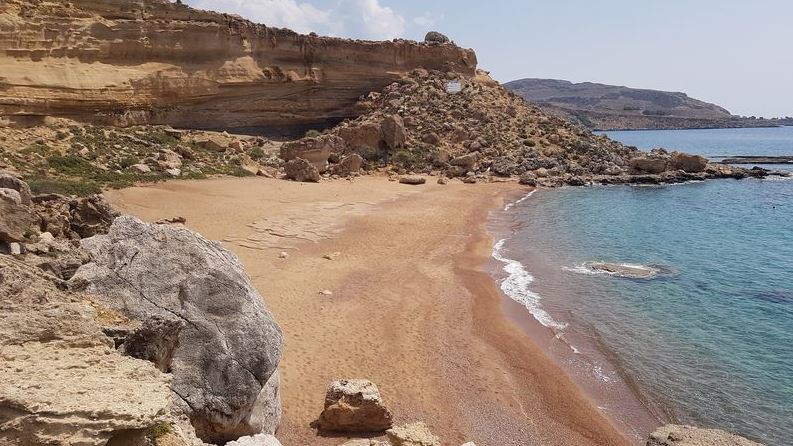
Die Wanderung zum Felsentor beginnt am Strand von Agathi und ist in einfacher Strecke ca. 2 km lang. Wer möchte kann bei Punkt "Abstieg Traumbucht" auf Ziegenpfaden zu einem einsamen Sandstrand absteigen oder auf dem Küstenpfad nach Stegna weiterwandern.
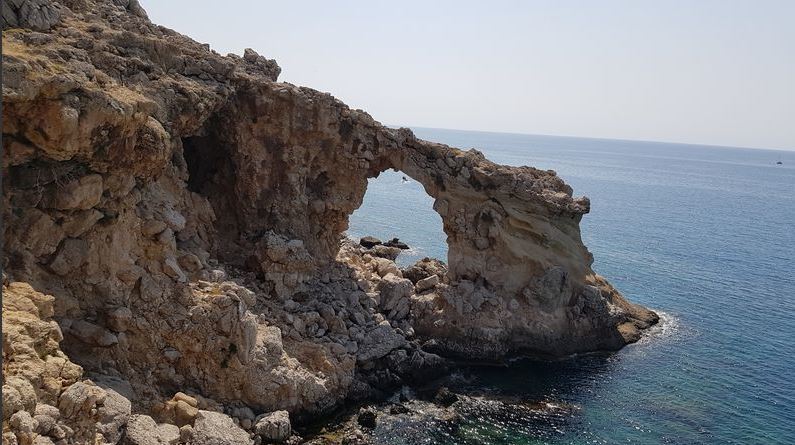
An Stage 1 habt ihr einen schönen Blick auf das Felsentor. Dort ist auch der Stein mit den Markierungen für Frage 4.
Achtung: Kliffkanten können abbrechen und man kann abstürzen. Haltet bitte ausreichend Abstand!
Felsentore sind brücken- oder fensterartig durchbrochene Gesteinsformationen. Sie entstehen im Regelfall durch Erosion, wodurch Teile natürlicher Felsformationen entfernt werden. Dauerhafte große Formen bilden sich besonders häufig in Sand- und Kalkstein. Dabei werden aus dem weichen Sandstein die verbackenen Sandkörnchen, aus denen er besteht, ausgewaschen. Im Gegensatz dazu löst sich der massive, helle Kalkstein durch chemische Prozesse auf, so dass durch das Wasser Hohlräume entstehen. Neben der Wirkung von Wasser sind Temperaturänderungen, Schwerkraft oder tektonische Kräfte für die Ausbildung von Felsentoren verantwortlich. Wind spielt bei der Entstehung meist keine direkte Rolle, er kann jedoch ein wichtiger Faktor bei der weiteren Gestaltung sein, zum Beispiel durch die schleifende Wirkung von mitgeführten Sandkörnern.
Folgende Faktoren können z. B. die Bildung von Felsentoren konkret bewirken:
- das Einschneiden von Fluss-Mäandern in den Untergrund kann bis zur Annäherung von Flussschlingen fortschreiten, so dass nur eine relativ dünne Felswand den zukünftigen Umlaufberg mit den Talwänden verbindet und ein Felssturz einen Steinbogen bilden kann
- die Entstehung unterirdischer Flussläufe durch Verkarstung und der Einsturz von Teilen der dadurch gebildeten Höhlen oder ihr Zusammenwachsen
- die Entstehung von Lavaröhren und der Einsturz von Teilen der Röhre
- die Tätigkeit der Brandung, die durch das Mitführen von Sand und Steinen zu einer starken Erosion im Brandungsbereich führt, während höhere Bereiche nur wenig betroffen sind. Sie führt darüber hinaus zu einer stark unterschiedlichen Abtragung verschieden harter Gesteinspartien
- unterschiedliche Erosion benachbarter, unterschiedlich widerstandsfähiger Gesteine
Fragen :
1. Wie breit ist das Felsentor?
2. Aus welchem Gestein ist die obere Schicht des Felsentores?
3. Beschreibe, wie das Felsentor deiner Meinung nach entstanden ist.
4. Auf dem Felsen bei Stage 1 (siehe Spoiler) sind drei Markierungspunkte in zwei unterschiedlichen Farben. Welche Farben haben die Punkte?
5. Der "Brückenpfeiler" am Meer soll dem Gesicht von Poseidon ähnlich sehen. Fertige eine Skizze der Seitenansicht dieses Gesichtes an und füge sie deinen Antworten bei. Alternativ reicht auch ein Foto mit dir oder einem persönlichen Gegenstand.
Sende bitte alle Antworten an mein Profil. Sollte etwas nicht stimmen melde ich mich.
Ihr dürft sofort Loggen!
EN:
... and Face of Poseidon.
The hike to the rock arche starts at Agathi beach and is about 2 km long one way. If you want, you can descend on goat paths to a secluded sandy beach at the point "Descent Dream Bay" or continue on the coastal path to Stegna.
On Stage 1 you have a nice view of the rock arche. There is also the stone with the markings for question 4.
Attention: cliff edges can break off and you can fall. Please keep enough distance!
Rock arches are rock formations with broken bridges or windows. They are usually formed by erosion, which removes parts of natural rock formations. Permanent large forms are particularly common in sandstone and limestone. In the process, the baked sand grains that make up the soft sandstone are washed out. In contrast, the massive, light-colored limestone dissolves through chemical processes, so that cavities are created by the water. In addition to the effects of water, temperature changes, gravity or tectonic forces are responsible for the formation of rock gates. Wind usually does not play a direct role in the formation, but it can be an important factor in the further development, for example through the grinding effect of sand grains that are carried along.
The following factors can e.g. cause the formation of rock arches concretely:
- the cutting of river meanders into the subsoil can progress to the point where river meanders approach, so that only a relatively thin rock face connects the future circulation mountain with the valley walls and a rock fall can form a stone arch.
- the formation of underground rivers through karstification and the collapse of parts of the caves formed as a result or their coalescence
- the formation of lava tubes and the collapse of parts of the tube
- the activity of the surf, which, by carrying sand and stones, leads to severe erosion in the surf area, while higher areas are little affected. It also leads to a very different removal of different hard rock sections
- differential erosion of neighboring rocks of different resistance
Questions :
1. How wide is the rock arche?
2. What rock is the upper layer of the rock arche made of?
3. Describe how you think the rock arche came into being.
4. On the rock at stage 1 (see spoiler) are three markers in two different colors. What colors are the dots?
5. The "pier" by the sea is said to resemble Poseidon's face. Make a sketch of the side view of this face and attach it to your answers. Alternatively, a photo of you or a personal item is sufficient.
Please send all replies to my profile. If something is wrong, I'll let you know.
You may log immediately.