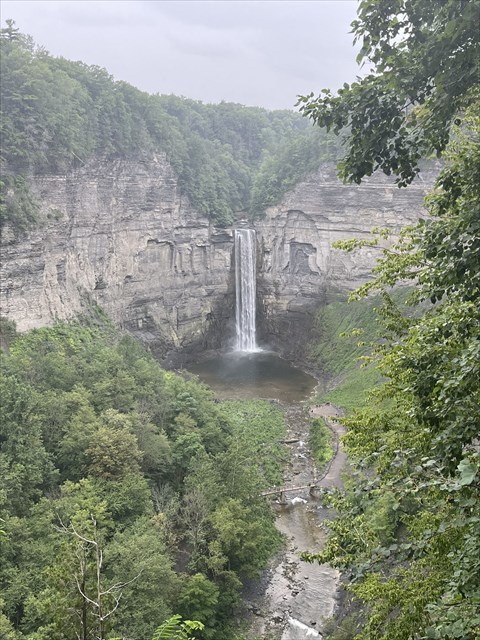
Taughannock Falls is a stunning natural wonder located in Taughannock State Park in the Finger Lakes region of New York. It is renowned for its breathtaking 215-foot plunge, making it one of the tallest waterfalls east of the Rocky Mountains. The falls are surrounded by lush forests and offer picturesque hiking trails that lead visitors to various vantage points, providing awe-inspiring views of the cascading water and the impressive gorge it has carved over thousands of years.
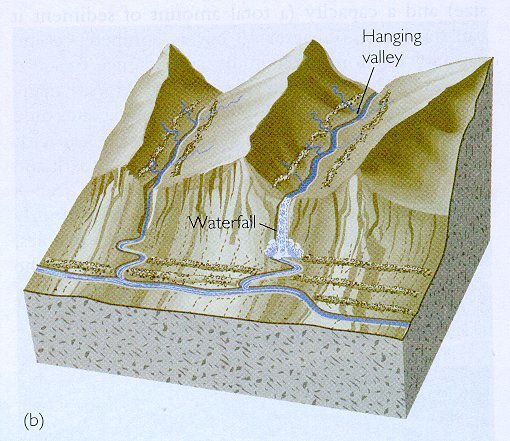
Perhaps one of the more unique geologic features that were formed by glaciers are hanging valleys. Hanging valleys are distinctive geological features formed as a result of glacial erosion and are commonly found in glaciated landscapes. These valleys exhibit a unique topographical relationship with their main, or trunk, valleys. The formation of hanging valleys is primarily attributed to differences in the erosional power of glaciers. As glaciers move down a valley, their immense weight and erosive capabilities lead to the deepening and widening of the main valley, creating a U-shaped profile. However, smaller tributary glaciers, known as hanging glaciers, lack the same erosional force. Consequently, when the ice melts, these hanging valleys are left perched above the main valley, often culminating in striking waterfalls as streams from the hanging valleys plunge into the deeper trunk valley. Hanging valleys serve as a prominent testament to the dynamic interplay of glacial processes and the shaping of Earth's geological features over time.
To gain insight into the formation of the hanging valley, it is essential to consider the local geology of Taughannock Falls. Taughannock Falls is predominantly composed of three distinct types of sedimentary rocks: shale, limestone, and sandstone. Shale, a fine-grained and easily erodible rock, forms the bulk of the geological makeup in the area. Intermixed with the shale are layers of limestone, a harder and more resistant rock. Additionally, sandstone, with its coarse-grained and porous texture, is present, further enriching the geological diversity of the region. The interplay of these three rock types, each with its distinct properties and erosion characteristics, has been instrumental in shaping the iconic Taughannock Falls and the hanging valleys that are an integral part of this geological marvel.
In geology, zones of weakness are pivotal features that significantly influence the behavior of rock formations and the development of geological structures. These zones often represent areas of reduced mechanical strength within the Earth's crust and can result from a variety of factors, including systematic fractures, non-systematic fractures, and bedding planes. Systematic fractures, aligned in a specific geometric pattern, and non-systematic fractures, occurring randomly, can both serve as prominent zones of weakness. These features play a crucial role in controlling the orientation and movement of geological formations. Bedding planes, representing the natural layering within sedimentary rocks, are another important type of zone of weakness. These horizontal interfaces between sedimentary layers can facilitate the separation and movement of rock units. Understanding and identifying these zones of weakness are fundamental in geology, especially in contexts like Taughannock Falls, where they can influence the formation and behavior of geological features. They provide critical insights into predicting geological hazards and interpreting the dynamic history of our planet's surface.
Logging Requirements:
- Looking at the falls, estimate the depth of the hanging valley (distance from top of the gorge to the spot where the water flows over). How does it compare to the overall depth of the valley?
- Based on the description and your observations, do you think the hanging valley has had this depth since the time of glaciation, or has it changed? What led you to that conclusion?
- Looking at the falls, are you able to observe any zones of weaknesses within the rock? If so, are they systematic or nonsystematic? Do you observe any bedding planes?
- Looking at the valley wall, which area do you think might be the next to break away? Do you think it will occur in the near future (within a few years), or in the distant future (decades)?
- Upload a photo taken from the overlook with Taughannock Falls. You don't have to be in the photo, though it is strongly encouraged.