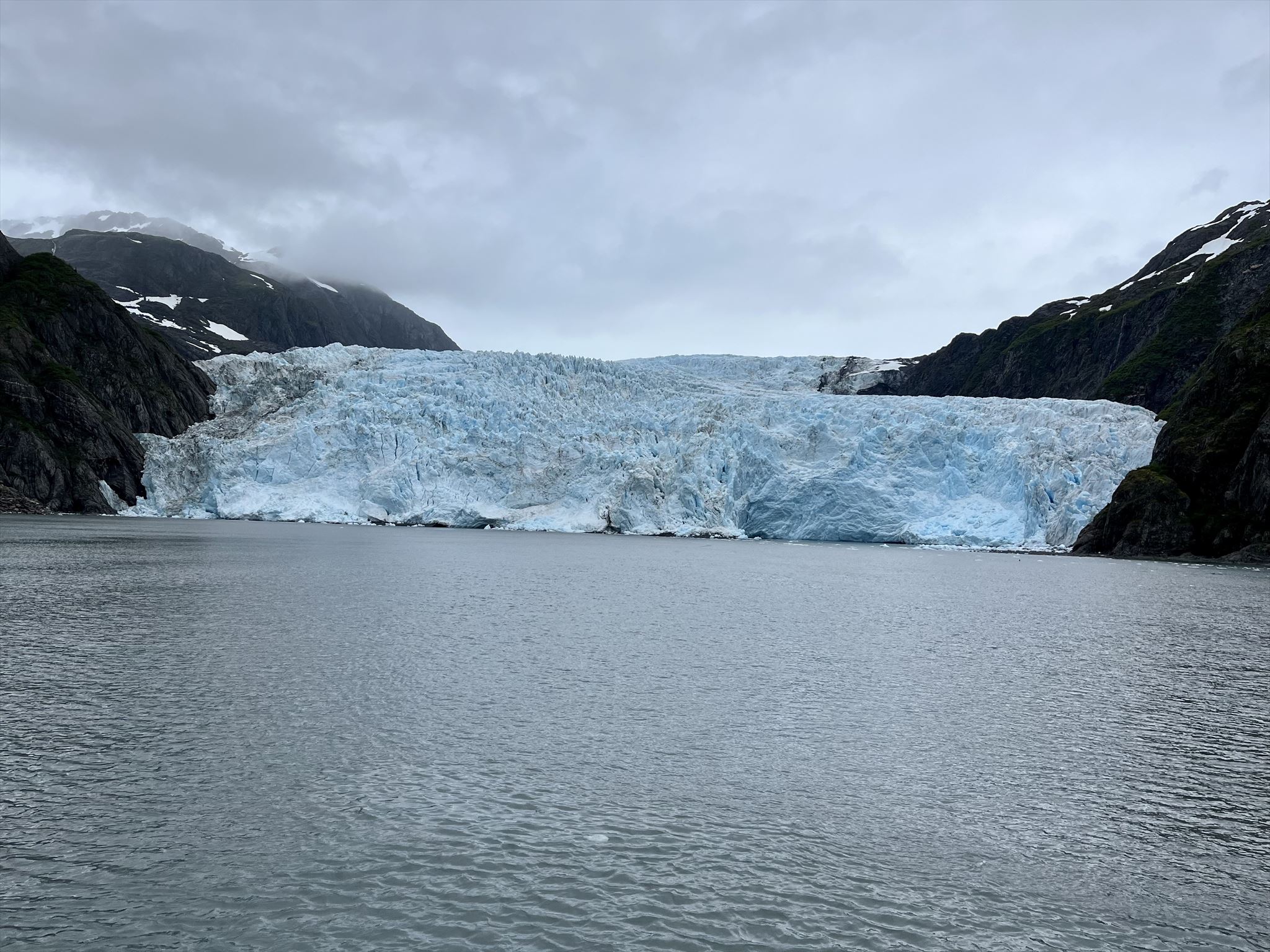
Kenai Fjords National Park is a breathtakingly beautiful and diverse national park located in south-central Alaska. Encompassing over 1,000 square miles of pristine wilderness, the park is characterized by its rugged coastline, majestic glaciers, and abundant marine and terrestrial wildlife. Visitors to Kenai Fjords can embark on thrilling boat tours to witness calving glaciers, spot humpback whales and sea otters, and marvel at the towering cliffs and fjords carved by ancient ice. Here you'll be able to see the Holgate Glacier, which is approximately 2 miles wide and towers up to 350 feet above the ocean's surface. It is considered one of the most accessible glaciers in the park.
In geology and glaciology, the colors of glaciers can tell us a lot about their composition and history. Glacial ice often appears blue due to its high density and near-purity. When snow accumulates on a glacier, it compresses over time, forcing out the air between snowflakes and transforming it into solid ice. This process leads to larger ice crystals, and as they grow, the ice becomes more transparent. As a result, longer wavelengths of light, such as red and yellow, are absorbed by the ice, while shorter wavelengths, like blue, are scattered back to our eyes. This phenomenon, known as Rayleigh scattering, is responsible for the striking blue color observed in glaciers. Blue ice is almost entirely composed of pure ice, which makes it exceptionally clear. Unlike snow, which contains air bubbles and reflects light in various directions, pure ice allows light to penetrate deeper, enhancing the blue hue. Consequently, the older and more compressed a glacier becomes, the bluer it appears.
The color variations within glaciers can also reveal information about their environmental history. As fresh snow falls on a glacier, it initially appears white due to the scattering of light by the air trapped between snowflakes. Over time, as the snow accumulates and undergoes compaction, the air is forced out, and the ice becomes denser and bluer. Glacial ice cores, contain valuable records of past climate conditions. The distinct layers of colored ice offer researchers a timeline of environmental changes, such as volcanic eruptions or the deposition of dust and pollutants, which have been preserved within the glacial ice over centuries.
Colors like brown or black on a glacier indicate the presence of impurities or debris within the ice, such as glacial till, mineral dust, volcanic ash, or pollutants. These dark hues can affect the glacier's ability to absorb sunlight and may contribute to localized melting. Scientists study these color variations to understand the impact of impurities and environmental factors on glacier behavior and their role in sea-level rise.
Logging Requirements:
- Do you see any blue ice? Where is it the "darkest"? Why do you think this area is darker compared to the rest of the glacier?
- Do you see any white areas on the glacier, and if so, describe where they are located. Over time, do you think the proportion of white areas on the glacier will increase or decrease, and why?
- Do you see any dark colored areas on the glacier, and if so, describe where on the glacier you see them. What do you think caused them?
- Upload a photo with the Holgate Glacier. You don't have to be in the photo, though it is strongly encouraged.
Sources:
- https://www.nps.gov/places/why-is-the-ice-blue-in-glacier-bay.htm#:~:text=Blue%20is%20the%20color%20of,blue%20color%20reaches%20our%20eyes.
- https://asf.alaska.edu/information/glacier-power/glacier-power-why-is-glacier-ice-blue/
- https://www.lastfrontierheli.com/news/glacier-ice-the-facts-behind-that-vibrant-color-heli-ski-news/