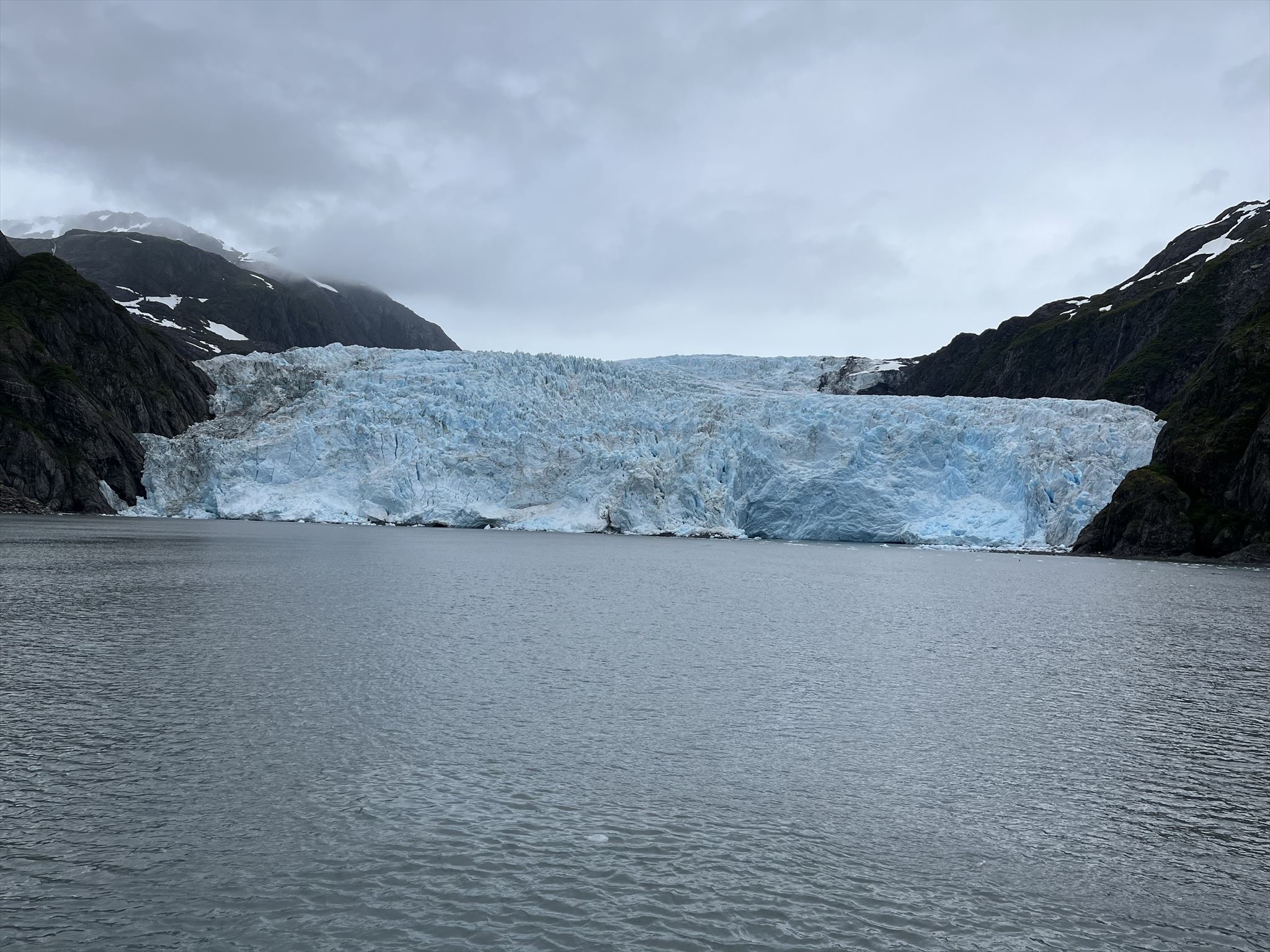
Kenai Fjords National Park is located on south-central Alaska and is a captivating natural wonderland characterized by its rugged coastline, majestic fjords, and icy glaciers. The park showcases a diverse array of ecosystems, from lush temperate rainforests to towering icy peaks. The Harding Icefield, a remarkable feature within the park, is a massive ice plateau spanning over 700 square miles. It serves as the primary source for numerous glaciers that cascade down the mountainsides and calve into the ocean, creating a stunning display of glacial beauty.
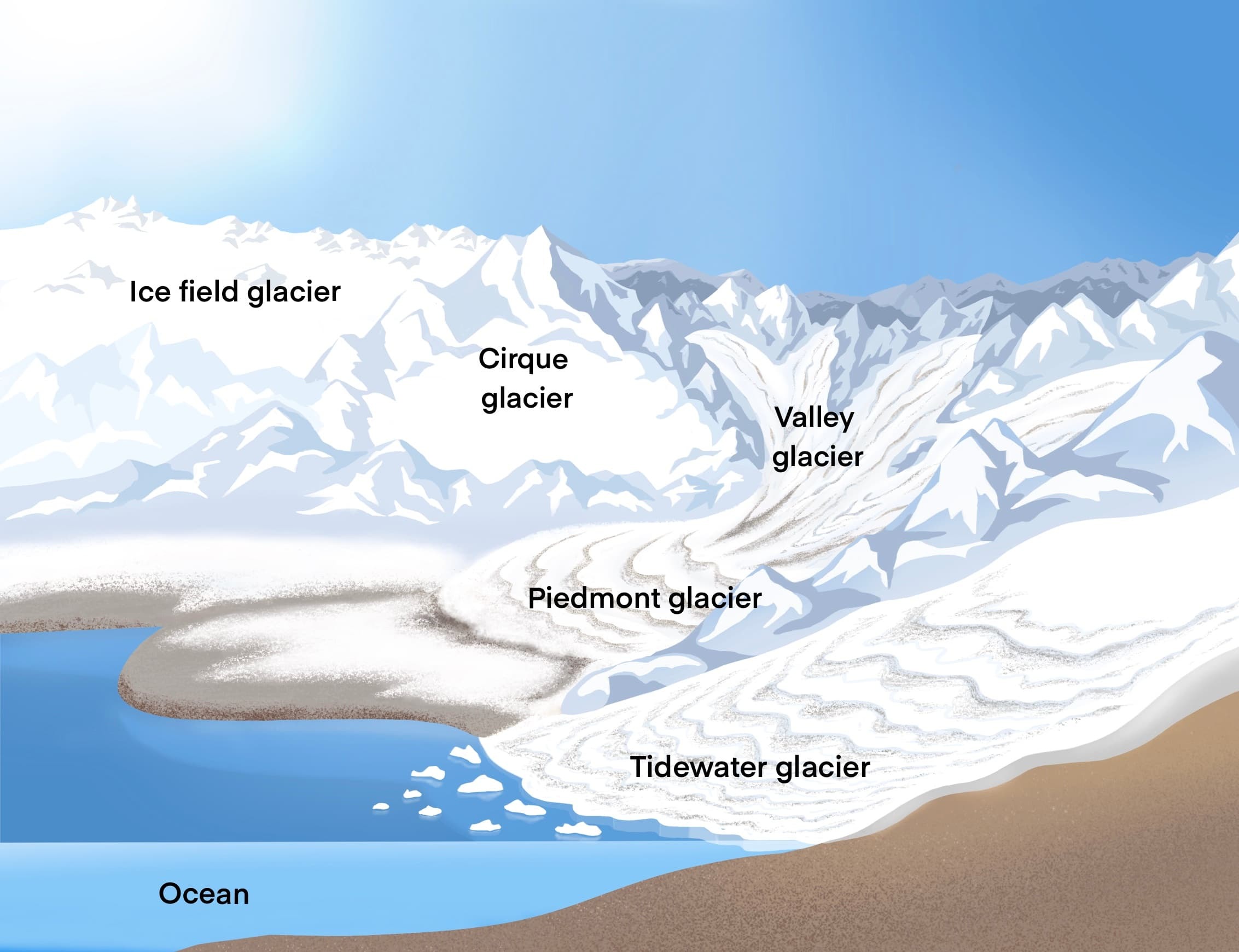
Glaciers come in various types, each exhibiting distinct characteristics shaped by geological processes. Alpine glaciers (the image above calls them icefield glaciers), commonly found in mountainous regions, form within valleys and are often narrow and steep. They sculpt rugged landscapes through erosional forces, leaving behind U-shaped valleys and sharp ridges. These glaciers originate from the accumulation and compaction of snow over many years, eventually transforming into dense ice. Valley glaciers, also known as alpine glaciers, are a subset of mountain glaciers that occupy valleys and flow downhill between the surrounding peaks. They typically form in high-altitude regions where snowfall exceeds melt rates, leading to the gradual buildup of ice over time. As valley glaciers flow downslope, they carve out deep and broad U-shaped valleys, often with sharp crests called arêtes, and form glacial cirques at their headwalls. These cirques act as the birthplace of valley glaciers, capturing and accumulating snow and ice that eventually feed into the glacier. Another intriguing type is the tidewater glacier, which terminates at the ocean, calving icebergs into the water. This process plays a crucial role in replenishing the ocean's freshwater and contributes to the global water cycle. Tidewater glaciers often undergo rapid retreat or advancement due to changing oceanic conditions, making them dynamic subjects of study for geologists concerned with climate change and sea-level rise. Another type of glacier is the Piedmont glaciers, which occurs when valley glaciers spill out onto lowland areas, spreading out and becoming wider and shallower. These glaciers often advance over flat plains, covering extensive areas as they expand. Piedmont glaciers can form striking lobate moraines, which are curved ridges of glacial debris, as they deposit sediment at their margins.
After a glacier retreats, a captivating process known as ecological succession takes center stage. As the barren, rocky landscape left behind by the glacier begins to recover, pioneer species like lichens and mosses gradually colonize the terrain. These hardy organisms break down the rock, forming a basic soil layer. Over time, more complex plants like grasses and shrubs establish themselves, further enriching the soil. The process of succession after glacier retreat offers invaluable insights into geology. By observing the types of plants that populate different stages of succession, geologists can discern vital clues about the age of the terrain and the pace of glacial retreat. Additionally, the changing plant communities reflect the geological forces at play, including soil formation, erosion patterns, and the influence of microclimates.
Logging Requirements:
- In front of you is the Holgate Glacier, which is one of the most photographed in the park. However we'll be focusing on another nearby glacier instead. Look slightly to the south at the South Holgate Glacier (sometimes called the Surprise Glacier), which has retreated dramatically. Describe what you see. How does it compare/contrast to the Holgate Glacier?
- How would you classify the South Holgate Glacier? Justify your classification by describing its location, shape, and relationship to the surrounding topography.
- Describe the landscape along the edge of the South Holgate Glacier. Describe what you see. Based on ecological succession, do you think the glacier is retreating at a slow, moderate, or fast pace?
- Upload a photo with the nearby scenery. You don't have to be in the photo, though it is strongly encouraged.
Sources:
- https://nsidc.org/learn/parts-cryosphere/glaciers/science-glaciers
- https://www.nps.gov/kefj/learn/nature/glacier-terminology.htm
- https://www.nps.gov/kefj/learn/nature/glacier-repeat-photography.htm