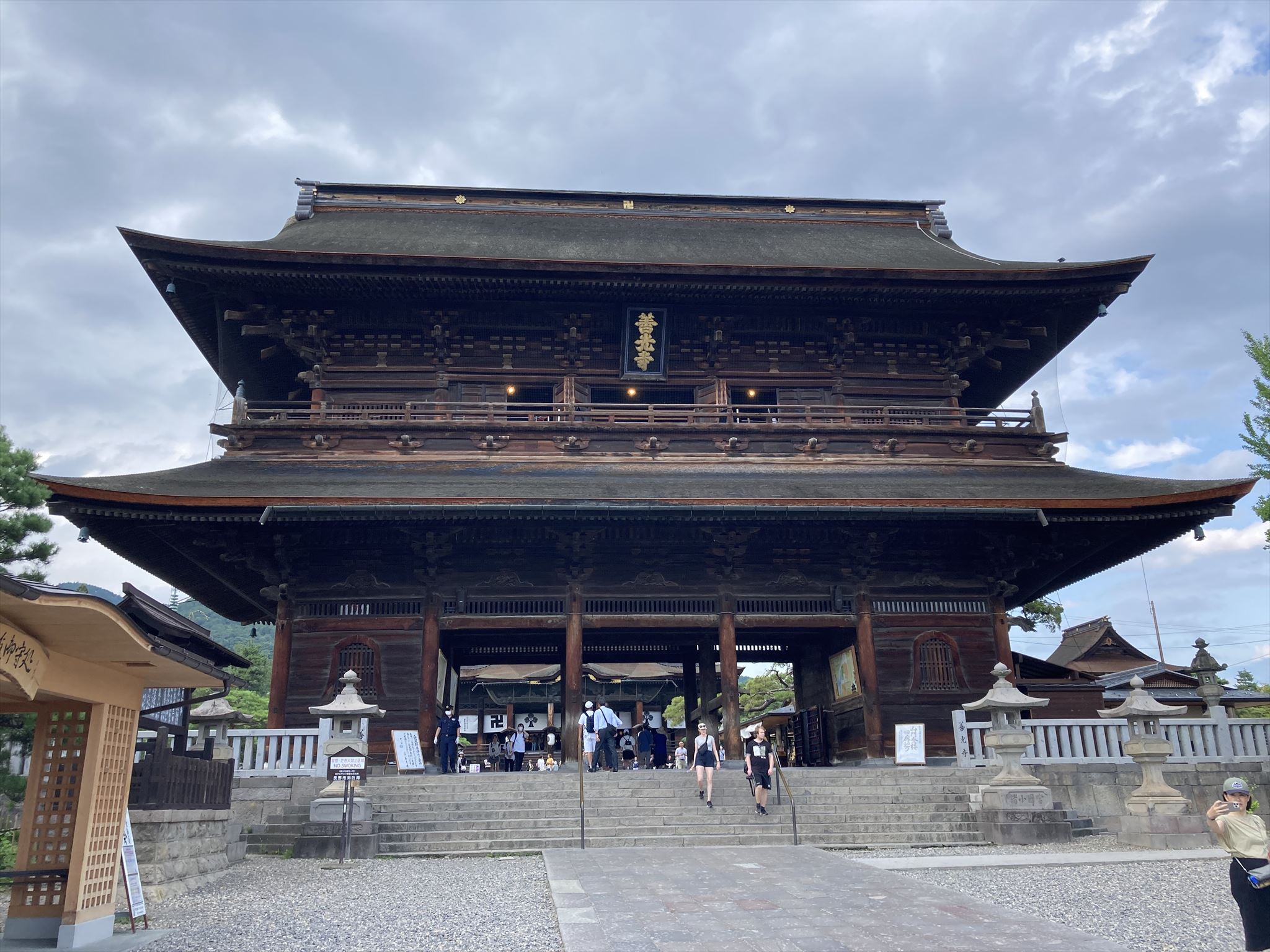
【国宝「善光寺本堂」に残る地震の痕跡とは?】
創建以来約1,400年の歴史を誇る「善光寺」ですが、その「本堂」には大地震の痕跡が残されています。
そして、その痕跡を調べることで地震のメカニズムや地球の営みを知ることができます。身近にある貴重な痕跡を調べてみましょう。
[What traces of the earthquake remain in the Zenkoji Temple Main Hall, a national treasure?]
Zenkoji Temple, which boasts a history of approximately 1,400 years since its foundation, has left traces of a major earthquake in its main hall.
And by examining the traces, you can learn about the mechanism of earthquakes and the workings of the earth. Let's examine the precious traces around us.
【善光寺地震について】
善光寺地震は1847年5月8日(旧暦:弘化(こうか)4年3月24日)夜10時ごろ、御開帳(ごかいちょう)でにぎわっていた善光寺界わいを含む長野盆地の西縁部を中心に、大きな被害をもたらした地震です。典型的な山地の縁辺部にある活断層に発生した内陸の浅い大地震で甚大な被害が発生ました。
「善光寺地震の犠牲者は、(家屋倒壊や土石流に埋められて、火災で焼かれ、洪水で流され)土葬にされて火葬にされて水葬にされて三度弔とむらわれた」といわれるほど多種多様な被害が発生し、犠牲者が観光客1,000人以上を含む8,000人を超えたことで有名です。
善光寺本堂に残る地震の痕跡が1847年の地震によるものだとの明確な証拠はありません。『しかし、次の2点から1847年の地震の痕跡である可能性が高いと言えます。①現存する本堂が再建された年が1707年であること、②1707年~1847年には大規模地震が発生していないこと(Cache ownerの個人的な見解)』
[About Zenkoji Earthquake]
Zenkoji Earthquake occurred around 10:00 p.m. on May 8, 1847 and caused extensive damage mainly along the western edge of the Nagano Basin, including the Zenkoji temple area, which was busy with the Gokaicho festival. It was a shallow inland earthquake that struck an active fault located on a typical mountainous rim, causing extensive damage.
"The victims of Zenkoji earthquake are said to have been "buried (in collapsed houses and mudslides), cremated(burned by fire), cremated in water(swept away by floods), and mourned three times over." It is famous for the wide variety of damage that occurred, with the death toll exceeding 8,000, including more than 1,000 tourists.
There is no clear evidence that the earthquake traces in the Zenkoji Temple main hall were caused by the 1847 earthquake. 『However, it is highly likely that they are traces of the 1847 earthquake based on the following two points. ①The existing main hall was rebuilt in 1707, ②No major earthquakes occurred between 1707 and 1847.(Cache owner's personal view)』
【善光寺地震が発生した要因とは?】
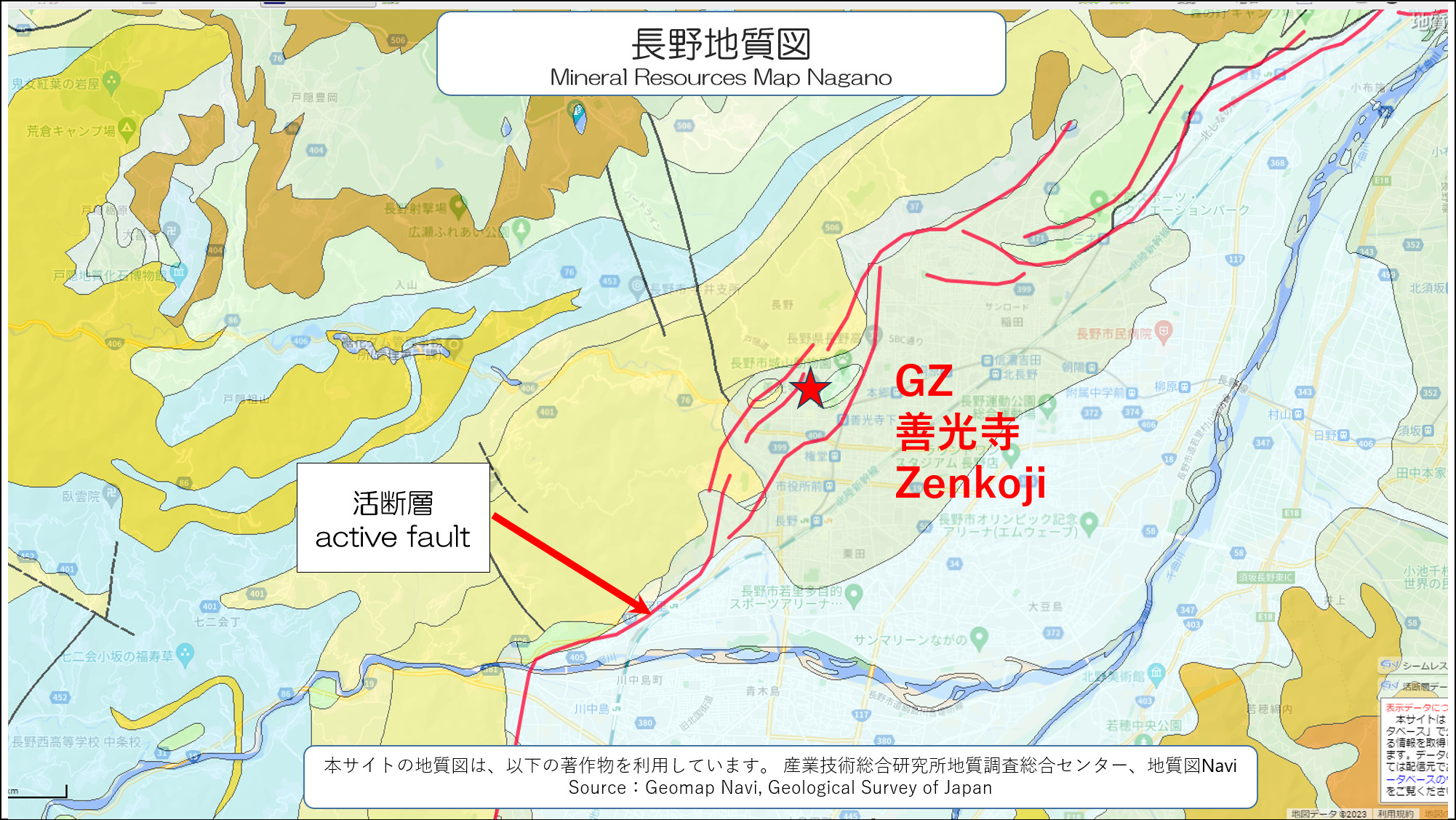
この地震は、長野盆地の西側を縁取っている山すそに沿って50kmほどの長さの活断層が起こしたものです。では、どうしてこの活断層が生じたのでしょうか?
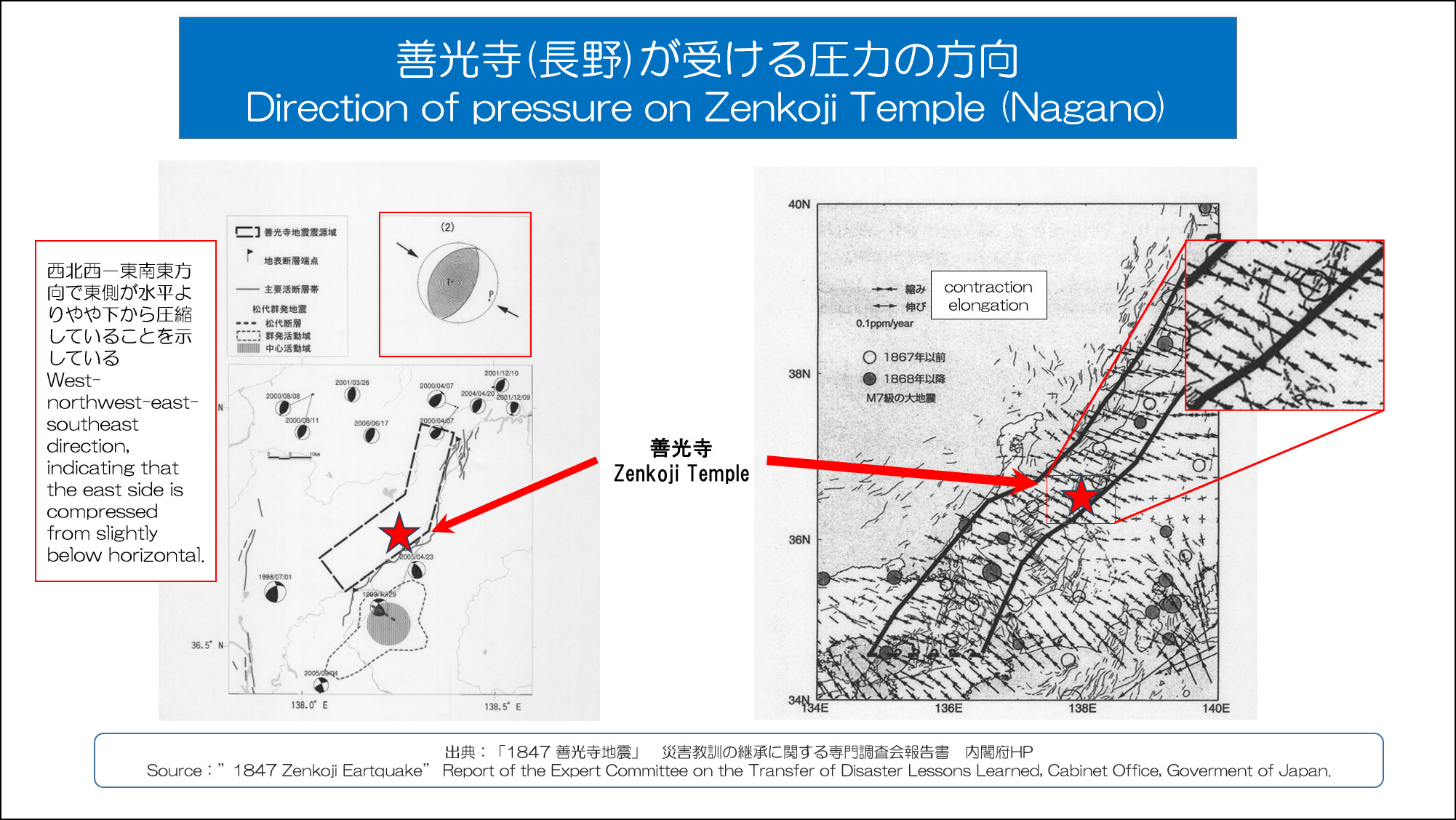
下の図をみてください。善光寺がある長野は太平洋側とユーラシア大陸との間でほぼ東西方向に圧縮力を常に受けています。このため断層が生じているのです。また、善光寺の周りには北東から南西に複数の活断層があり、善光寺は活断層に囲まれていると言えます。
そして長野盆地では、盆地の縁から西側方向に斜めに深くなっていく面を境に西の山側が高くなり、盆地側に乗り上げるという動きを繰り返してきたことが分かっています。
【What caused Zenkoji earthquake?】
This earthquake was caused by a 50 km long active fault along the western edge of the Nagano Basin. How did this active fault come into being?
Take a look at 2 figures below. Nagano, where Zenkoji Temple is located, is constantly subjected to compressive forces in a roughly east-west direction between the Pacific Ocean side and the Eurasian continent. This is the reason for the faults. In addition, Zenkoji Temple is surrounded by several active faults from northeast to southwest, and it can be said that Zenkoji Temple is surrounded by active faults.
And in the Nagano Basin, it is known that the western mountain side of the basin has repeatedly moved higher and higher up the basin side, bounded by a surface that deepens diagonally from the basin rim to the west.
出典:「1847 善光寺地震」災害教訓の継承に関する専門調査会報告書 平成19年3月、内閣府
Reference: Report of the Expert Committee on the Transfer of Disaster Lessons from the 1847 Zenkoji Earthquake, March 2007, Cabinet Office, Government of Japan.
【断層の種類について学びましょう】
地層のずれである断層は、そのずれ方によって4つに分類されます。
We learned about the earthquake mechanism, next Let's learn about fault classification.The fault which is the gap of the stratum is classified in four by the gap variation.
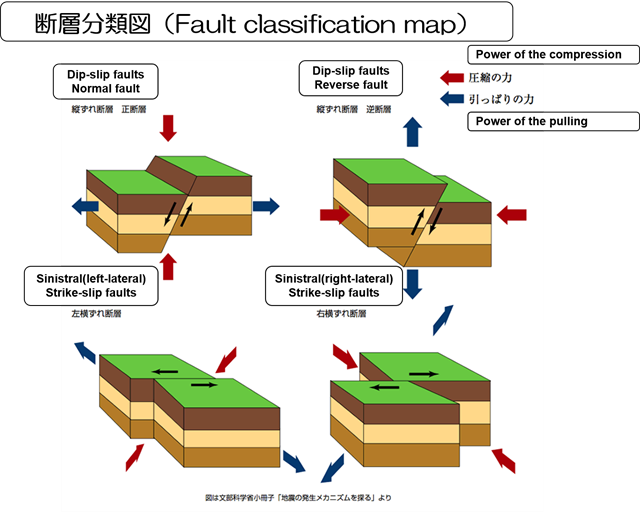
出典:文部科学省「地震の発生メカニズムを探る」
Source: Japan Ministry of Education, Culture, Sports, Science and Technology
断層面が傾いている場合、両側の岩盤のうち、浅い側を「上盤」、深い側を「下盤」と呼びます。断層面を境として両側のブロックが上下方向に動くときを「縦ずれ断層」と呼びます。「縦ずれ断層」のうち、上盤側がずり下がる場合を「正断層」、のし上がる場合を「逆断層」と言います。
一方,両側のブロックが水平方向に動くときは「横ずれ断層」と呼び、断層線に向かって相手側のブロックが右に動く場合を「右横ずれ断層」、左に動く場合を「左横ずれ断層」と言います。
日本の内陸地震では、中部地方から西日本にかけては横ずれ断層型が多く、東北地方などの北日本では逆断層型が多いと言われています。
実際の断層を見ると、上記のように純粋に「縦ずれ断層」、「横ずれ断層」と呼べるものはまれで、多くのものは斜めにずれています。
When a fault plane inclines, among the bedrock of both sides, We call "a hanging wall", a deep side "a footwall" in a shallow side. We call time when the block of both sides moves the fault plane in the top and bottom direction as a boundary "Dip-slip faults". Among "Dip-slip faults" We say , a case to push its way up to in the case is "normal fault", other the hanging wall side slips down is "reverse fault". On the other hand, when the block of both sides works horizontally, I call it with "Strike-slip faults" and call a case to move the case that the block of the counterpart moves to the right towards a fault line to "Sinistral (right-rateral) Strike-slip faults", the left "Sinistral (left-rareral) Strike-slip faults". By the inland earthquake of Japan, a lot of "Strike-slip faults" types are existed in the West Japan from the Chubu District, and "reverse fault"types are existed in North Japan of the Tohoku districts. "Dip-slip faults", the thing to be able to call "Strike-slip faults" are rare, and many things are diagonally purely as above when they watch real dislocation.
1. 以下のTASKを実行してください。
2.キャッシュ名と解答をキャッシュオーナー(hikohohodemi)にメールしてください。
3. 答えはログに記入しないでください。
4.メールを送信したらファウンドログを上げてください。私の承認を待つ必要はありません。
1. Please carry out following TASK.
2. Please send e-mail this cache name and the answer to following questions to cache owner.(hikohohodemi)
3. Do not include this answer in your on-line log.
4. You do not need to wait for confirmation from me before posting online.
TASK 1
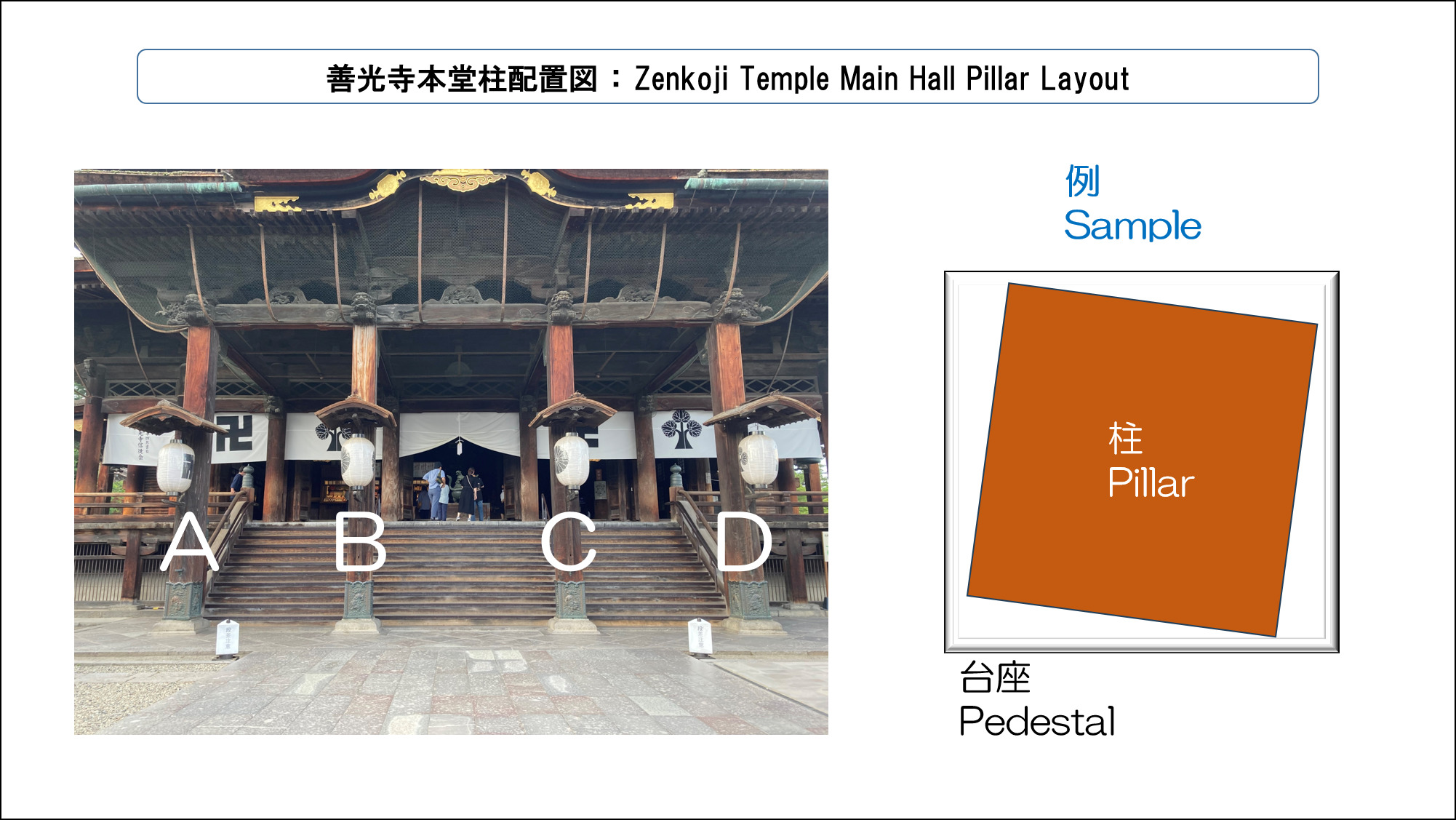
公開座標近くにある本堂正面の4つの柱(A〜D)の根元を観察してください。地震により全ての柱が台座から少しだけずれています。4つの柱は全て同じ方向にずれていますか?
Observe the base of the four pillars (A〜D) on the front of the main hall near the public coordinates. All of the pillars have shifted slightly from their bases due to the earthquake. Are the four pillars all displaced in the same direction?
TASK 2
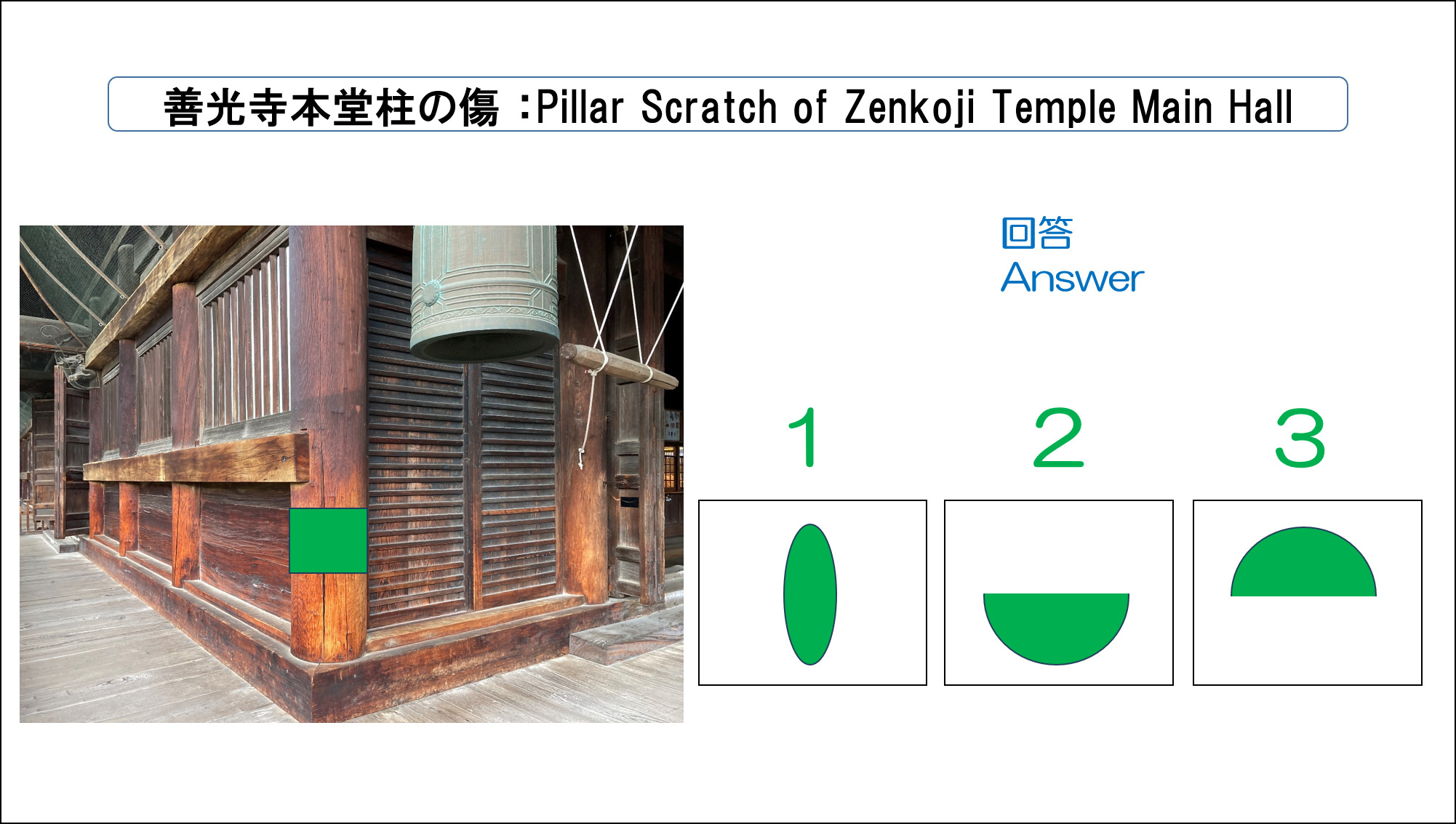
観察地点1では柱に残った「傷」を観察できます。これは地震により落下した鐘が柱に当たってできたものです。「傷」のどのような形ですか?該当する番号で回答ください。
At reference point 1, you can observe "scars" left on the pillars. These were caused by the falling bells that struck the pillars during the earthquake. What shape are the "scratches"? Please answer with the appropriate number.
TASK 3
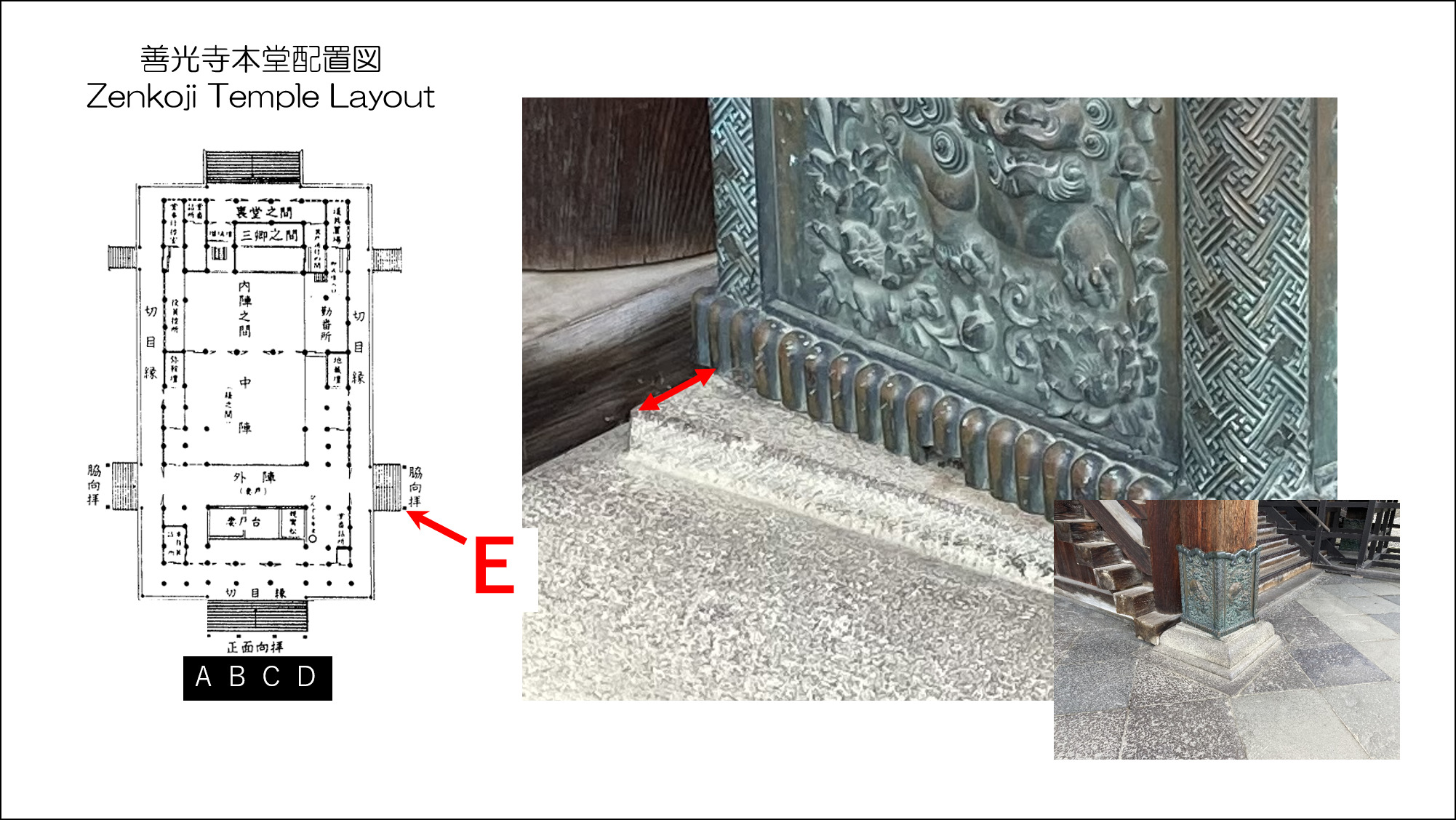
観察地点2では台座から大きくずれている柱(E)を観察できます。最も大きいずれ幅はあなたの指で何本分でしょうか?
At reference point 2, you can observe a pillar(E)that is well off its pedestal. What is the width of the widest one, how many fingers would you use to measure it?
TASK 4
善光寺地震を起こした地震震動について考えてください。
①この地震を引き起こした活断層の種類(A:正断層、B:逆断層、C:横ずれ断層)はどれだと思いますか?
②この地震の特徴的な震動は「縦揺れ」だったでしょうか?それとも「横揺れ」だったでしょうか?
あなたが考える理由も一緒に述べてください。
Think about the seismic tremor that caused the Zenkoji earthquake.
① Which type of active fault do you think caused this earthquake A: normal fault, B: reverse fault, C: horizontal strike-slip fault)?
② Was the characteristic tremor of this earthquake "vertical shaking"? Or was it "horizontal shaking"?
Please state your thoughts.
OPTION
善光寺を背景にあなた、またはあなたのGPS機器の写真を撮り、ログにアップロードしてください。
Please take a picture of you or your GPS receiver at front of the Zenkoji Temple, and upload it with log.