Almohada de lava y vetas de cuarzo
Prefacio
¡Peligro! No se puede acceder a este caché en todo momento, ¡así que ten cuidado con las mareas!
Solo mira aquí: Tideking
También tenga en cuenta que necesita herramientas aquí. ¡Mira la tabla de dureza de Mohs!
¡Presta atención a la naturaleza, no tienes que escalar a ningún lado y no dejes nada atrás!
Almohada de lava
La lava almohada o almohada de lava (este término fue acuñado por John Walter Gregory en 1890) es lava solidificada bajo el agua con forma de almohada.
y por lo tanto se considera un signo seguro de vulcanismo subacuático.
Es una característica común a lo largo de las dorsales oceánicas y, por lo tanto, es una parte integral de las ofiolitas: la corteza oceánica,
que fue empujado hacia la corteza continental. Las lavas almohadilladas también se forman cuando entran en erupción volcanes subglaciales (un volcán debajo de un glaciar).
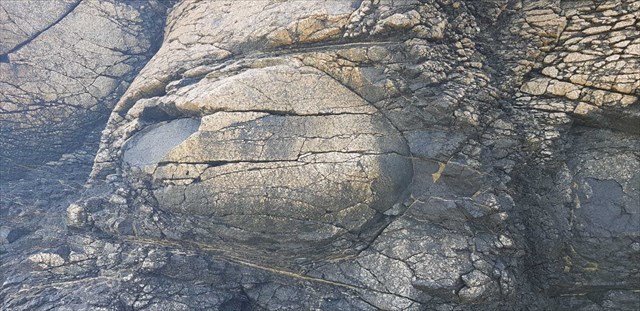
La formación de la lava almohada.
La lava solidificada debe su consistencia vidriada al enfriamiento extremadamente rápido de la roca fundida caliente cuando entra en contacto con el agua, un medio que puede absorber grandes cantidades de calor.
Una masa plástica dura de vidrio de roca se forma en la superficie que se enfría rápidamente.
Dentro de la almohada, la lava se enfría mucho más lentamente, dando como resultado la formación de una masa cristalina.
Esto generalmente crea anillos de burbujas de gas dispuestos radialmente justo debajo de la corteza, ya que la lava experimenta un alivio de presión masivo cuando escapa de la roca y, por lo tanto, conduce a la desgasificación de la masa fundida. Si fluye más lava, el caparazón se abre en un punto y se crean más cojines.
La meteorización de los cojines de lava también es muy interesante aquí.
Puedes mirar dentro de la almohada de lava y ver las capas de cristalización.
Vetas de cuarzo
La formación de cuarzo se debe a la cristalización dentro de la fusión de silicato de la roca.
Como resultado, también se encuentra cada vez más en rocas magmáticas. Parte del cuarzo cristaliza muy fácilmente en las geodas y vetas.
El cuarzo también se encuentra en rocas sedimentarias y metamórficas, en este caso en forma de aglomerante sedimentario.
o como parte de la mezcla.
El cuarzo es el segundo mineral más común en todo el mundo después del feldespato.
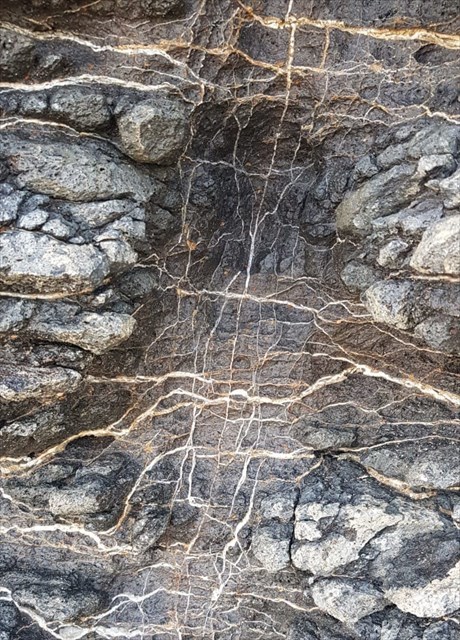
Características del cuarzo
Entre las características más comunes entre todos los tipos de cuarzo se encuentran las siguientes:
- El vidrio de cuarzo pertenece a la clase de los silicatos, en particular a los tectosilicatos.
- Su composición química pura corresponde al dióxido de silicio (SiO2), que consta de una parte de silicio y dos partes de oxígeno.
- Se caracteriza por su alta dureza Mohs de 7.
- Su densidad, o peso específico, es muy similar al valor medio de la corteza terrestre, oscilando entre 2,6 y 2,7 gramos por centímetro cúbico.
- Tiene un sistema de cristal principal que corresponde al sistema de cristal hexagonal.
- Su brillo es muy similar a los cristales de vidrio.
- Su translúcido o transparente es translúcido o transparente, lo que permite que la luz atraviese el vidrio con facilidad.
- Finalmente, su color rayado es incoloro o está ausente.
Tabla de ayuda para la dureza de Mohs:
| Dureza de Mohs |
examen auxiliar |
| 1 |
raspable con la uña |
| 2 |
se puede rayar con una uña |
| 3 |
se puede rayar con una moneda de cobre |
| 4 |
fácil de rayar con un cuchillo |
| 5 |
todavía se puede rascar con un cuchillo |
| 6 |
se puede rayar con una lima de acero |
| 7 |
arañazos en el cristal de la ventana |
| 8 |
arañazos de cuarzo |
| 9 |
talla topacio |
| 10 |
arañazos corindón |
Preguntas y tareas:
1. Encuentra almohadas de lava en las coordenadas de la lista.
Describa cómo surgieron y qué era importante.
2. Calcula el diámetro de las almohadas.
3. ¿Por qué la superficie está parcialmente agrietada y astillada?
4. También se encuentran aquí basalto veteado con cuarzo.
Describa brevemente estas vetas de cuarzo con sus propias palabras.
5. Determina la dureza Mohs de las vetas de cuarzo. (ver tabla)
6. Hazte una foto contigo, tu mascota o GPS
Listado de coordenadas y subirlo al iniciar sesión. (¡Sin imagen = sin registro!)
De acuerdo con las pautas actuales de Earthcache, puede registrar su visita a este Earthcache inmediatamente con una imagen.
Al mismo tiempo, envíe un correo electrónico a raubritterec@gmail.com con almohada lava + nombre de cacher en el asunto
o a través de Messager!
Si algo no encaja, me pondré en contacto contigo.
NOTA: Las fotos ya no son obligatorias con el cambio en las pautas de Earthcache a partir del 10/06/2019,
¡pueden ser una condición de registro! Por lo tanto, todos los registros sin foto se eliminarán en el futuro.
Asimismo, eliminaré los registros en los que no pueda asignar una respuesta.

Pillow lava & quartz veins
foreword
Danger ! This cache is not accessible at all times, so watch out for the tides!
Just look here: Tideking
Also note that you need tools here. Look at the Mohs hardness table!
Please pay attention to nature, you don't have to climb anywhere and don't leave anything behind!
pillow lava
Pillow lava or pillow lava (this term was coined by John Walter Gregory in 1890) is underwater solidified lava with a pillow-like shape
and is therefore considered a sure sign of subaquatic volcanism.
It is a common feature along mid-ocean ridges and is therefore an integral part of ophiolites - oceanic crust,
which was pushed onto continental crust . Pillow lavas also form when subglacial volcanoes (a volcano beneath a glacier) erupt.
The formation of the pillow lava
The solidified lava owes its glazed consistency to the extremely rapid cooling of the hot molten rock when it comes into contact with water, a medium that can absorb large amounts of heat.
A tough, plastic mass of rock glass forms on the quickly cooled surface.
Inside the pillow, the lava cools much more slowly, resulting in the formation of a crystalline mass.
This usually creates radially arranged rings of gas bubbles just below the crust, since the lava experiences massive pressure relief when it escapes from the rock and thus leads to degassing of the melt. If more lava flows, the shell tears open at one point and more cushions are created.
The weathering of the lava cushions is also very interesting here.
You can sort of look into the lava pillow and see the layers of crystallization.
quartz veins
The formation of quartz is due to crystallization within the silicate melting of the rock.
As a result, it is also increasingly found in magmatic rock. Some of the quartz crystallizes very readily in the drusen and veins.
Quartz is also found in sedimentary rocks and metamorphs, in this case in the form of a sedimentary binder
or as part of the mixture.
Quartz is the second most common mineral worldwide after feldspar.
Features of Quartz
Among the most common characteristics among all types of quartz there are the following:
- Quartz glass belongs to the class of silicates, in particular the tectosilicates.
- Its pure chemical composition corresponds to silicon dioxide (SiO2), which consists of one part silicon and two parts oxygen.
- It is characterized by its high Mohs hardness of 7.
- Its density, or specific gravity, is very similar to the average value of the Earth's crust, ranging from 2.6 to 2.7 grams per cubic centimeter.
- It has a main crystal system that corresponds to the hexagonal crystal system.
- Its luster is very similar to glass crystals.
- Its translucent or transparency is translucent or transparent, allowing light to pass through the glass easily.
- Finally, its striped color is colorless or absent.
Help table for Mohs hardness:
| Mohs hardness |
auxiliary exam |
| 1 |
scrapable with fingernail |
| 2 |
can be scratched with a fingernail |
| 3 |
can be scratched with a copper coin |
| 4 |
easy to scratch with a knife |
| 5 |
still scratchable with a knife |
| 6 |
can be scratched with a steel file |
| 7 |
scratches window glass |
| 8 |
scratches quartz |
| 9 |
carves topaz |
| 10 |
scratches corundum |
Questions and tasks:
1. Find pillow lava at the listing coordinates.
Describe how they came about and what was important.
2. Estimate the diameter of the pillows.
3. Why is the surface partially cracked and chipped.
4. Also found here are basalt veined with quartz.
Briefly describe these quartz veins in your own words.
5. Determines the Mohs hardness of the quartz veins. (See table)
6. Take a picture with you, your mascot or GPS
Listing coordinates and upload it when logging. (No picture = no log !)
According to the current Earthcache guidelines, you may log your visit to this Earthcache immediately with a picture.
At the same time, send an email to raubritterec@gmail.com with pillow lava + cacher name in the subject
or via the Messager!
If something doesn't fit, I'll contact you.
NOTE: Photos are no longer mandatory with the change in the Earthcache guidelines from 06/10/2019,
they may be a log condition! Therefore, all logs without a photo will be deleted in the future.
Likewise, I will delete logs where I cannot assign an answer.
Kissenlava & Quarzadern
Vorwort
Achtung ! Dieser Cache ist nicht zu jeder Zeit erreichbar, deshalb beachtet die Gezeiten !
Schaut einfach hier nach: Tideking
Beachtet auch, das ihr hier Werkzeug benötigt. Schau auf die Tabelle Mohshärte!
Bitte achtet auf die Natur, ihr müsst nirgends klettern und lasst nichts liegen !
Kissenlava
Kissenlava oder Pillowlava (dieser Begriff wurde 1890 von John Walter Gregory geprägt) ist unter Wasser erstarrte Lava von kissenartiger Form
und gilt daher als sicheres Indiz für subaquatischen Vulkanismus.
Sie ist eine häufige Erscheinung entlang der Mittelozeanischen Rücken und darum ein wesentlicher Bestandteil von Ophiolithen – ozeanische Kruste,
die auf kontinentale Kruste geschoben wurde. Kissenlaven entstehen auch beim Ausbruch subglazialer Vulkane (ein Vulkan unter einem Gletscher).
Die Entstehung der Kissenlava
Ihre glasierte Konsistenz verdankt die erstarrte Lava der extrem schnellen Abkühlung der heißen Gesteinsschmelze beim Kontakt mit Wasser, einem Medium, das große Mengen Wärme aufnehmen kann.
An der schnell abgekühlten Oberfläche bildet sich eine zähe, plastische Masse aus Gesteinsglas.
Im Innern des Kissens kühlt die Lava wesentlich langsamer ab, sodass es zur Bildung einer kristallinen Masse kommt.
Dabei entstehen zumeist radial angeordnete Gasblasenkränze knapp unterhalb der Kruste, da die Lava beim Austreten aus dem Gestein eine massive Druckentlastung erfährt und somit zum Entgasen der Schmelze führt. Fließt weitere Lava nach, reißt die Hülle an einer Stelle auf und weitere Kissen entstehen.
Auch hier sehr Interessant ist die Verwitterung der Lavakissen.
Man kann dadurch irgendwie in das Lavakissen schauen und die Schichten der Kristallisierung sehen.
Quarzadern
Die Entstehung des Quarzes ist auf die Kristallisation innerhalb des silikatischen Schmelzens des Gesteins zurückzuführen.
Demzufolge kommt es vermehrt auch im magmatischen Gestein vor. Ein Teil der Quartze kristallisiert überaus gerne in den Drusen und Gängen aus.
Quarz ist darüber hinaus im sedimentären Gestein und Metamorphe vorkommend, in diesem Fall in Gestalt eines sedimentären Bindemittels
oder auch als Teil des Gemenges.
Weltweit kommt Quarz nach dem Feldspat am zweithäufigsten als Mineral vor.
Merkmale von Quarz
Zu den häufigsten Merkmalen unter allen Arten von Quarz, die es gibt, gehören die folgenden:
- Quarzglas gehört zur Klasse der Silikate, insbesondere der Tektosilikate.
- Seine reine chemische Zusammensetzung entspricht Siliziumdioxid (SiO2), das aus einem Teil Silizium und zwei Teilen Sauerstoff besteht.
- Es zeichnet sich durch seine hohe Mohs-Härte von 7 aus.
- Seine Dichte oder sein spezifisches Gewicht ist dem Durchschnittswert der Erdkruste sehr ähnlich und liegt zwischen 2,6 und 2,7 Gramm pro Kubikzentimeter.
- Es hat ein Hauptkristallsystem, das dem hexagonalen Kristallsystem entspricht.
- Sein Glanz ist Glaskristallen sehr ähnlich.
- Seine durchscheinende oder Transparenz ist durchscheinend oder transparent, so dass Licht leicht durch das Glas gelangen kann.
- Schließlich ist seine gestreifte Farbe farblos oder nicht vorhanden.
Hilfstabelle zur Mohshärte:
| Mohshärte |
Hilfsprüfung |
| 1 |
mit Fingernagel schabbar |
| 2 |
mit Fingernagel ritzbar |
| 3 |
mit Kupfermünze ritzbar |
| 4 |
mit Messer leicht ritzbar |
| 5 |
mit Messer noch ritzbar |
| 6 |
mit Stahlfeile ritzbar |
| 7 |
ritzt Fensterglas |
| 8 |
ritzt Quarz |
| 9 |
ritzt Topas |
| 10 |
ritzt Korund |
Fragen und Aufgaben:
1. Finde Kissenlava bei den Listingskoordinaten.
Beschreibe wie sie entstehen konnten und was war dabei wichtig.
2. Schätze den Durchmesser der Kissen.
3. Warum ist die Oberfläche teilweise aufgebrochen und abgesplittert.
4. Auch hier zu finden sind Basalt mit Quarzadern durchzogen.
Beschreibe diese Quarzadern kurz mit eigenen Worten.
5. Ermittelt die Mohshärte von den Quarzadern. (Siehe Tabelle)
6. Macht von ein Foto mit euch, eurem Maskottchen oder GPS an den
Listingskoordinaten und ladet es beim loggen mit hoch. (Kein Bild = kein Log !)
Nach den aktuellen Earthcache-Guidelines dürft Ihr den Besuch dieses Earthcaches sofort mit Bild loggen.
Parallel dazu sendet eine E-Mail an raubritterec@gmail.com mit Kissenlava + Cachernamen im Betreff
oder auch über den Messager !
Sollte etwas nicht passen melde ich mich bei dir.
HINWEIS: Fotos sind mit der Änderung der Earthcache-Guidelines vom 10.06.2019 nicht mehr zwingend optional,
sie dürfen eine Logbedingung sein! Daher werden alle Logs ohne Foto in Zukunft gelöscht.
Genauso werde ich Logs löschen, wo ich keine Antwort zuordnen kann.
Für alle Banner-Freunde gibt es hier auch etwas:

<img src="https://img.geocaching.com/cache/large/443d265b-9417-4163-9eed-199efff9c849.jpg?rnd=0.4366445" alt name="Banner" width="600" height="250" />
Quellen: wikipedia, www.juwelle.de, eigenes Bilderarchiv