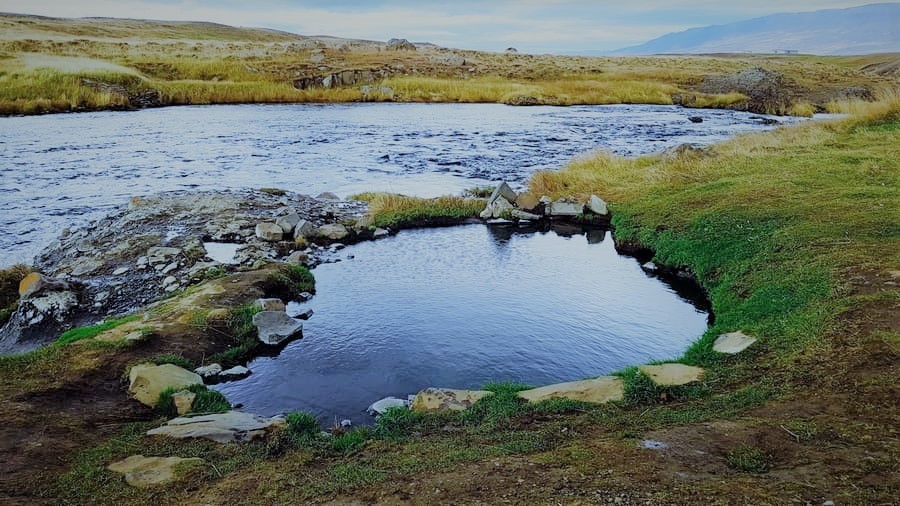
At the given coordinates, close to the Reykjafoss waterfall, you can find a natural pot called Fosslaug which is sourced by a hot spring.
Unlike at other hot springs in Iceland, Fosslaug's pool is hardly developed. It consists of rocks and a mud floor. It is situated next to the river Svartá which flows ca 50m beside the pool.
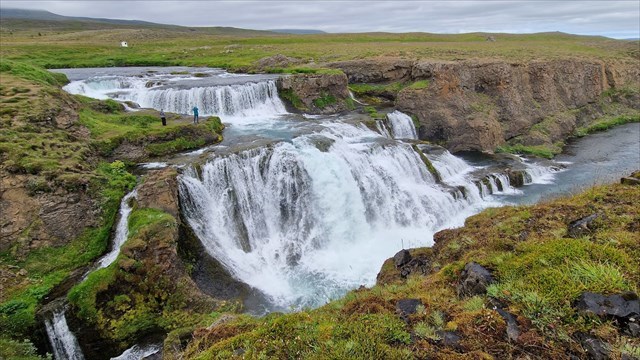
The Reykjafoss waterfall is located in northern Iceland, near the town of Akureyri. The geological features in this region are shaped by Iceland's unique volcanic and tectonic activity.
-
Volcanic Activity: Iceland sits on the Mid-Atlantic Ridge, a divergent boundary between the North American and Eurasian tectonic plates. This makes it highly geologically active, with frequent volcanic eruptions and geothermal activity. The landscape around Reykjafoss is likely formed from layers of basaltic lava flows, which are common in Iceland.
-
Glacial History: During the last Ice Age, glaciers covered much of Iceland, sculpting the landscape through erosion and deposition. The Reykjafoss waterfall may have formed as a result of glacial meltwater carving through the surrounding basaltic rock over thousands of years.
-
Geothermal Features: The presence of the natural pot called Fosslaug suggests the influence of geothermal activity in the area. Geothermal springs are common in Iceland due to the heat generated by volcanic activity beneath the surface. Fosslaug may be a hot spring formed by the interaction of groundwater with volcanic rocks, providing a natural bathing spot for locals and visitors.
Overall, the geological features around Reykjafoss and Fosslaug reflect Iceland's dynamic geology, shaped by volcanic eruptions, glacial activity, and geothermal processes over millions of years.
Reykjafoss
What are natural hot springs?
Hot springs are bodies of water that are heated naturally by geothermal energy. To determine whether a body of water is a hot spring or not, you take the temperature of the water and compare it to the earth around it. If the water is hotter, it’s a hot spring. Most hot springs are at least 38° Celsius (or 100 degrees Fahrenheit).
There are three main factors that contribute to the heat of a hot spring:
1) The first is the depth at which the heat is supplied, which is sometimes referred to as the “magma chamber”.
2) Then the rate at which the water of the spring flows, or if there is any sort of current.
3) The last factor is the amount of cool water that the hot water source flows into.
Hot springs in Iceland
We know that hot springs are caused by geothermal activity, but what exactly does that mean and why are there so many in Iceland?
Iceland is located on the meeting place of two diverging tectonic plates. This ridge is called the Mid-Atlantic Ridge. Half of Iceland is located on the North American plate and half is located on the Eurasian plate.
Volcanic activity is very common along tectonic rifts. Since there is so much volcanic activity, water is often heated under the ground, and this is called geothermal activity. Hot springs are caused by this geothermal activity.
The divergence of the plates causes the volcanic activity, and the hot springs are the end result. The hot springs in Iceland may seem to pop up in random places, but their locations are far from random. Their hot water sources and origins can usually be traced
Different minerals found in hot springs
While the benefits of some hot springs come from microorganisms that live within, most hot springs are beneficial because of their high mineral content.
Since different hot springs have water that flows through different locations and areas of the Earth, the mineral content and quality will vary.
While many feel that the hot springs in Iceland are magical, the healing benefits are purely through the mineral-rich water itself.
The following minerals are commonly found in hot springs:
- Sulphur: Treats respiratory problems and dermatitis
- Calcium: Boosts blood circulation and increases oxygen flow
- Potassium: Promotes skin health and helps remove toxins from the body
- Magnesium: Helps to clear acne and blemish and keep skin glowing
- Sodium: Helps regulate the lymphatic system and reduce pain and inflammation in tender joints
More information on hot springs: https://en.wikipedia.org/wiki/Hot_spring
To validate your log, go to the given coordinates and answer the following questions.
Send your answers via GC-message centre to the cache-owner before logging.
1) Try the water in the pot. How does it look, taste and smell? - By referring to the information in the listing, which minerals can you recognise?
2) Measure the temperature of the water in the hot pot.
3) Find the source of the hot water, the place where it reaches the surface. Hint: It is nearby, on the river side of the pot.
Compare the temperature of the water flowing out of the source with the water in the pot. How would you explain the difference?
4) Put your hands into the water. How does your skin feel afterwards?
5) A picture to be added to your log. Shoot a picture of you and/or your GPS device at the location.
You may log immediately. If there are any problems with your answers, I will contact you.