Enjoy finding/collecting fossils at these three sites in the Hamburg, New York area.
EARTHCACHE REQUIREMENTS
NOTE - This series was archived, but revised/returning by special request.
Each cacher must send his/her own answers to log a find. Enjoy the journey (learning adventure) as well as the destination (smiley earned). Remember to take only pictures and leave only footprints. To get credit for this Earthcache, complete the following tasks:
ANSWERS ... SEND ALL ANSWERS VIA MESSAGE
LOG ... INCLUDE THREE ON-SITE VERIFICATION PICTURES ... Creek / Talus / Quarry
FOSSILS
1. MESSAGE ... Based on the reading - The Devonian Period is also known as the ___________.
CREEK
2. MESSAGE ... SEARCH ... a. Describe the matrix (rock). b. What tools (if any) did you use?
3. MESSAGE … FOSSILS ... What fossils did you find? Use the picture to help you identify your finds.
4. LOG …. Post a picture of your finds. This picture is your log signature.
TALUS
5. MESSAGE ... SEARCH ... a. Describe the matrix (rock). b. What tools (if any) did you use?
6. MESSAGE … FOSSILS ... What fossils did you find? Use the picture to help you identify your finds.
7. LOG …. Post a picture of your finds. This picture is your log signature.
QUARRY
8. MESSAGE ... SEARCH ... a. Describe the matrix (rock). b. What tools (if any) did you use?
9. MESSAGE … FOSSILS ... What fossils did you find? Use the picture to help you identify your finds.
10. LOG …. Post a picture of your finds. This picture is your log signature.
OPTIONAL - Please respect the time and effort involved in creating this earthcache by adding A and B to your log.
A. JOURNEY OF THE MIND ... Science explains what we observe. Relate (in your own words) something you found interesting in the reading. This adds to your learning adventure and your log.
B. JOURNEY OF THE HEART ... Art shares our personal experience of what we see. Share something special you found on site, and why it is special to you. This is a memorable addition to your log and will make other hearts smile.
Journeys of Heart and Mind ...
Stories to Touch the Heart and Puzzles to Challenge the Mind / Rainbow Tree Story
MATRIX
The rock the fossils are embedded in is called the matrix. This can vary from soft to hard.
SOFT - you can use your fingers and a brush to extract the fossils.
HARD - use of a tool is needed to extract the fossils.
DEVONIAN PERIOD
During the Middle Devonian, a mountain building phase began when Avalon (ancient) collided into eastern North America (modern). This collision created the Acadian Mountain range. Rivers filled with sediments flowed into the Catskill Basin at the base of the mountains. The basin was flooded by the Kaskaskia Sea, which covered New York west of the Hudson river, as well as many other states down to the gulf of Mexico.
These sediments accumulated and formed the rock layers seen today in western New York. The most fossiliferous shale and mudstone is the Wanakah shale of the Ludlowville formation -and- the Windom Shale of the Moscow formation. Due to the warmer climate (New York was near the equator), the shallow sea was home to a flourishing fauna of trilobites, brachiopods, pelecypods, crinoids, cephalopods, and gastropods.
The Devonian period is also known as the "Age of Fishes." The fish of this time period were mainly cartilagenous so they rarely fossilized. However, the harder dermal armor, scales, and teeth did fossilize. These preserved parts are the major links to understanding fish of that time period and tracing the ancestry of most modern fish to this period.

NOTE: Eurypterus is the official fossil of NY State.

CREEK ... HOBUCK FLATS PUBLIC FISHING ACCESS TO EIGHTEEN MILE CREEK IN NORTH EVANS, NY
I had just adopted my beloved Cotie (year-old sheltie). We were in the backyard, but he disappeared. I looked around and could not find him. Luckily my landlord chose that time to visit, and we both looked. Lo and behold, there was Cotie at the bottom of the cliff looking up. I walked down the road to the path along the bank and rescued him. My landlord, bless his heart, then built a fence to keep Cotie from venturing down the bank to the creek again. We did, however, enjoy many a walk to the creek and the falls.
Walk the trail from parking to creek. After crossing the bridge, the right fork in the trail takes you along the creek bed to the bottom of the falls. The left fork takes you along the creek. Search for fossil trilobites, brachiopods, and others from the Middle Devonian ~385 Million Years Old. Because Western New York was once a shallow sea teaming with invertebrates, fossils are abundant in the shales.
TALUS ... 18-MILE CREEK COUNTY PARK
Descend the path from parking to 18-Mile Creek. Walk along the creek to find fossil trilobites and brachiopods from the Middle Devonian ~385 Million Years Old. DO NOT DIG IN THE CLIFFS. DO NOT CLIMB THE UNSTABLE TALUS. Search only the talus (rubble) that has fallen at the base of the cliff. Because Western New York was once a shallow sea teaming with invertebrates, fossils are abundant in the shales.
This diagram is a cross-section of the cliffs, which shows the formations, and different members in the formations. Also, the letters correspond to different faunal assemblages.

"Unit reduced in rank to North Evans Member of Genesee Formation of Seneca Group. Described as a bone bed with a matrix of black and gray limestone and shale. Overlies Windom Shale Member of Moscow Formation (Hamilton Group). Age given as Middle Devonian."
QUARRY ... Penn Dixie Fossil Park / See link for operating hours and fees.
Penn Dixie is ranked as the #1 fossil park in the U.S. At the site of a former cement quarry in Hamburg, NY, you can dig, collect and keep Devonian Period fossils.
THANK YOU Phil Stokes (Executive Director Hamburg Natural History Society/Penn Dixie) for permission to share this learning adventure.
"Our shale units have calcareous cement and are relatively soft. Surface rocks are very easily weathered and collecting is straightforward. Most fossils can be extracted with hammers, chisels, and dental tools, but we recommend professional preparation for trilobites since they have many tiny features."
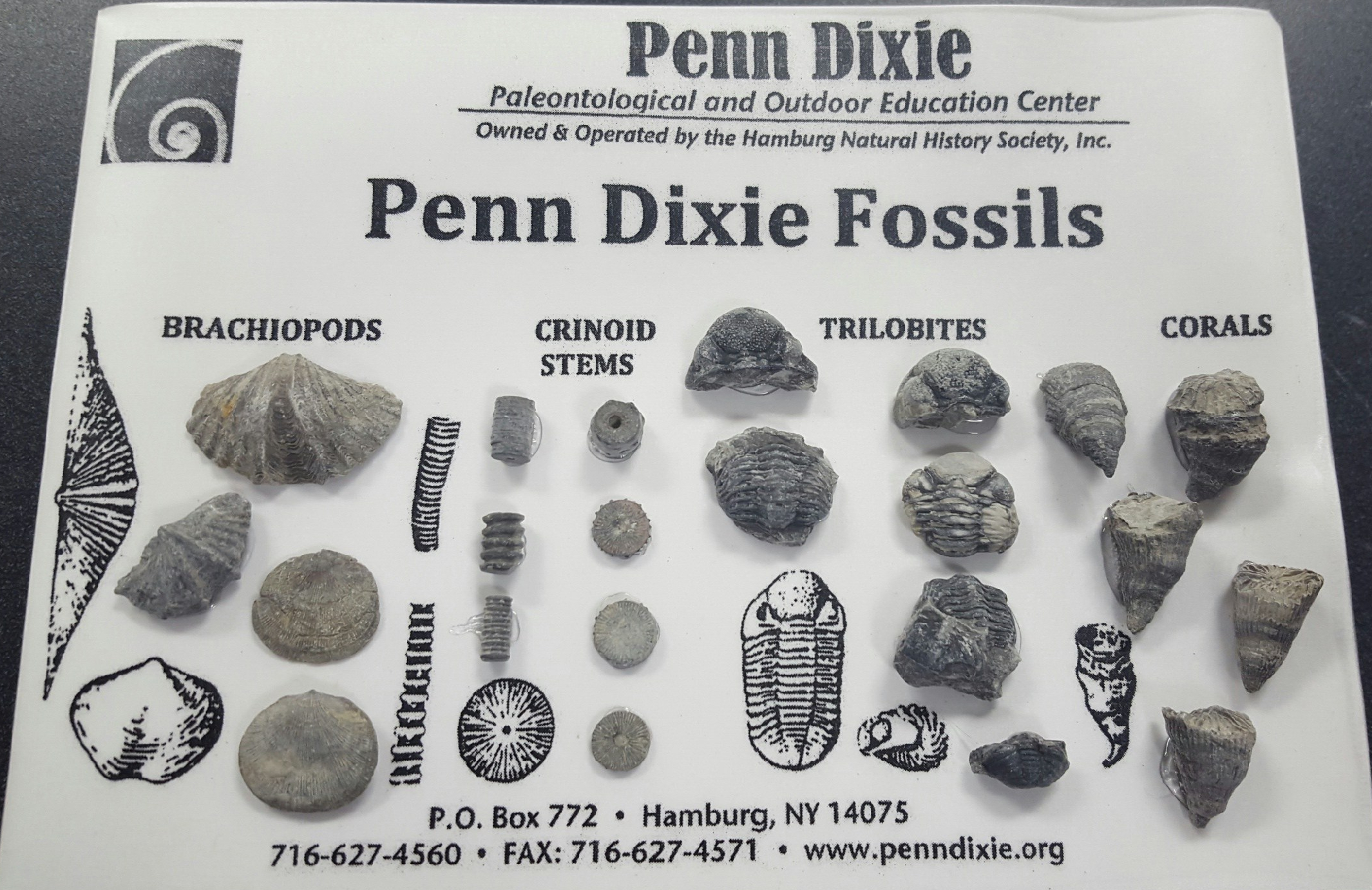
INVERTEBRATES ... Bivalves – clams / Brachiopods – symmetrically shelled filter feeders / Bryozoans – moss animals / Cephalopods – predatory marine molluscs / Corals – colonial and solitary filter feeders / Crinoids – sea lilies / Crustaceans – arthropods such as lobsters and crabs / Gastropods – snails / Ostrocods – tiny crustaceans / Other echinoderms – related to sea stars / Trilobites – extinct marine arthropods
VERTEBRATES ... Conodonts – extinct eel-like vertebrates / Fish – primitive Paleozoic fish
PLANTS ... Petrified wood – extinct plants from the Devonian

RESOURCES
https://ngmdb.usgs.gov/Geolex/UnitRefs/NorthEvansRefs_3030.html
Fossil Guy http://www.fossilguy.com/sites/18mile/index.htm
Penn Dixie Fossil Park https://penndixie.org/
Field Guide https://penndixie.org/2018/02/13/official-penn-dixie-field-guide/
Preparation https://english.fossiel.net/information/article.php?id=82&/Preparation
Niagara Fossil Sites http://www.earlysunriserealty.org/fossils.htm ... "First, remember that the fossil record was almost completely scrubbed away by the advance and retreat of huge glaciers, which wore the soil and bedrock down to layers 350 million years old. This age, the Silurian/ Devonian, saw New York covered by the vast Potsdam Sea, dominated by trilobites and bivalves. People hiking or driving through Upstate New York will often encounter shale out- crops (the fossilized mud of the Potsdam Sea bottom). Dig a little! You never know what you'll find."