English version below
Mit diesem Earthcache werden wir das interessante metamorphe Gestein Amphibolit und seine einzigartigen Mineralgänge erkunden.
Um den Earthcache zu loggen, schicke mir bitte Antworten auf folgende Aufgaben und Fragen:
- Finde den breitesten Mineralgang. Welche Länge und Breite hat es ungefähr? Äußere eine Vermutung, warum dieser Gang länger und breiter ist als die anderen?
- Beweise, dass Mineralgänge nicht immer relativ geradelinig sein müssen. Hinweis: bitte nicht googeln sondern einfach beobachten!
- Beschreibe die Farben des größten und breitesten Mineralgangs. Welche Mineralien könnten diese Farben hervorrufen? (siehe Listing)
- Findest Du Risse ohne Mineralausfüllung? Wenn ja, begründe ihr jüngeres Alter.
Bitte beim Loggen des Caches ein Foto hochladen. Es reicht aus, dass auf dem Foto ein Gegenstand von Euch zu sehen ist, damit es klar ist, dass ihr den Earthcache besucht habt.
Briesker Koloss
In der Landschaft gibt es viele geologische Objekte, deren Existenz wir für selbstverständlich halten. Manchmal lohnt es sich einfach über diese Gegenstände zu reflektieren und sie besser zu erkunden. In Brieske steht bei dem Eingang zu der Gartensparte "Franz Mehring" ein Koloss. Lass uns diesen Koloss näher untersuchen.
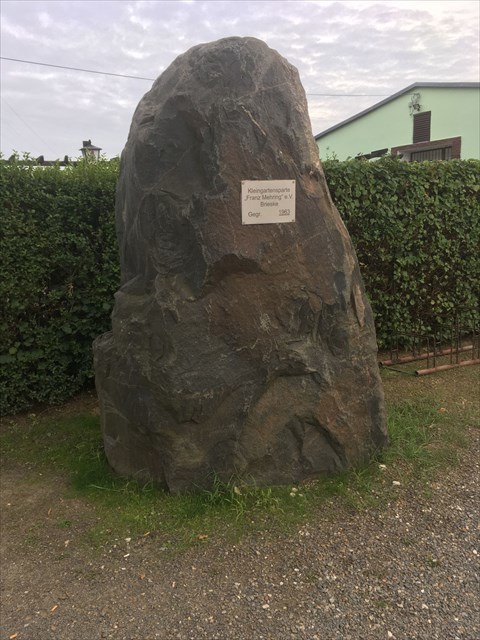
Was für ein Gestein ist es?
Nach dem Gespräch mit einem Geologen und meiner Recherche hat es sich ergeben, dass es ein metamorphes Gestein Amphibolit ist.
In der Tabelle unten sind die wichtigsten Merkmale des Amphibolit Gesteins zusammengefasst.
Amphibolit
|
|
Herkunft des Begriffs Amphibolit
|
Vom griechischen Wort amphibolos, was zweideutig oder unbestimmt bedeutet. |
|
Andere Begriffe
|
Hornblende, Hornblendstein
|
|
Herkunft des Begriffs Hornblend
|
Vom schwedischen Wort horn, was Horn bedeutet und blende, was trübe oder dunkel bedeutet. |
|
Typ des Gesteins
|
metamorphes Gestein
|
|
Haupt-Mineralinhalte
|
Amphibole (bis 50%), Plagioklas (15%-40%)
|
|
geringere Mineralinhalte (bis 10%)
|
Feldspat, Quarz, Biotit, Granat, Olivin
|
|
Ursprungsgestein
|
Basalt, Gabbro
|
|
Entstehungsgebiete
|
Subduktionszonen oder kontinentale Kollisionszonen
|
|
Härte
|
Sehr hart, zwischen 6 und 7 auf der Mohs-Härteskala
|
|
Bedingungen für die Metamorphose
|
|
Temperaturbereich der Metamorphose
|
550 – 800 Grad Celsius
|
|
Druckbereich der Metamorphose
|
4kbar bis 12 kbar
|
|
Tiefe, wo Metamorphose stattfindet
|
20 – 40 km unter der Erdoberfläche
|
Amphibolit-Gestein ist also ein Umwandlungsgestein, das nur unter ganz bestimmten Bedingungen tief unter der Erdoberfläche entsteht.
Unser konkretes Gestein aus Brieske ist ein Findling. Daraus kann man ableiten, dass das Gestein im Laufe von Jahrmillionen durch erdinnere Kräfte emporgehoben wurde und erdäußere Kräfte darüberliegendes Gestein abtrugen.
Durch Gletscher wurde der Findling während des Eiszeitalters aus Skandinavien in unsere Gegend gebracht und wahrscheinlich beim Abbau von Braunkohle gefunden.
An der Stelle muss noch vermerkt werden, dass Amphibolit eine Seltenheit unter den Findlingen in Brandenburg ist.
Risse und Gänge
Unser Gestein in Brieske besitzt aber auch ganz interessante geologische Merkmale. Wenn wir uns den Koloss aus Brieske genauer anschauen, werden uns viele Risse auffallen.
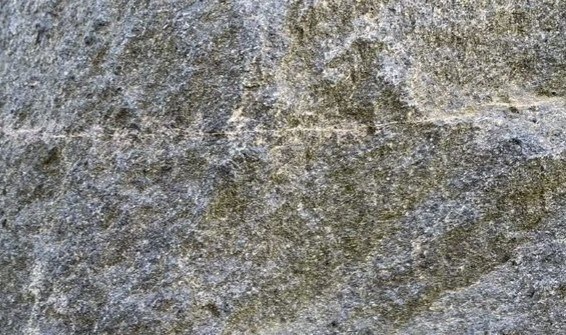
Zusätzlich werden wir auch aus Kristall bestehende "Adern" finden. Auf English nennt man dieses geologische Phänomen tatsächlich nach Blutgefäßen und man sagt tatsächlich, dass es "veins" (Venen) sind. Der deutsche Fachbegriff heißt aber Gang, beziehungsweise Mineralgang.
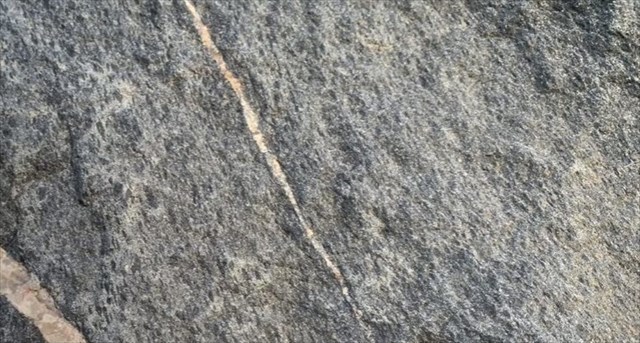
Gänge in Gesteinen
Gänge entstehen in allen Gesteinsarten, wenn mineralhaltige Flüssigkeiten durch Risse sickern. Dies geschieht in der Regel über Tausende oder sogar Millionen Jahre hinweg. Mineralgänge sind außerdem jünger als das Gestein, in dem sie auftreten. Ihre Dimensionen variieren in Breite und Länge von Millimetern, Zentimetern bis zu mehreren Metern.
Mineralgänge bilden sich in der Nähe von Verwerfungszonen, wo Gesteine gebrochen und deformiert wurden. Die Mineralien aus denen Gänge bestehen, werden typischerweise aus hydrothermalen Flüssigkeiten abgelagert, die unter Druck durch Risse und Lücken im Gestein wandern. Diese Flüssigkeiten sind reich an gelösten Mineralien, manchmal sogar an seltenen Metallen wie z.B. Gold.
Verschiedene Faktoren spielen eine wichtige Rolle bei der Entstehung von Gängen. Dazu gehören Flüssigkeitsdruck, Temperatur und Zeit. Je größer diese Faktoren sind, desto breitere und längere Gänge entstehen.
Bedeutung von Mineralgängen
Ganz allgemein gesagt, Mineralgänge sind von großem wirtschaftlichem Interesse. In den Mineralgängen werden oft hochwertige Minerale, Erze oder sogar reines Gold gefunden. Die Gänge an unserem Koloss beinhalten wahrscheinlich kein Gold oder andere hochwertige Metalle. Es sieht so aus, dass sich einfach Quarz und Kalifeldspat abgelagert haben. Quarz hat eine weiße Farbe, beziehungsweise ist einfach farblos. Kalifeldspat kann rosafarbig sein.
Zusammenfassung
Die Mineralgänge sagen uns, dass unser Koloss aus Brieske über längere Zeiträume einem großen Druck ausgesetzt wurde. Daraus können wir mit ableiten, dass sich der Koloss tief unter Erdoberfläche befand. Da herrschten nicht nur hoher Druck, sondern auch höhere Temperaturen.
Beweis für hohe Temperaturen sind die hydrothermalen, mineralhaltigen Flüssigkeiten, die sich ihren Weg unter hohem Druck durch die Risse im Gestein nach oben suchten. Dabei kühlten sie ab, die Mineralien kristallisierten aus und füllten die Gänge.
Quellen:
Hugues Raimbourg, Kristijan Rajič, Benjamin Moris-Muttoni, Vincent Famin, Giulia Palazzin, Donald Fisher, Kristin Morell, Saskia Erdmann, Ida Di Carlo, Clément Montmartin, Quartz Vein Geochemistry Records Deformation Processes in Convergent Zones, Geochemistry, Geophysics, Geosystems, 05 March 2021
The Mechanics of Vein Formation, Stephen Taber, 1918
Briesker Colossus
With this Earthcache we will explore the interesting metamorphic rock amphibolite and its unique features of veins.
To log the Earthcache, please send me answers to the following tasks and questions:
1. Find the widest mineral vein. What is its approximate length and width? Why is this vein longer and wider than the others?
2. Prove that mineral veins do not always have to be relatively straight. Note: please don't google it, just observe the rock!
3. Describe the colors of the largest and widest mineral vein. What minerals could produce these colors? (see listing)
4. Do you find cracks without mineral filling? If yes, justify their younger age.
Please upload a photo when logging the cache. It is enough that an object of yours can be seen in the photo so that it is clear that you have visited the Earthcache.
Briesker Colossus
There are many geological objects in the landscape whose existence we take for granted. Sometimes it's just worth reflecting on them and exploring them better. In Brieske, at the entrance to the "Franz Mehring" garden section, there is a colossus. Let's examine this colossus in more detail.
What type of rock is it?
After talking to a geologist and doing research, it turned out that it is a metamorphic rock called amphibolite.
The table below summarizes the key features of the amphibolite rock.
Amphibolite
|
|
The origing of the term Amphibolite
|
From the Greek word amphibolos, which means ambivalent oder undetermined. |
|
Other names
|
Hornblende
|
|
Origin of the term Hornblende
|
from the Swedish words horn, which means horn and blende, which means dark |
|
Rock type
|
metamorphic rock
|
|
Main Minerals
|
Amphibole (bis 50%), Plagioklas (15%-40%)
|
|
Traces of minerals (less than 10%)
|
Feldspar, Quartz, Biotite, Garnae, Olivin
|
|
Protolith (rock type before metamorphosis)
|
Basalt, Gabbro
|
|
Location of formation
|
subduction zones, collision zone between tectonic plates
|
|
Hardness
|
very hard, between 6 and 7 on the Mohs scale
|
|
Conditions of the metamorphosis
|
|
Temperature
|
550 – 800 degrees of Celsius
|
|
Pressure
|
4kbar to 12 kbar
|
|
Depth
|
20 – 40 km below the surface of the Earth
|
Amphibolite rock is a metamorphic rock that only forms deep beneath the earth's surface under very specific conditions.
Our concrete rock from Brieske is a erratic boulder. From this it can be deduced that the rock was lifted up over the course of millions of years by forces internal to the earth and forces external to the earth eroded the rock above it.
The boulder was brought to our area from Scandinavia by glaciers during the Ice Age and was probably found during the mining of lignite.
It should also be noted that amphibolite is a rarity among the boulders in Brandenburg.
Cracks and Veins
Our rock in Brieske also has very interesting geological features. If we take a closer look at the colossus from Brieske, we will notice many cracks.
Additionally, we will also find “veins” made of various minerals. Interestingly in English, this geological phenomenon is actually named after blood vessels hence the term "veins."
Veins in rocks
Veins form in all types of rock when mineral-containing fluids seep through the cracks. This typically happens over thousands or even millions of years. Mineral veins are also younger than the rock in which they occur. Their dimensions vary in width and length from millimeters, centimeters to several meters.
Mineral veins form near fault zones where rocks have been fractured and deformed. The minerals that make up veins are typically deposited from hydrothermal fluids that travel under pressure through cracks and gaps in the rock. These liquids are rich in dissolved minerals, sometimes even rare metals such as gold.
Various factors play an important role in the formation of veins. These include fluid pressure, temperature and time. The greater these factors are, the wider and longer veins are created.
Importance of Veins
Generally speaking, mineral veins are of great economic interest. High quality minerals, ores or even pure gold are often found in the mineral veins. The veins on our Briesker colossus probably do not contain gold or other high-value metals. It appears that quartz and potassium feldspar were simply deposited. Quartz has a white color, or is simply colorless. Potassium feldspar can be pink in color.
Summary
The mineral veins tell us that our Brieske colossus was exposed to great pressure over long periods of time. From this we can deduce that the colossus was located deep beneath the surface of the earth. There was not only high pressure, but also higher temperatures.
Proof of high temperatures are the hydrothermal, mineral-containing fluids that found their way up through the cracks in the rock under high pressure. As they did so, they cooled and the minerals crystallized and filled the cracks.
Sources:
Hugues Raimbourg, Kristijan Rajič, Benjamin Moris-Muttoni, Vincent Famin, Giulia Palazzin, Donald Fisher, Kristin Morell, Saskia Erdmann, Ida Di Carlo, Clément Montmartin, Quartz Vein Geochemistry Records Deformation Processes in Convergent Zones, Geochemistry, Geophysics, Geosystems, 05 March 2021
The Mechanics of Vein Formation, Stephen Taber, 1918