► What is earthcaching ? 什么是地球缓存?
VISIT website www.geocaching.com READ the cache description. GO TO cache coordinates. OBSERVE stones at all the waypoints. ANSWER to questions. SEND me your answers (without writting them in your public log) and finally LOG your "found it".
Feel free to contact me for any questions.
访问网站 www.geocaching.com。阅读缓存描述。转到缓存坐标。观察所有路径点的石头。回答问题。将您的答案发送给我(不要将其写在您的公共日志中),最后记录您的“找到它”。
如有任何疑问,请随时与我联系。
GEOLOGY OF HONG KONG - 香港地质
► Geology and bedrock in Hong Kong - 香港的地质及基岩
The geology of Hong Kong is dominated by igneous rocks (including granitic rocks and volcanic rocks) formed during a major volcanic eruption period in the Mesozoic era. It made up 85% of Hong Kong's land surface and the remaining 15% are mostly sedimentary rocks located in the northeast New Territories. There are also a very small percentage (less than 1%) of metamorphic rocks in the New Territories, formed by deformation of pre-existing sedimentary rocks (metamorphism).
The geological history of Hong Kong started as early as the Devonian period (~420 million years ago) which is marked by the discovery of Placoderm (a Devonian fish) fossils in northeast Hong Kong. While the youngest rocks in Hong Kong are formed during the Paleogene period (~50 million years old). They are today exposed in Tung Ping Chau in northeast Hong Kong.
Each of the three types of rocks: igneous, sedimentary, and metamorphic rocks formed spectacular geological features in Hong Kong. Igneous rocks formed the hexagonal columns in Sai Kung. Sedimentary rocks formed various erosion features such as wave-cut platforms and sea stacks in Tung Ping Chau. Metamorphic rocks formed the iron ore deposits in Ma On Shan.
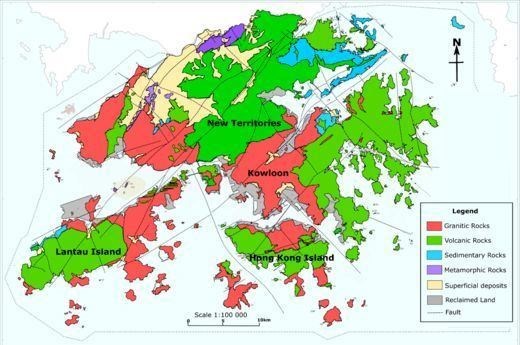
香港的地质以中生代主要火山喷发时期形成的火成岩(包括花岗岩和火山岩)为主。它占香港陆地表面的85%,其余15%主要是位于新界东北部的沉积岩。新界还有极小比例(少于1%)的变质岩,是由原有沉积岩变形(变质作用)形成的。
香港的地质历史早在泥盆纪(约4.2亿年前)就开始了,其标志是在香港东北部发现了盾皮鱼(一种泥盆纪鱼类)化石。香港最年轻的岩石是在古近纪时期(约 5000 万年前)形成的。它们今天暴露在香港东北部的东平洲。
火成岩、沉积岩和变质岩这三种岩石在香港形成了壮观的地质特征。西贡的火成岩形成了六角柱。沉积岩在东平洲形成了海蚀台、海蚀柱等多种侵蚀特征。变质岩形成了马鞍山的铁矿床。
► Granite and marble in Hong Kong - 香港
的花岗岩和大理石
The granitic bedrock was exploited to extract the stones necessary for the construction of the city's buildings and numerous quarries existed in Hong Kong. The granite used for the construction of the Saint Andrew's church was extracted in these quarries.
Regarding marble, the basement in Hong Kong does not contain marble. All of the marble used in construction comes from imports.
花岗岩基岩被开采来提取建造城市建筑物所需的石头,并且香港存在许多采石场。用于建造圣安德鲁教堂的花岗岩就是从这些采石场开采的。
在香港,地下室不含有大理石。建筑中使用的所有大理石均来自进口。
SAINT ANDREW'S CHURCH - 圣安德鲁教堂
Between 1901 and 1904, Sir Catchick Paul Chater, a prominent british businessman, built a sumptuous private residence, “Marble Hall”. Fascinated by marble, the residence was built from imported marble quarried in Italy and Greece and finished in Belgium.
In 1904, Sir Catchick Paul Chater accepted to finance the construction of Saint andrew's church. Work began in November 1904 and was completed in 1906. The church was consecrated on 6 October 1906.
St Andrew's church is located at 138 Nathan Road, Kowloon, Hong Kong. It is a church of the Anglican Province of Hong Kong and in the Diocese of Western Kowloon. It is the oldest English speaking protestant church in Kowloon.
The church was designed in the Victorian Gothic style. It is built of red brick and granite, laid on rammed earth foundations. The bricks on the external walls are exposed and pointed with a lime-based mortar. Interior walls are rendered with raised mortar joints and painted to represent the underlying brick pattern. The church also has numerous European marble decorations.
1901年至1904年间,英国著名商人卡奇克·保罗·查特爵士 (Sir Catchick Paul Chater) 建造了一座豪华的私人住宅“大理石厅”。该住宅对大理石着迷,采用意大利和希腊开采的进口大理石建造,并在比利时完成。
1904年,卡奇克·保罗·查特爵士接受资助建造圣安德鲁教堂。工程于 1904 年 11 月开始,于 1906 年竣工。教堂于 1906 年 10 月 6 日落成。
圣安德烈堂位于香港九龙弥敦道138号。它是香港圣公会和西九龙教区的一座教堂。它是九龙最古老的英语新教教堂。
教堂采用维多利亚哥特式风格设计。它由红砖和花岗岩建造,建立在夯土基础上。外墙上的砖块裸露在外,并用石灰砂浆打磨。内墙采用凸起的灰缝进行渲染,并涂漆以代表底层的砖块图案。教堂内还拥有众多欧洲大理石装饰。
THE MARBLES - 弹珠
► The "pure" marble -
For the geologist, a marble is a metamorphic rock derived from a sedimentary limestone. In this process of transformation of the original rock, the sedimentary structures are erased and the carbonate rock recrystallizes into a mass of calcite crystals.
Pure calcite is white or gray in color with a finely grainy texture (you can feel the grain under your fingers).
Pure marble, containing only calcite, is white or gray.
Clay intercalations, detrital minerals or mineral oxides can give the rock various colors and polychrome veining.
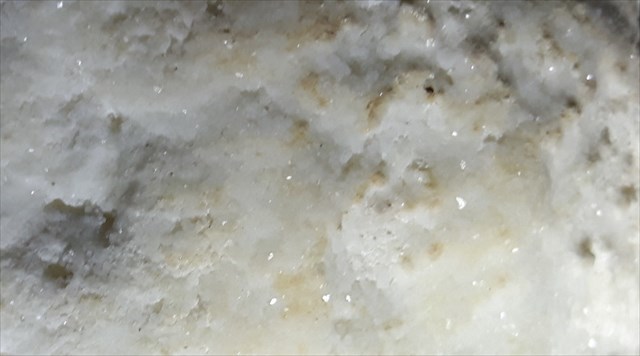
Beyond this coloring during metamorphism, exposure to the open air can cause coloring of the marble by oxidation of the mineral traces it contains.This is the case for iron, whose oxidation to ferric oxides giving a red-rust hue.
Pure marble differs from other marble stones by its relative tenderness; calcite being of a hardness of 3 on the Mohs scale, it is possible to scratch it with a knife. In addition, calcite reacts on contact with hydrochloric acid (effervescence).
对于地质学家来说,大理石是一种源自沉积石灰岩的变质岩。
在原始岩石转变的过程中,沉积结构被消除,碳酸盐岩石重结晶成大量方解石晶体。
纯方解石呈白色或灰色,具有细腻的颗粒纹理(您可以在手指下感觉到颗粒)。
纯大理石仅含有方解石,呈白色或灰色。
粘土夹层、碎屑矿物或矿物氧化物可以赋予岩石各种颜色和多色脉纹。
► The veined marbles -
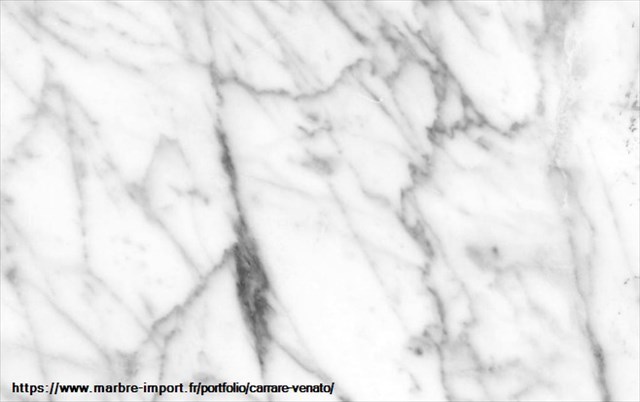
The veined marbles have various veins on a uniform background but whose design presents a certain irregularity. Carrara marble is the best known example, white with some darker veins.
纹理大理石在统一的背景上有各种各样的纹理,但其设计却呈现出一定的不规则性。卡拉拉大理石是最著名的例子,白色,带有一些深色纹理。
► The breccias -
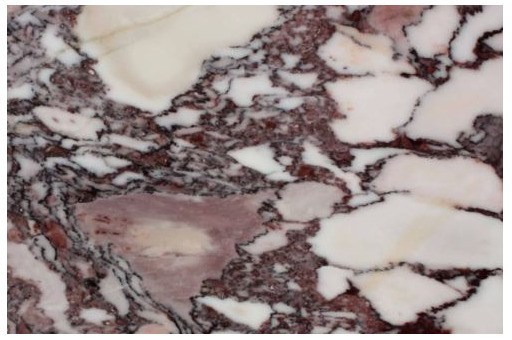
They are marbles formed by a crowd of broken debris agglomerated by a calcite cement. These angular fragments, with sharp edges can be white or of various colors. There are many varieties of breccias offering a wide range of colors and patterns.
它们是由一群破碎的碎片通过方解石水泥凝聚而成的大理石。这些具有锋利边缘的角状碎片可以是白色的或各种颜色的。角砾岩种类繁多,具有多种颜色和图案。
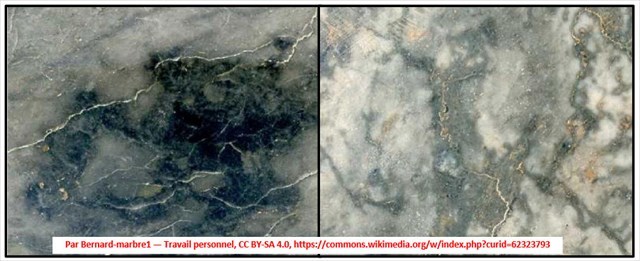
► The gray marbles -
Gray marbles are characterized by a predominant proportion of bioclastic carbonate mud from benthic deposits. These angular fragments, with sharp edges can be white or of various colors. Their formation is explained by an accumulation of limestone mounds formed from communities of briozoa, sponges, crinoids and then corals. It is this presence of carbon from deposits of organic matter that gives the rock this gray color. The darker this shade, the higher the carbon concentration.
灰色大理石的特点是主要比例是来自底栖沉积物的生物碎屑碳酸盐泥。这些具有锋利边缘的角状碎片可以是白色的或各种颜色的。它们的形成是由于石灰石丘的堆积而形成的,这些石灰石丘由布里索亚、海绵、海百合和珊瑚群落形成。正是有机物沉积物中的碳的存在使岩石呈现出灰色。该颜色越深,碳浓度越高。
THE QUESTIONS - 问题
- Question 0 : Take a photo of yourself or something that identifies you inside the Cathedral. This photo must either be sent to me with the answers or added to your log. This photo is not optionnal, all logs without it will be deleted.
- 问题0 : 在大教堂内拍一张你自己的照片或一些能识别你身份的东西。这张照片必须与答案一起发送给我或添加到您的日志中。此照片不是可选的,所有没有它的日志都将被删除。
- Question 1 (waypoint 1) : In the gateway (entrance), you can see a commemorative plaque on the wall (1954). Please describe this plaque : which stone do you think it is ? Why ?
- 问题 1(航点 1) : 在大门(入口处),你可以看到墙上挂着一块纪念牌(1954年)。请描述一下这块牌匾:你认为它是哪块石头?为什么 ?
- Question 2 (waypoint 2) : near the main door of the church, you can see another commemorative plaque (1904). Please describe this plaque : which stone do you think it is ? Why ?
- 问题 2(航点 2) : 在教堂正门附近,您可以看到另一块纪念牌匾(1904年)。请描述一下这块牌匾:你认为它是哪块石头?为什么 ?
- Question 3 : What kind of rock are marbles ? igneous, metamorphic or sedimentary ? Explain with your words the transformation process.
- 问题3 : 哪种岩石是大理石?火成岩、变质岩还是沉积岩?用你的话解释一下转变的过程。
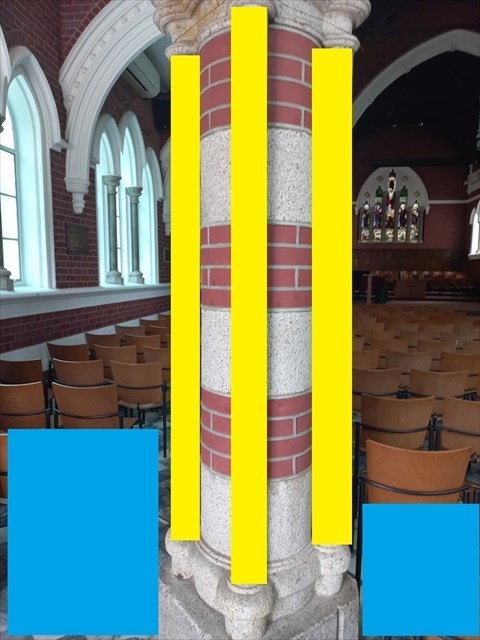
- Question 4 : Around each column made of granite and bricks, the church builders added 4 small marble columns (yellow on the picture). Describe these 4 columns (colors, shapes). What type of marble is it?
- 问题4 : 在每根花岗岩和砖砌的柱子周围,教堂建造者添加了 4 个小大理石柱(图中黄色)。描述这 4 列(颜色、形状)。它是什么类型的大理石?
- Question 5 : The floor of the church is made of marble tiles of different colors (blue on the picture). Describe the 2 main colors and identify the types of marble.
- 问题5 : 教堂的地板由不同颜色的大理石瓷砖铺成(图中为蓝色)。描述 2 种主要颜色并识别大理石的类型。
REMINDS FOR VALIDATION - 提醒验证
- No container at location : Concerning "Earthcaches": there is neither a container to look for nor a logbook to sign. One need only go to the location, answer to the differents questions and send me the answers.
- 该地点没有集装箱 : 关于“Earthcaches”:既没有要寻找的容器,也没有要签署的日志。您只需前往该地点,回答不同的问题并将答案发送给我即可。
- Answers and photo : You can log this cache without waiting for our confirmation, but you must send me the answers at the same time, by the system of Message Center of geocaching.com. If there is a problem with your answers i will notify you. The logs recorded without answers and photo inside the church will be deleted.
- 答案和照片 : 您可以记录此缓存,无需等待我们的确认,但您必须同时通过geocaching.com的消息中心系统将答案发送给我。如果您的答案有问题,我会通知您。没有答复的记录和教堂内的照片将被删除。
- Opening hour : For opening hour and sunday services, please check before coming at https://www.standrews.org.hk/
- 營業時間 : 有关开放时间及周日服务,请于来访前查看 https://www.standrews.org.hk/
- SOURCES :
Geology of Hong-Kong
Saint Andrew church, Kowloon
Marble Hall in Hong-Kong