
🇪🇸 Bienvenido al Earthcache Conglomerado, un tipo de roca formado por varios guijarros y sedimentos.
Un conglomerado geológico es un tipo especial de roca sedimentaria que consiste en una mezcla de fragmentos de roca redondeados (al menos un 50% de grava o cantos rodados) a angulosos de diferentes tamaños y composiciones incrustados en una masa rocosa similar a una matriz.

Estos fragmentos de roca se denominan "clastos" y pueden ser de distintos tipos, como cuarzo, caliza, esquisto, basalto y otros. La masa rocosa en forma de matriz que rodea a los clastos suele estar formada por partículas sedimentarias más finas, como arena, limo o arcilla.
Los conglomerados suelen formarse en ambientes fluviales (de ríos), aluviales (en lechos de ríos o arroyos) o costeros, donde el agua transporta, hace rodar y redondea fragmentos de roca. A continuación, estos clastos se incrustan en el depósito en forma de matriz y, con el tiempo, se convierten en conglomerados a través de la diagénesis, un proceso en el que los sedimentos se solidifican hasta convertirse en rocas sólidas.
Los conglomerados suelen ser formaciones geológicas interesantes porque pueden proporcionar información sobre el tipo de medio de transporte (por ejemplo, el agua), la distancia que han recorrido los clastos y el tipo de rocas de origen. También son útiles en investigaciones geológicas para recabar información sobre condiciones ambientales y acontecimientos geológicos pasados.
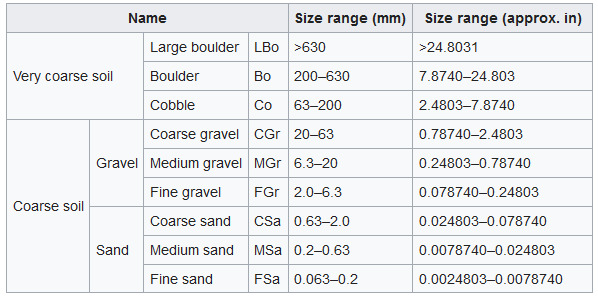
Para registrar este Earthcache, tienes que responder a algunas preguntas. A continuación, envíanos tu respuesta a través de nuestro perfil de geocaching. No es necesario que esperes nuestra respuesta antes de registrar el Earthcache. Si algo va mal, nos pondremos en contacto contigo.
Observa el material del que está hecho el conglomerado.
1. Describe las formaciones rocosas de este lugar (color y forma).
2. Toca la superficie de la formación rocosa y los guijarros. ¿Hay alguna diferencia?
3. Mide el tamaño medio de los guijarros, ¿de qué tamaño son (véase la tabla anterior)?
Estaremos encantados de recibir una foto tuya o de tu equipo en la playa.
🇬🇧 Welcome to the Conglomerate Earthcache, a rock type consisting of various pebbles and sediments.
A geological conglomerate is a special type of sedimentary rock that consists of a mixture of rounded (at least 50% gravel or boulders) to angular rock fragments of different sizes and compositions embedded in a matrix-like rock mass.
These rock fragments are called "clasts" and can be different types of rocks, including quartz, limestone, shale, basalt and others. The matrix-like rock mass surrounding the clasts often consists of finer sedimentary particles such as sand, silt or clay.
Conglomerates usually form in fluvial (from rivers), alluvial (in river or stream beds) or coastal environments where rock fragments are transported, rolled and rounded by water. These clasts then become embedded in the matrix-like deposit and, over time, become conglomerates through diagenesis, a process in which sediments solidify into solid rocks.
Conglomerates are often interesting geological formations because they can provide information about the type of transport medium (e.g. water), the distance the clasts have travelled and the type of source rocks. They are also useful in geological investigations to gather information about past environmental conditions and geological events.
To log this Earthcache, you need to answer some questions. Then send us your answer via our geocaching profile. You don't need to wait for an answer from us before you log the earthcache. If something is wrong, we will contact you.
Look at the material the conglomerate is made of.
1. Describe the rock formations at this site (colour and shape).
2. Feel the surface of the rock formation and the pebbles. Is there a difference?
3. measure the average size of the pebbles, what size are they (see table above)?
We would be very happy to receive a photo of you or your equipment on the beach.
🇩🇪 Willkommen zum Konglomerat Earthcache, einem Gesteinstyp, der aus verschiedenen Kieselsteinen und Sedimenten besteht.
Ein geologisches Konglomerat ist ein spezieller Typ von Sedimentgestein, das aus einer Mischung von abgerundeten (mindestens 50 % Kies oder Geröll) bis kantigen Gesteinsfragmenten unterschiedlicher Größe und Zusammensetzung besteht, die in einer matrixartigen Gesteinsmasse eingebettet sind.
Diese Gesteinsfragmente werden als "Klasten" bezeichnet und können verschiedene Arten von Gesteinen sein, darunter Quarz, Kalkstein, Schiefer, Basalt und andere. Die matrixartige Gesteinsmasse, die die Klasten umgibt, besteht oft aus feineren Sedimentpartikeln wie Sand, Schluff oder Ton.
Die Bildung von Konglomeraten erfolgt in der Regel in fluvialen (von Flüssen), alluvialen (in Fluss- oder Bachbetten) oder küstennahen Umgebungen, wo Gesteinsfragmenten durch Wasser transportiert, gerollt und abgerundet werden. Diese Klasten werden dann in der matrixartigen Ablagerung eingebettet und im Laufe der Zeit durch Diagenese, einen Prozess, bei dem Sedimente zu festen Gesteinen verfestigt werden, zu Konglomeraten.
Konglomerate sind oft interessante geologische Formationen, da sie Informationen über die Art des Transportmediums (z.B. Wasser), die Entfernung, die die Klasten zurückgelegt haben, und die Art der Quellgesteine liefern können. Sie sind auch in geologischen Untersuchungen nützlich, um Informationen über vergangene Umweltbedingungen und geologische Ereignisse zu sammeln.
Um diesen Earthcache zu loggen, musst du einige Fragen beantworten. Dann sendest du uns deine Antwort über unser Geocaching Profil zu. Du brauchst nicht auf eine Antwort von uns warten, bevor du den Earthcache loggst. Wenn etwas falsch ist, werden wir dich kontaktieren.
Schau dir das Material aus dem das Konglomerat besteht an.
1. Beschreibe die Felsformationen an diesem Ort (Farbe und Form).
2. Fühle die Oberfläche von der Felsformation und den Kieselsteinen. Gibt es einen Unterschied?
3. Messen die durchschnittlieche Größe der Kieselsteine, welche Größe haben sie (siehe Tabelle oben)?
Über ein Foto von dir oder deinem Gerät am Strand, würden wir uns sehr freuen.
Sources / pictures / further information:
- https://de.wikipedia.org/wiki/Konglomerat_(Gestein)
- https://www.mineralienatlas.de/
