The Coral Lagoon, also known as
Dragonara Cave, is a naturally formed sea cave near Armier Bay in the
north of Malta. It is an example of karstic feature in Upper Coralline
Limestone Formation.
Sea caves are very common along the coastline wherever there is a
steeply dipping fracture or a fault. Wave action on the rock weakened
along the joint or fault plane enlarges the feature until it forms a
large circular cave. In the presence of horizontal bedding, the cave
may reach 30–40 m in width. In some instances, the roof of the cave has
collapsed producing a large blowhole, which is known locally as
‘dragonara’. The most spectacular one at Malta is the Coral Lagoon.
Karstic features are well developed on the surface topography of
plateaus, characterized by highly irregular and rugged surface
morphology, resulting from solution processes. Karst pavements,
solution holes and solution pans are also particularly relevant.
Sinkholes have been found in the area, usually caused by the collapse
of cave roofs. They are characterized by a flat bottom and may reach a
few hundreds of meters in diameter and stratigraphic throw.
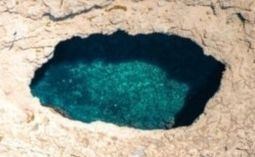
The Coral Lagoon is a subsidence structure. This structure is created
as a result of the corrosive action of rainwater with limestone which
enlarges a cave to an extent where the cave’s roof becomes unstable and
collapses. This unique site is connected with the sea and it is a place
of interest for diving and kayaking. It lies 10 m above sea level; for
this reason, it is regarded as a panoramic lookout point from where it
is possible to view all Marfa peninsula, Gozo and Comino. The site has
already considered as a site with aesthetical value frequented by
recreational activities, but it has also scientific relevance being a
unique sinkhole in Malta connected with the sea.
The rocks exposed in the island comprise a marine sedimentary
succession, mostly composed of limestones and marls and deposited in a
period between Upper Oligocene and Miocene. There are five geological
formations constituting the Maltese archipelago. From the oldest to the
youngest the formations are:
- The Lower Coralline Limestone Formation, consists of pale grey, hard,
shallow marine biomicrites and biosparites, and outcrops in a
restricted coastal stretch forming subvertical cliffs.
- The Globigerina Limestone Formation appears as a yellowish,
fine-grained, planktonic foraminiferal limestone and dominates in
southern Malta and western Gozo.
- The Blue Clay Formation that consists of grey, soft marls, clays and
silty sands, extensively outcrops along gentle slopes.
- The Greensand Formation is composed of bioclastic carbonate rock
which is abundant in glauconite, and was deposited in a warm marine
environment.
- The Upper Coralline Limestone Formation, forms plateaus and is
frequently weathered into steep cliffs and well-developed karst
topography.
For the tasks of this earthcache it is not necessary to go down into
the water. It can be solved from above. If you want to visit the
interior of the cave, it is best to go by kayak. There are people who
jump from above, but it is very dangerous and it is difficult to get
back up (you have to swim out the cave and the climb is complicated,
especially if the sea is rough).