 Tehtävät
1. Minkälaisia muotoja havaitset boudinagessa? Miten havainnot liittyvät kuvauksessa mainittuun luokkajakoon?
2. Perustuen mitä näet paikan päällä, mikä on ollut deformaation suunta? Miksi juuri tämä suunta?
3. Vapaaehtoinen: Ota kuva paikan päällä paljastamatta vastauksia ja liitä kuva lokiin.
Voit logata kätkön lähetettyäsi vastaukset profiilisivun kautta.
Mitä on deformaatio?
Deformaatio tarkoittaa kiven muodon, paikan tai asennon muuttumista. Deformaation seurauksena kivikerrosten rakenne muuttuu ja niihin voi muodostua esim poimuja tai venyilyä. Deformaatiota tapahtuu, kun kivet joutuvat syntyolosuhteistaan poikkeavaan paineeseen.
Mikä on boudinage? Esimerkkikuva ilmiöstä > 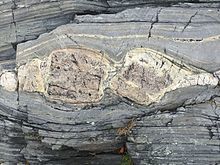
Boudinage juontaa ranskankielisestä sanasta Boudin, joka tarkoittaa makkaraa. Ilmaisu on peräisin ilmiön ulkonäöstä, joka muistuttaa monesti makkaraa. Boudinaget sijaitsevat tavallisesti vierekkäin, ja niitä yhdistää lyhyet kaulat, jolloin ne näyttävät makkaranauhalta.
Boudinage on deformaation tulos. Deformaatiossa kivikerros venyy ja siihen pääsee sekoittumaan toisenlaista kiveä. Ilmiö perustuu jäykän ja pehmeän kiven vuorovaikutukseen eli osallisena on kaksi kivikerrosta, joista toinen on jäykempää ja toinen pehmeämpää kiveä. Usein myös toinen on vanhempaa ja toinen nuorempaa, nuorempi monesti graniittia. Tässä tapauksessa kyseessä on pegmatiittinen nuorempi graniitti ja vanhempi amfiboliitti, joka on peräisin magmakivestä.
Boudinage syntyy, kun kallioperään kohdistuu jonkinlainen rasitus kuten venytys, joka luo deformaatiota. Jäykempi kivikerros venyy ja hajoaa deformaation seurauksena usein nimenomaan "makkaramaisiksi" palasiksi pehmeämmän kiven ympäristössä. Jäykkä kivi vastustaa deformaatiota paremmin ja sinnittelee, kunnes alkaa murtua. Jäykkä kivi pääsee murtumaan palasiksi myös pehmeämän kiven ansiosta, sillä pehmeämpi materiaali murtuu heikompana ensin, antaen sille enemmän tilaa. Tämän tapahtuman yhteydessä murtuneen jäykän kiven väliin pääsee tunkeutumaan jälleen nuorempaa ja pehmeämpää kiveä. Ilmiö edellyttää, että maankuoren jäykät kerrokset ovat riittävän jäykkiä murtuakseen venytyksessä, mutta ympäröivät pehmeämmät kerrokset ovat tarpeeksi joustavia, jotta ne voivat virrata pois ja sitten täyttää syntyvät aukot.
Aina jäykempi kivi ei kuitenkaan hajoa helposti vaan siitä irtoaa vain pieniä paloja sattumanvaraisesti ja niihin kohtiin pääsee tunkeutumaan muuta kiveä. Tällöin boudinagesta ei tule täysin makkaramainen. Silloin myös jäykkä kerros venyy eri nopeudella kuin ympäröivä pehmeämpi materiaali, jolloin boudinagesta tulee vuorotellen ohutta ja paksua. Tämän seurauksena syntyy rakenteita, jotka näyttävät paikoin puristuneilta ja paikoin turvonneilta.
Boudinagen rakenteeseen vaikuttaa myös deformaation voimakkuus, suunta, kesto sekä kiven jäykkyysaste. Jos deformaatio on tietynsuuntainen, voi muodostua pitkiä boudiineja deformaation suuntaisesti. Tietynsuuntaisuuteen voi vaikuttaa esimerkiksi jäykän kiven juoni tai kivikerroksen suuntaisuus. Pidempi ajallinen altistus deformaatioon voi myös vaikuttaa boudinien kokoon ja leveyteen, koska pitkäkestoinen venytys antaa kivelle enemmän aikaa muotoutua. Jos deformaatio on heikohkoa ja kestää kauan, kivi sopivan jäykkää, kiven suuntaisuutta on, niin boudiineista voi muodostua pitkiä deformaation suuntaisesti.
Boudinage voidaan jakaa moneen luokkaan. Monesti seurauksena on symmetrinen tai ainakin lähes symmetrinen makkaranauhan muoto, mutta joskus kyseessä voi olla myös "pinch-and-swell boudinage", jossa kivikerrokset eli segmentit ovat eriytyneet enemmän toisistaan tai ne muodostavat erilaisia muotoja, makkaramaisia ja vaikka nauhamaisia. Kolmas tapa luokitella boudinaget on lähes pelkästään makkaroista muodostuvat muodot, jotka ovat epäsymmetrisiä eli makkarakerrokset ovat eri muotoisia toistensa kanssa.
Paikalta
Paikalla Tapiolan keskusaltaan rannalla on pieni kalliopaljastuma suuremman toisen maakätkökallion vieressä, joka esittelee hyvin boudinage-ilmiön. Tämä kallio koostuu pääasiassa nuoremmasta pegmatiittisesta graniitista.
Kallion poikki menee pitkä, kapea ja tumma amfiboliittijuoni, johon deformaatio on vaikuttanut ja jonka sisälle on päässyt vaaleaa graniittia. Boudiinit eli vaaleat graniitit ovat näkyvissä pitkällä matkalla kallion pinnalla paikoissa, jossa deformaation aikana vaalea graniitti on päässyt tunkeutumaan amfiboliittijuonen väliin. Deformaation vaikutuksesta amfiboliitti on venynyt ja hajonnut muodostaen selkeitä boudiineja. Kalliopaljastuman alue tarjoaa esimerkin siitä miten jäykät ja pehmeämmät kivilajit vuorovaikuttavat keskenään, muodostaen eri rakenteita geologisen deformaation alla.
 Tasks
Tasks
1. What shapes do you observe in the boudinage? How do these observations relate to the classification mentioned in the description?
2. Based on what you see on-site, what has been the direction of deformation? Why this direction?
Optional: Take a photo on-site without revealing the answers and attach it to the log.
You can log the cache after sending the answers via profile page.
What is deformation?
Deformation refers to the change in shape, position, or orientation of a rock. As a result of deformation, the structure of rock layers changes, and features such as folds or stretches can form. Deformation occurs when rocks are subjected to pressures that deviate from their formation conditions.
an example of the phenomenon >
Boudinage derives from the French word "boudin," which means sausage. The term originates from the phenomenon's appearance, which often resembles sausages. Boudinages are typically situated side by side and are connected by short necks, making them look like a string of sausages.
Boudinage is a result of deformation. Deformation is a geological phenomena where a rock layer stretches and mixes with another type of rock. It is based on the interaction between rigid and ductile rocks, involving two layers where one is stiffer and the other is softer. Often, one is older and the other younger, with the younger one often being granite. In this case, it involves younger pegmatitic granite and older amphibolite originating from magmatic rock.
Boudinage forms when some stress, such as stretching, causes deformation in the bedrock. The stiffer rock layer stretches and breaks due to deformation, often into "sausage-like" pieces within the softer rock's surroundings. The rigid rock resists deformation better and holds out until it starts to fracture. The stiffer rock also breaks into pieces due to the softer rock, as the weaker material breaks first, providing more space. During this event, younger and softer rock again penetrates the spaces between the fractured stiff rocks. The phenomenon requires that the rigid layers of the Earth's crust are stiff enough to break under tension, but the surrounding softer layers are flexible enough to flow away and then fill the resulting gaps.
However, the stiffer rock does not always break easily but only loses small pieces randomly, into which other rock can penetrate. In this case, the boudinage does not become completely sausage-like. Then, the rigid layer also stretches at different speeds than the surrounding softer material, making the boudinage alternately thin and thick. As a result, structures form that look compressed in some places and swollen in others.
The structure of boudinage is also influenced by the intensity and direction of deformation, its duration, and the intensity of rock stiffness. If the deformation is in a specific direction, long boudins can form in the direction of deformation. Specific directionality can be influenced, for example, by veins in the rigid rock or the orientation of the rock layers. Longer temporal exposure to deformation can also affect the size and width of boudins, as long-term stretching or compression gives the rock more time to shape and break. If the deformation is mild and lasts a long time, the rock is appropriately stiff, and the rock has some orientation, the boudins can become long.
Boudinage can be classified into many categories. Often, the result is a symmetric or almost symmetric sausage chain shape, but sometimes it can also be "pinch-and-swell boudinage," where the rock layers or segments are more separated or form various shapes, sausage-like or even ribbon-like. Another way to classify boudinages is by forms consisting almost entirely of sausages, which are asymmetrical, meaning the sausage layers have different shapes from each other.
The place
At the site by the shore of the central basin in Tapiola, there is a small rock outcrop next to a larger migmatite rock formation, that clearly demonstrates the boudinage phenomenon. This outcrop consists mainly of younger pegmatitic granite.
A deformation-affected dark and long amphibolite vein runs through the rock. During the deformation, the surrounding granite has penetrated into the amphibolite. Boudins are visible over a long stretch of the rock surface, where the granite has intruded between the amphibolite veins. As a result of the deformation, the amphibolite has stretched and partially broken, forming distinct boudins. The area of the rock outcrop provides an example of how rigid and softer rock types interact with each other, forming different structures under geological deformation.