No permit is required to visit the Lockhart River community, but it is a totally dry area.
Large fines can be imposed for carrying alcohol in this area.
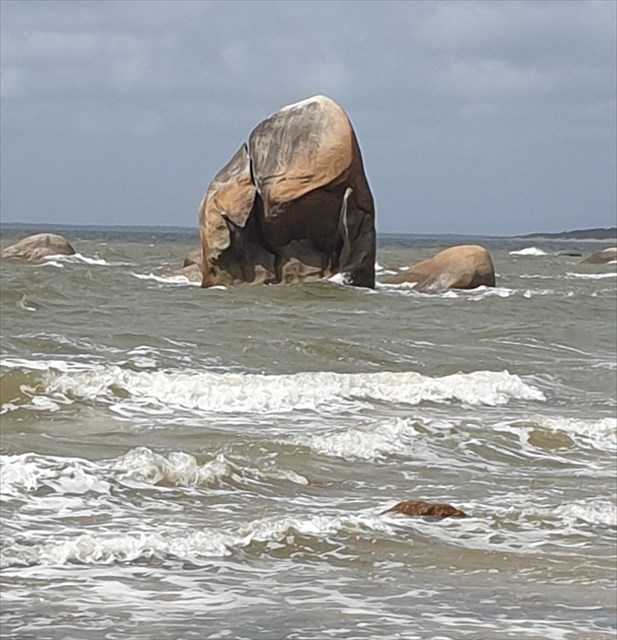
From GZ you will see a massive array of Granite boulders, if you look out to sea you will see two predominate rocks above the water line. One close to shore in picture below and one further out that looks different.
Now, let's break down what exactly an intrusive igneous rock is:
Granite colors are most commonly white, pink, variations of grey and black. Granite must contain at least 20% quartz within a rock to make it granite.
- An intrusive rock means that molten rock cooled within the crust and was never expelled as molten rock. The gradual cooling of molten rock is imperative to create the large crystals of a singular mineral that we see in granites. With time, there is differential lithification or solidifying of molten rock dependent on chemical makeup, this allows for different types of minerals to form at different periods of time and alter the final resulting granite. Therefore, the size of individual grains is proportional to how slowly the molten rock was cooled. Extrusive rocks cool during a volcanic eruption and allow no time for orientation of minerals, creating a homogenous looking rock with no discernible grains.
- An igneous rock is a rock that has solidified from molten rock. This is in comparison to the two other major types of rock, sedimentary and metamorphic.
What Determines Granite Colors?
Granite is a conglomerate of minerals and rocks, primarily quartz, potassium feldspar, mica, amphiboles, and trace other minerals. Granite typically contains 20-60% quartz, 10-65% feldspar, and 5-15% micas (biotite or muscovite). The minerals that make up granite give it the unique colors we see in different types of granite.
The relative proportion of different colored minerals in a granite is largely due to the original source of molten rock that cooled to form the granite. If the molten rock was abundant in potassium feldspar, the granite is more likely to take on a salmon pink color. On the other hand, if the molten rock is abundant in quartz and minerals that make up amphibole, you will likely get a black and white speckled granite commonly seen on countertops.
- Quartz - typically milky white color
- Feldspar - typically off-white color
- Potassium Feldspar - typically salmon pink color
- Biotite - typically black or dark brown color
- Muscovite - typically metallic gold or yellow color
- Amphibole - typically black or dark green color
The combination of the minerals above make up most of the colors we typically see in a granite.
Requirements to Log this Earth Cache
Q1. The name of this earth cache
Q2. There are two prominent rocks sticking out of the water. Describe the colour and shape of the one further out in the water. It will be easy to see which one we are referring to. Roughly SSE from where you are standing.
Q3. Why do you think it is this shape?
Q4. Examine a piece of Granite on the shore, it’s easier with a broken piece, and tell us what the main colour it is and what mineral has made it the colour it is. (look closely.)
Q5. Upload a picture of yourself or something that identifies your team at GZ.
(Preferably with the pictured rock on the cache page in the back ground.)
Please do not give anything away in the photo
Most of all we hope you enjoy this fantastic area.
If the tide is out you can then take a drive south along the beach to the mouth of the Lockart River and some more beautiful scenery and Geology, or you can drop a line off the nearby Jetty, the locals say it is great fishing there.