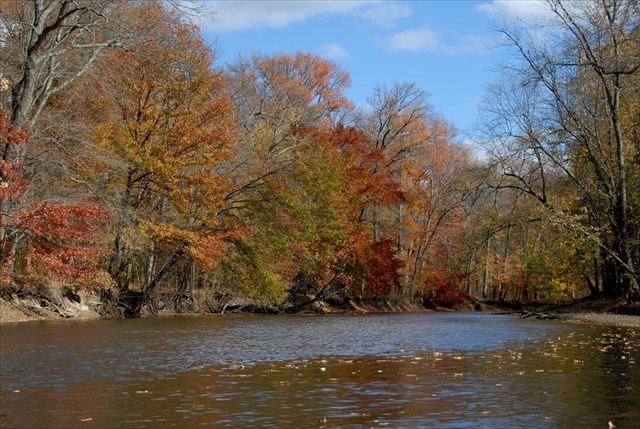
Great Piece Meadows is an idyllic spot for kayakers and canoe enthusiasts, situated in the heart of northern New Jersey along the Passaic River. This natural preserve, spanning over 1,100 acres, offers a unique opportunity to paddle through a diverse ecosystem of wetlands, meadows, and woodlands. The Passaic River meanders through the meadows, providing a picturesque route for kayakers and canoers to explore. With its tranquil waterways and abundant wildlife, it's a peaceful haven for those looking to enjoy a fun and relaxing day of paddling. This stretch of the Passaic River also offers the chance to learn about geomorphology, which is defined as the study of the origin, evolution, and dynamics of landforms and the processes that shape the Earth's surface.
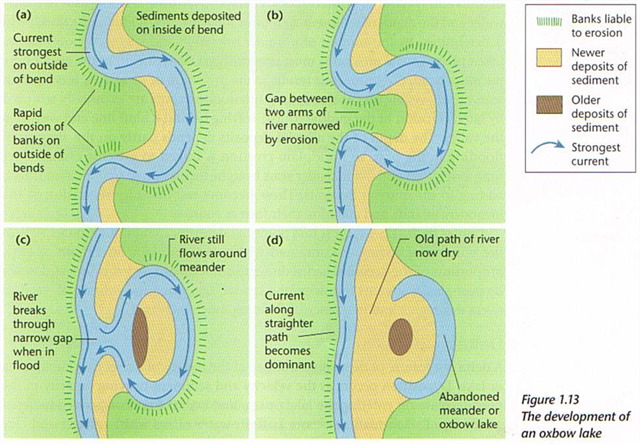
Oxbow lakes are features resulting from the intricate interplay of fluvial processes, and they offer valuable insights into landscape evolution over time. They primarily originate as meandering rivers gradually shift and migrate laterally, carving sweeping bends in their paths. Over time, the river's erosional forces, including the relentless scouring of the outer bank of a meander loop and the deposition of sediment on the inner bank (more on this later), lead to the gradual narrowing of the neck of the meander. As the neck of the meander constricts, the river's course becomes increasingly curved, and eventually, the watercourse may take a shortcut by breaching through the neck of the meander. This natural phenomenon, known as meander cutoff, leaves behind a remnant loop that is isolated from the main river channel. The result is an oxbow lake, characterized by its horseshoe or crescent shape. Over time, oxbow lakes continue to evolve. They often fill with sediment and organic matter, gradually transitioning from deep water bodies to shallower wetlands. The process of sedimentation within these lakes can provide crucial data about the historical river dynamics, past sedimentation patterns, and environmental conditions during their formation. Geologists frequently analyze the sediment layers within oxbow lakes to unravel the complex story of a region's geological history and the intricate interplay between fluvial processes and landscape evolution.
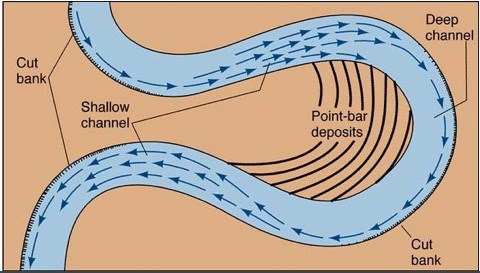
Two other important processes relating to the formation of oxbow lakes are point bars and cut banks, which are significant geological features within river systems. Point bars develop as a result of the gradual deposition of sediments on the inside bend of meandering rivers. Reduced flow velocity on the inner bank allows for the accumulation of fine-grained materials like sand and silt. These point bars play a crucial role in understanding the lateral migration of river meanders and the evolution of river landscapes. Conversely, cut banks represent the eroded outer banks of meandering river bends. The swifter flow along the outer bank exerts erosional forces, leading to bank erosion and retreat. Cut banks are typically characterized by steep, unstable slopes, which change and reshape the riverbanks continuously.
This earthcache can only be completed from a kayak/canoe. Waypoints for both the upstream and downstream boat launches are included.
Logging Requirements:
- Looking north, you will see an old channel of the Passaic River. Using the image on the cache page as a guide, what stage of oxbow lake formation is it in (a, b, c, or d)?
- Paddle over to the inside bend of the river channel and describe what you see (steep/gentle bank, deep/shallow...etc). Next, paddle to the outside bend and then describe what you see there (steep/gentle bank, deep/shallow...etc).
- The Passaic River often floods, and overflows its banks. How do you think flooding impacts the process of oxbow lake formation? How do you think this area will change over time?
- Upload a photo taken on the Passaic River. The photo must be taken from the water. You don't have to be in the photo, though it is strongly encouraged.