Welcome to War Memorial Park! This is one of three Earthcaches I listed in the park – as such, there is no physical cache container. Instead you will partake in a geology lesson by making observations and answering 4 questions about the diabase memorial stones at the posted coordinates. This memorial is located in War Memorial Park and the park grounds are open daily from dawn to dusk. This Earthcache listing was approved by the Martinsburg-Berkeley County Parks and Recreation.

Residents of Martinsburg wanted to create a living memorial for their World War II heroes that sacrificed their lives during the war, and in 1946 they raised enough money to purchase roughly 20 acres to create a living park. War Memorial Park officially became a public space in 1947, launching a long history of community events, milestone moments and times of appreciation for those who lost their lives defending the country. In 1952, 162 maple trees were planted along with a plaque for every veteran who died in both WW1 and WW2. As more and more of the trees aged and died off, a plan was orchestrated in 2006 to build a more permanent stone veterans memorial here in the center of the park.
DIABASE
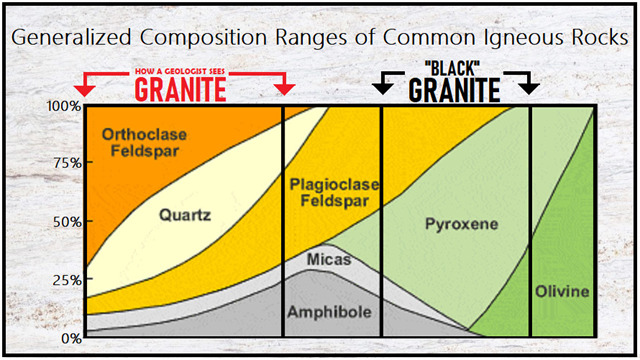
The black memorial stones like the ones you see here are known on the international market as “black granites,” Though not a granite, these rocks are lumped into granitoids due to their similar strength and hardness. To a petrologist, these rocks would be classified as gabbros, norites, anorthosites, diorites, dolerites, and basalts.
These diabase markers that you see here at War Memorial Park are made from a stone called American Black Granite. This stone is cut from a large intrusive body of dark gray to black, fine- to medium-grained, intrusive igneous rock with white veining, which is quarried from Rock of Ages quarry in Elverson Pennsylvania.

Diabase, like granite, is an igneous intrusive rock. That is, it formed from cooling magma over a long period of time underground. Diabase is like basalt. The big difference is that Basalt is an extrusive igneous rock that cooled fast above ground from lava. Both intrusive and extrusive igneous rocks differ in only how quickly they have cooled, both types darken as the transition from felsic to ultramafic composition occurs.
Diabase typically has a mineral composition that is dominated by the plagioclase feldspar known as labradorite (approximately 40% to 70% of the rock). Most of the remainder is made up of pyroxene minerals. Minor amounts of hornblende, olivine, magnetite, and quartz can be found in some diabase rocks.
The pyroxene minerals in diabase, as well as the feldspars, will form a weathering rind when exposed to the elements. So, an initially black construction stone can alter to a chalky white, gray, or tan color. This should be expected unless the stone has been polished, treated, or used in a location not exposed to the elements.
Veining refers to the long, curvy and zigzagging lines that crisscross and cut through stone. From a geological standpoint, the term refers to the actual veins as layers or sheets of minerals that have crystallized inside of a rock. The minerals have been placed there through a flow of water that eventually evaporates and leaves behind the mineral particles. The remnants or mineral traces are elongated and can have varying widths and various branches.
LOGGING REQUIREMENTS:
To log this Earthcache: Read the geology lesson above. Answer all four questions posted below. Answers can be sent via e-mail or messenger contacts on my Geocaching profile within a reasonable time. Group answers are fine, but please include the members of the group you are with.
QUESTION 1. What is the dominate plagioclase feldspar that makes up 40% to 70% diabase called?
QUESTION 2. The sides of these memorial markers are not polished. Does the sides have chalky gray "weathering rind," or do the sides appear treated witha sealant?
QUESTION 3. About how thick is the average white veins in the stone?
QUESTION 4. Most of these stones have linear veining pattern, but on the back of the WW2 memorial it appears that some geologic pressure altered the veining pattern. How is the veining pattern altered here?
OPTIONAL PHOTO: Posting a photo that readily indicates that you (and anyone else logging the find) are at the location.

Awesnap has earned GSA's highest level:


REFERENCES:
1. Granite Vs Gabbro: Similarities and Differences, March 7, 2018, website, geologyin.com
2. Diabase, J.Wilt, The Journal, May 30, 2021, website, geology.com
3. War Memorial Park serves as symbol of honor for those who made ultimate sacrifice, H.M.King, Geology.com, website, journal-news.net