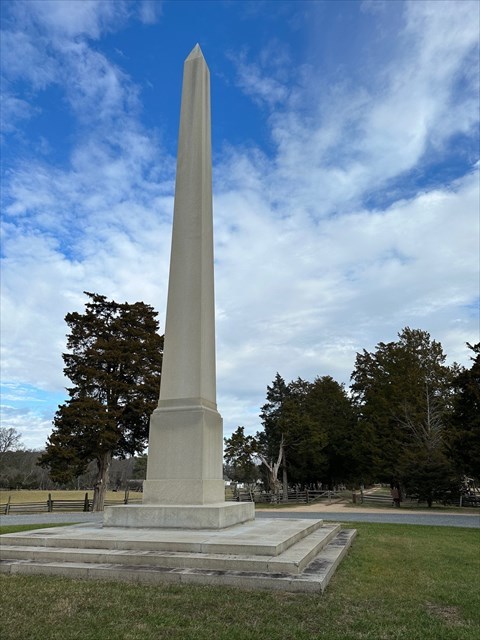
George Washington Birthplace National Monument is located along Popes Creek and the Potomac River in Westmoreland County, Virginia. The site holds historical significance as the ancestral family home of the Washington family and birthplace of the first President of the United States, George Washington, who was born on February 22, 1732. The current 551 acres managed by the National Park Service includes a Memorial House Museum and farm built in the 1930s. Additionally, nearby is the Memorial Obelisk erected in 1896 by the US War Department. The obelisk stands tall as a tribute to George Washington's enduring legacy and his pivotal role in American history.
The Birthplace Monument is constructed from Vermont Granite and weighs about 50 tons. It is one-tenth the size of the Washington Monument in the Nation's capital, and of the same relative proportions.
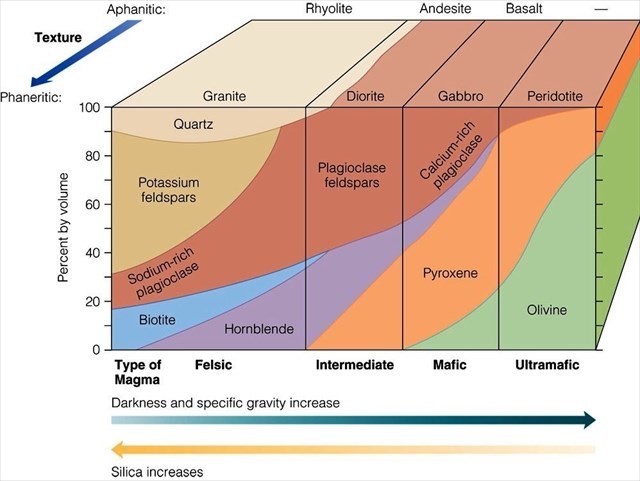
Vermont granite is a geologically significant and durable igneous rock that is well known for its exceptional strength and unique aesthetic qualities. Granite is a type of igneous rock and forms through the slow crystallization of molten magma beneath the Earth's surface. It belongs to the intrusive category of igneous rocks, indicating that it solidifies within the Earth, resulting in a coarse-grained texture. In contrast, rocks that formed outside of the earth's surface (and cool rapidly) are considered extrusive. Generally, the longer it takes for a rock to cool, the larger the crystal size. In the chart above, which shows how igneous rocks are classified, notice that it says aphanitic and phaneritic, even though the composition remains the same. Aphanitic is a scientific term referring to a fine crystal size (which indicates that the rock cooled rapidly, outside of the earth's surface), while phaneritic refers to coarse crystal size (indicating rock cooled slowly, within earth's surface). Formed through the slow cooling and solidification of molten magma deep within the Earth's crust, Vermont granite belongs to the larger Appalachian Mountain range, specifically the Precambrian-aged rocks that underlie the state. Vermont Granite is known for its characteristic speckled appearance, Vermont granite exhibits a diverse range of colors, including shades of pink, gray, and black. The rock's mineral composition typically includes quartz, feldspar, and mica, contributing to its distinct appearance and robust physical properties.
Also notice how igneous rocks can be classified as either felsic or magic. Felsic rocks, exemplified by granite, are characterized by their high silica content, consisting predominantly of light-colored minerals such as feldspar and quartz. These rocks typically exhibit a coarse-grained texture, lower density, and higher melting point. Felsic rocks are commonly associated with continental crust, forming through processes like continental collisions, and they contribute to the composition of many mountain ranges. In contrast, mafic rocks, exemplified by basalt, have a lower silica content and are rich in darker-colored minerals like pyroxene and olivine. Mafic rocks often display a finer-grained texture, higher density, and lower melting point. They are commonly found in oceanic crust, associated with volcanic activity along mid-ocean ridges and oceanic basins. The presence of mafic rocks in these regions contributes to the dynamic processes shaping the Earth's surface, including plate tectonics and the formation of oceanic crust.
Feldspar is a common mineral group in the Earth's crust, and it is divided into two main types: plagioclase and potassium feldspar (orthoclase). Plagioclase feldspar encompasses a series of minerals with varying compositions between sodium and calcium aluminum silicates. These minerals exhibit a broad range of colors, from white to gray to green. Plagioclase feldspar is a key component in many igneous rocks, including basalt and granite. On the other hand, potassium feldspar which is predominantly orthoclase, is recognized for its pink to reddish hues (though it can also be white). It is a vital constituent of granitic rocks and contributes to their overall composition. Another common mineral found in granite is biotite, which is typically black or brown and possesses a high metallic luster. Biotite forms in sheets or flakes and exhibits perfect basal cleavage, meaning it readily splits into thin, flexible sheets. It is composed of potassium, magnesium, aluminum, silicon, oxygen, and hydrogen. Lastly, there is hornblende, which is a group of dark-colored amphibole minerals, primarily composed of calcium, sodium, magnesium, iron, aluminum, silicon, and oxygen. Its color can range from black to dark green and even brown. Hornblende crystals typically form elongated prismatic shapes with two distinct cleavage directions (the angle separating two different planes) intersecting at around 56 and 124 degrees.
Please do not park/stop along the road shoulder. There is parking available at the Visitor Center.
Logging Requirements:
- Examine the stone closely and describe the color, texture, and grain size. Does the color of the monument appear consistent throughout, or are there some slight variations?
- Based on the description and your observations, which mineral is most abundant in the Vermont granite? Are you able to identify any other minerals within the stone? Estimate the relative proportion of each mineral (i.e. X% of quartz...etc).
- Why do you think Vermont Granite was used to construct the Memorial Obelisk?
- Vermont granite can be found in a wide range of colors, including shades of pink, gray, and black. Why do you think such a wide range of variations in colors exist, even though geologically they are considered the same stone?
- Upload a photo with the Memorial Obelisk. You don't have to be in the photo, though it is strongly encouraged.