Hallersteinov zvezdni opazovalnik
Stojite pred natančno repliko zvezdnega opazovalnika, ki je posvečen slovenskemu astronomu, matematiku, kartografu, diplomatu, jezuitu in mandarinu Ferdinandu Avguštinu Hallersteinu, ki je med bivanjem na Kitajskem, po naročilu kitajskega cesarja sredi 18. stoletja zasnoval in izdelal ta znameniti pekinški zvezdni opazovalnik. Izjemen dosežek, pri katerem je s kombinacijo heliocentrične zasnove, ki je bila v uporabi v Evropi, in ekvatorialne postavitve, kot je bilo v navadi na Kitajskem, dosegel povsem inovativno in sodobno rešitev, kakršna se uporablja pri teleskopih.
Original še danes stoji na starem pekinškem astronomskem observatoriju.
Kdo je bil Hallerstein – Liú Sōnglíng
Baron Ferdinand Avguštin Hallerstein, s kitajskim imenom 劉松齡, Liú Sōnglíng, je izhajal iz plemiške družine, ki je posedovala dvorec v Mengšu kjer je bil 27. avgusta 1703 rojen. Po končanem študiju je vstopil v jezuitski red. Na Kitajsko je odpotoval leta 1735 in po dveh letih prispel v Peking.
Že takrat je Hallerstein slovel kot dober matematik, zato je takoj nastopil službo kot namestnik predstojnika Cesarskega astronomskega urada. Leta 1746 je prevzel mesto predstojnika Cesarskega astronomskega urada, ki ga je zadržal vse do smrti 29. oktobra leta 1774.
V svojem bogatem znanstvenem delu je vzpostavil sodelovanje z akademijami znanosti v Parizu, Sankt Peterburgu in Londonu ter s tem dobro znanstveno korespondenco med tedanjo Evropo in Kitajsko. Poleg astronomskih opazovanj, korekcije kitajskega koledarja in izdelave zvezdnega opazovalnika je njegovo znanstveno delo obsegalo tudi izdelavo geografskih kart, izračun zemeljske dolžine Pekinga, odkritje kometa, poskuse z induktivno elektriko in vakuumsko tehniko, proučevanje avtohtonih kitajskih rastlin in živali ter prvi izračun števila kitajskega prebivalstva.
Po baronu Hallersteinu je imenovan tudi asteroid, ki so ga leta 1999 odkrili na Observatoriju Črni vrh v Sloveniji. Imenuje se 15071 Hallerstein.
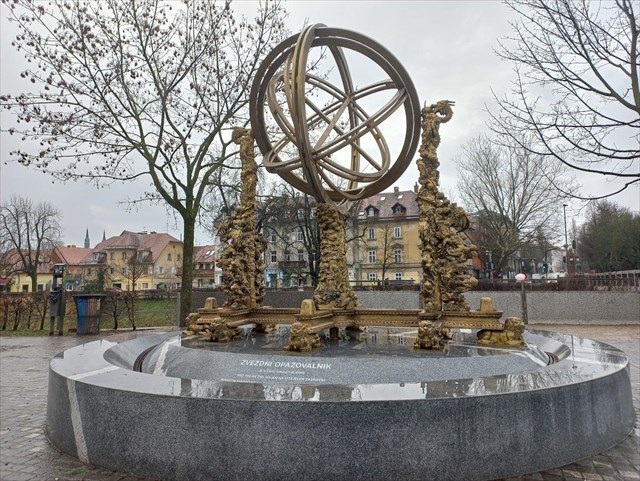 Zvezdni opazovalnik / Star Observatory (foto: Emahana)
Bronasti spomenik je dolg 3,7m, širok 2,1m in visok 3,3m ter tehta skoraj 5 ton. Repliko so ustvarili astronomi in strokovnjaki v pekinškem planetariju. Za njeno izdelavo so potrebovali kar sedem let, kar je le tri leta manj, kot je Hallerstein potreboval za izdelavo originala. Na podstavku je napis v kitajščini in slovenščini. Repliko opazovalnika je podarilo veleposlaništvo LR Kitajske.
NALOGE ZA VPIS ZAKLADA
Da bi lahko vpisali ta virtualni zaklad kot najden, morate izpolniti dve nalogi:
1. Na koordinatah zaklada preštejte vse zmaje in vse leve na spomeniku.
2. K vpisu priložite fotografijo sebe (obraz ni zahtevan) ali svoj osebni predmet s spomenikom v ozadju.
POMEMBNO: Fotografije, ki prikazujejo le spomenik ne izpolnjujejo pogojev za vpis. Če oba pogoja ne bosta izpolnjena, bo vaš vpis brisan brez opozorila. Vsak vpis mora imeti pripeto svojo fotografijo. Odgovor na vprašanje nam pošljite neposredno na naslov emahanagc@gmail.com. Rešitev ne vpisujte v dnevniški zapis.

Hallerstein Star Observatory
You are standing in front of an exact replica of the star observatory, which is dedicated to the Slovenian astronomer, mathematician, cartographer, dipolomat, Jesuit and mandarin Ferdinand Augustine Hallerstein, who during his stay in China, designed and built the famous Beijing Star Observatory for the Emperor of China in the mid-18th century. A remarkable achievement in which, by combining the heliocentric design that was in use in Europe and the equatorial arrangement, as was customary in China, he achieved a completely innovative and modern solution of the kind used in telescope.
The original still stands today at the old Beijing Astronomical Observatory.
The bronze monument is 3,7m long, 2,1m wide and 3,3m high, and weighs almost 5 tonnes. The replica was created by astronomers and experts at the Beijing Planetarium. It took seven years to complete, just three years less than it took Hallerstein to make the original. The inscription on the base is in Chinese and Slovenian. The replica was donated by the Embassy of the People's Republic of China.
Who was Hallerstein – Liú Sōnglíng
Baron Ferdinand Augustine Hallerstein, with the Chinese name 劉松齡, Liú Sōnglíng, came from a noble family that owned a manor house in Mengeš, where he was born on 27 August 1703. Afetr completing his studies, he entered the Jesuit order. He travelled to China in 1735 and arrived in Beijing two years later.
Hallerstein already had a reputation as a good mathematician, so he immediately took up a job as Deputy Head of the Imperial Astronomical Office. In 1746 he took over the post of head of the Imperial Astronomical Office, which he held until his death on 29 October 1774.
In his rich scientific work, he established cooperation with the academies of sciences in Paris, St Petersburg and London, and thus a good scientific correspondence between Europe and China at that time. In addition to astronomical observations, the correction of the Chinese calendar and the construction of a star observer, his scientific work included the production of geographical maps, the calculation of the longitude of Beijing, the discovery of a comet, experiments with inductive electricity and vacuum technology, the study of native Chinese plants and animals and the first calculation of the Chinese population.
Baron Hallerstein is also the name of an asteroid discovered in 1999 at the Črni Vrh Observatory in Slovenia. It is called 15071 Hallerstein.
TASKS TO LOG A CACHE
In order to log this Virtual cache as found you have to visit cache location and fulfill two tasks:
1. At the header coordinates, count all the dragons and all lions on the monument.
2. Attach a photo of yourself (your face is not required) or your personal item with the monument to your log entry.
IMPORTANT: Photos that show only the monument do not qualify for logging. If both conditions are not fulfill the log will be delited without warning. Each log must have it's own photo according to the instruction from the listing. Please send the anwser to us on emahanagc@gmail.com. Do not enter the solution on the log file.
Virtual Rewards 4.0 - 2024-2025
This Virtual Cache is part of a limited release of Virtuals created between January 17, 2024 and January 17, 2025. Only 4,000 cache owners were given the opportunity to hide a Virtual Cache. Learn more about Virtual Rewards 4.0 on the Geocaching Blog.
Viri / Sources: www.delo.si, sl.wikipedia.org, ars.rtvslo.si/