Triumph Over Tragedy
(Virtual Rewards 4.0)
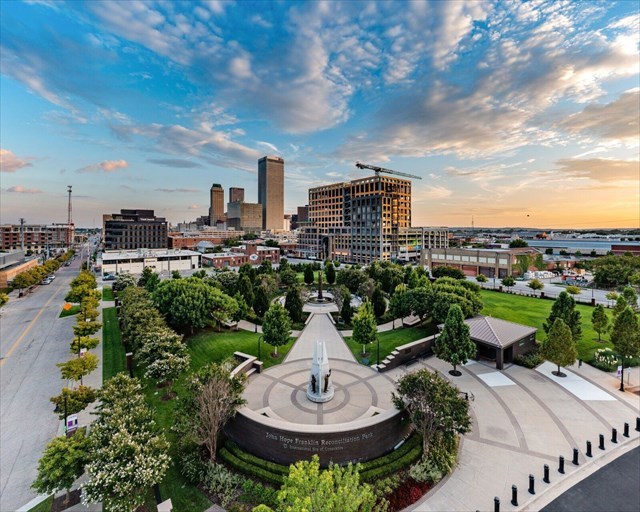
Please note: This is a virtual geocache and there is no container to find. You must visit this location in person and complete the logging tasks found near the bottom of this page in order to claim a find.
I grew up in Oklahoma my entire life. I went to public school where I had good grades and took Oklahoma history as one of my courses. I thought I had a decent understanding of major events that had occurred here in my state. Perhaps I goofed off too much in school or perhaps this dark history was sparsely covered in class. Either way, I can honestly say it was only as an adult that I learned of the tragic events that took place here in Tulsa barely more than a century ago in 1921.
I was moved by the history and wanted to give a glimpse into the events that unfolded over those short few days in May/June 1921. Some people say things were different in 1921 than they are now and that it was "a different time." In a lot of aspects, this is absolutely true. But in many other ways, we still suffer from not learning the lessons of the past. My hope is the story will speak for itself.
The information was taken from multiple sources, including the results from the 2001 Oklahoma Commission to Study the Tulsa Race Riot.
Tulsa Race Massacre, May 1921
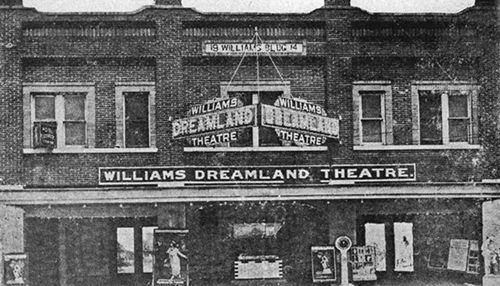
Williams Dreamland Theater
After statehood in 1907, Tulsa's black community, through resourcefulness, spirit and self-sufficiency, developed a vibrant showcase of African American culture around the intersection of Greenwood Ave and Archer St. Hundreds of prosperous black businesses lined the streets and brought unheralded wealth to the community, earning the name "The Black Wall Street of America." Archer St, the line of segregation between the black and white worlds, was the ironic symbol of both opportunity and oppression. While segregation created a vital economic center for blacks, it also defined their place in the nation.
On the morning of May 30, 1921, a young black man named Dick Rowland was riding in the elevator in the Drexel Building at Third and Main with a young woman named Sarah Page. The details of what occurred vary from person to person but when Mr. Rowland entered the elevator, someone nearby heard a scream. They thought the woman was being assaulted and alerted the police. Other accounts say he just stumbled into her. Nobody knows the exact truth but accounts of the incident circulated among the city's white community during the day and became more exaggerated with each telling.
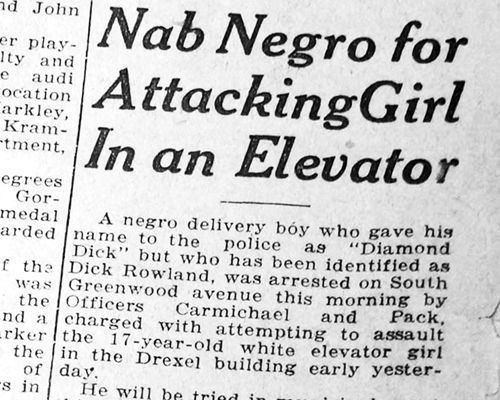
Tulsa Tribune, May 31st, 1921 Edition
Tulsa police arrested Rowland the following day and began an investigation. An inflammatory report in the May 31st edition of the Tulsa Tribune rallied the white community toward the courthouse to take the law into their own hands. This lynch mob was met by several dozen armed black men, many of whom were veterans, who attempted to stop the lynching from happening.
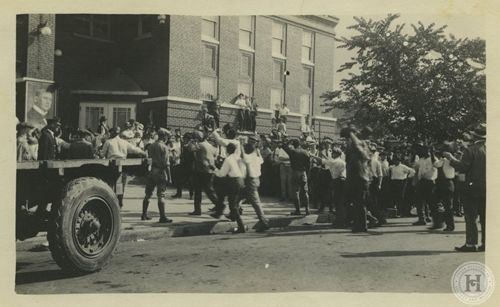
Armed standoff at the courthouse
Word of a black uprising spread through the white community and in the early morning hours of June 1st, 1921, upwards of 10,000 armed white rioters stormed the Greenwood community looting, killing and burning as they went through. Planes dropped firebombs on the district and firemen who attempted to stop the burning homes were threatened by the mob.
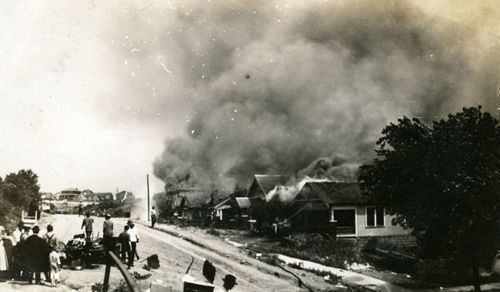
Homes burning
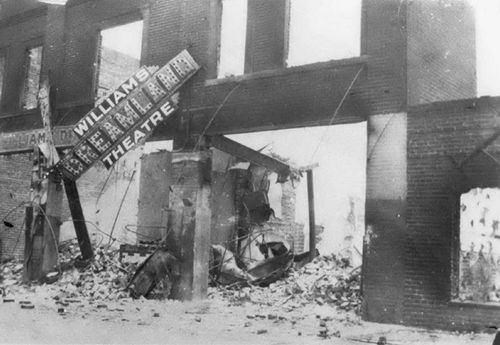
Williams Dreamland Theater destroyed
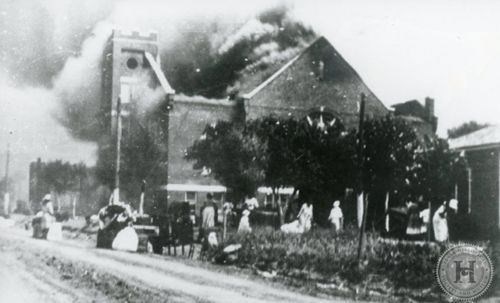
Newly built Mount Zion Baptist Church
Governor Robertson declared martial law and requested the help of National Guard troops. These Guardsmen assisted firemen in putting out fires and quelling the riot. They also took African Americans out of the hands of vigilantes and imprisoned all black Tulsans, marching them through the streets at gunpoint to the Convention Hall and the Fairgrounds. Over 6,000 men, women and children were rounded up and interned... some for as long as eight days.
Even after the restoration of order, it was official policy to release a black detainee only upon the application of a white person, and then only if that white person agreed to accept responsibility for that detainee's subsequent behavior.
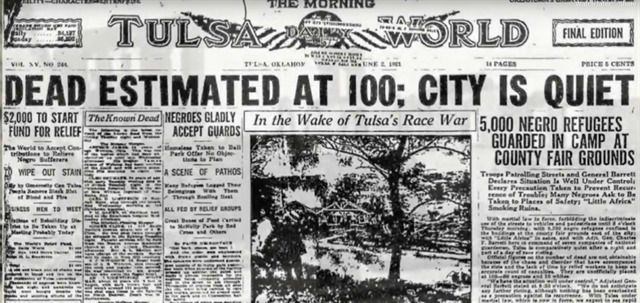
Tulsa World Newspaper dated June 2, 1921
Twenty-four hours after the violence erupted, it had ceased. Over a thousand homes and businesses were destroyed; scores of innocents were murdered and hundreds more required medical attention. By the time the violence was quelled, Tulsa's entire 35 block black community lay in ashes. Because of the cover-up that began immediately, the death count from the massacre is still uncertain, though estimates say as many as 300 Americans, most of them black, were killed in this event.
Not one of these criminal acts has ever been prosecuted or punished by the government at any level: municipal, county, state, or federal.
What's in a name? Riot vs Massacre
In recent years there has been ongoing discussion about what to call the event that happened in 1921. Historically, it has been called the Tulsa Race Riot. Some say it was given that name at the time for insurance purposes. Designating it a riot prevented insurance companies from having to pay benefits to the people of Greenwood whose homes and businesses were destroyed. It also was common at the time for any large-scale clash between different racial or ethnic groups to be categorized a race riot.
Definition of RIOT: a tumultuous disturbance of the public peace by three or more persons assembled together and acting with common intent.
Definition of MASSACRE: the act or an instance of killing a number of usually helpless or unresisting human beings under circumstances of atrocity or cruelty.
John Hope Franklin Reconciliation Park
This park is the long-awaited result of the 2001 Oklahoma Commission to Study the Tulsa Race Riot of 1921. It memorializes the Tulsa Race Riot/Massacre, called the worst civic disturbance in American history. The park also tells the story of African Americans' role in building Oklahoma and thus begins the long-delayed rendering of the full account of Oklahoma's history.
All of the statues here were created by Ed Dwight, the first African American astronaut and artist from Denver. The primary art elements are:
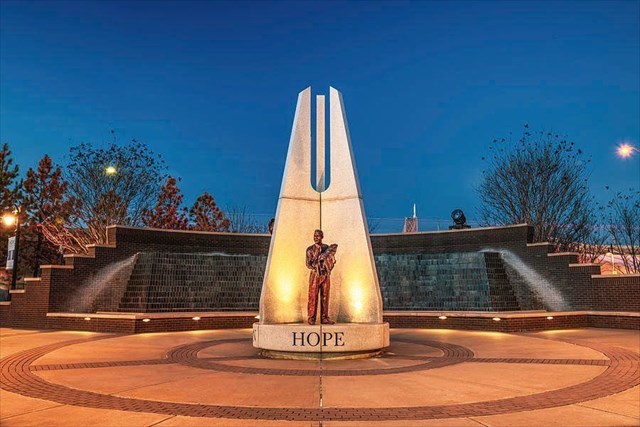
Hope Plaza
The park entry's 16-foot granite structure contains three larger-than-life bronze sculptures representing actual pictures from the 1921 riot:
- Hostility: A man fully armed for assault.
- Humiliation: A man with his hands raised in surrender.
- Hope: Maurice Willows, Director of the Red Cross holding a baby born June 1921.
The Tower of Reconciliation
At the center of the park you'll find the 25-foot-tall memorial tower. This tower depicts the history of the African American struggle from Africa to America – from the migration of enslaved men, women and children with Native Americans on the Trail of Tears, the slave labor experience in the Territories, the 1st Kansas Colored Volunteer Infantry that won the Battle of Honey Springs – to Oklahoma statehood, the immigration of free African Americans into Oklahoma, and the All-Black towns and Greenwood. It honors Buck Colbert Franklin (prominent attorney and Dr. Franklin’s father) and other early Tulsa African American prominence.
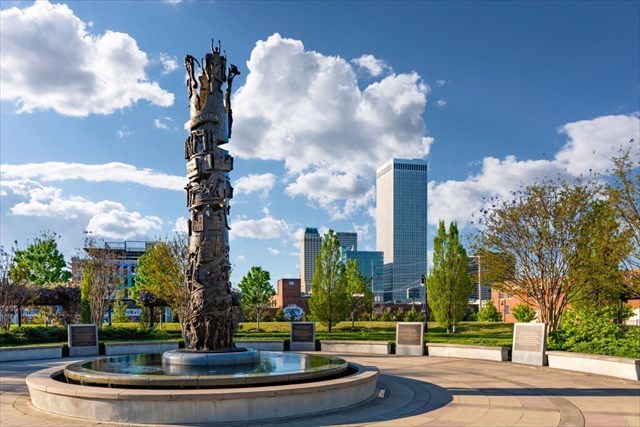
John Hope Franklin Reconciliation Park continues the American tradition of erecting memorials based on tragic events by giving voice to the untold story of the 1921 Tulsa Race Massacre and the important role African Americans played in building Oklahoma.
To Get Credit For This Virtual
Copy the questions below and send your answers via geocaching messages.
- DO NOT post the answers in your log.
- Group answers are fine, just let me know who all was there.
- Note: The photo task is a requirement for each account claiming a find.
- Found logs submitted without the completed logging tasks below will be quietly removed (no offense intended).
Logging Tasks
1| The name of this virtual: Triumph Over Tragedy (Virtual Rewards 4.0)
2| In your log, please provide a photo of yourself inside of the park with the Tower of Reconciliation.
- If you prefer, the photo with the tower can be of something geocaching related like a trackable or a piece of paper with your geocaching name. Just make the photo unique to you and your visit.
Surrounding the Tower of Reconciliation is a group of stones with plaques that discuss the various parts of African American history in the US. In order to answer the two questions below, please walk to the two virtual stages nearby.
3| Storm Clouds (Waypoint #1 - N36 09.651 W095 59.403):
Look for the plaque that begins with "But storm clouds were gathering." This plaque here describes the events of May 31st, 1921. Read through this inscription and answer the following question.
- On the inscription, what is the last word in the third paragraph? (9 letters)
4| We Survived (Waypoint #2 - N36 09.657 W095 59.404):
Look for the plaque that begins with "We survived." This talks about the aftermath these events had on the city and the African American community. Read through this inscription and answer the following question.
- On this inscription, what is the last word in the second paragraph? (9 letters)
5| Optional but highly recommended :
I can't recommend enough that you to visit the Greenwood Rising (Waypoint #3 - N36 09.582 W095 59.147) non-profit museum just a few blocks away if you have time. It provides a powerful and phenomenally in-depth experience about the Tulsa Race Massacre that you will never forget!
*FAVORITE POINTS RAISE AWARENESS TO OTHER GEOCACHERS.
CONSIDER GIVING A FAVORITE IF YOU ENJOYED THIS VIRTUAL!*
Additional Resources
Virtual Rewards 4.0 - 2024-2025
This Virtual Cache is part of a limited release of Virtuals created between January 17, 2024 and January 17, 2025. Only 4,000 cache owners were given the opportunity to hide a Virtual Cache. Learn more about Virtual Rewards 4.0 on the Geocaching Blog.