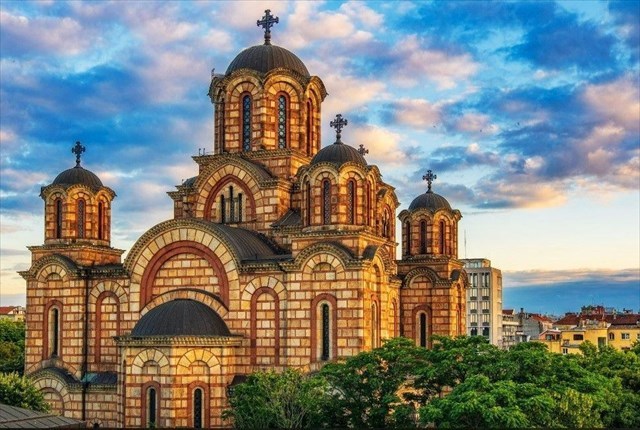
Located in Tasmajdan Park near Parliament, the Church of St. Mark is a Serbian Orthodox church built in the Byzantine style. The building you see today was mostly completed by 1940, but there was a church dating from 1835 on this same site. That original church was built of wood and also dedicated to St. Mark. It was built in an existing cemetery. Here, King Alexander Obrenovic I and Queen Draga Obrenovic were buried after they were assassinated during the May Coup in 1903. The original church was hit by German bombs and badly damaged on Palm Sunday in 1941. The rubble was cleared in 1942. At the time, the new church's exterior from sandstone had been completed, but finishing work was stalled due to the war. Nevertheless, divine service took place inside during the war. Officially, the building was consecrated in 1948. The church has three altars. One of the altars contains a mosaic that is believed to be one of the largest in the world, spanning 1,400 square feet (130 square meters). It is made of Venetian glass and is titled "Mother of God, Larger than Heaven."
Fossils are the traces and the remains of the living organisms which are preserved in the sedimentary rocks, The traces of once old living organisms indicate their activity during their life and the remains are the traces that indicate the remains of once old living organisms after death.
Types of fossils according to ways of formation: The fossils are classified according to the way of formation into several types which are the fossil of the complete body, The cast, the mold, and the petrified fossils.
The fossil of complete body- It keeps the whole shape and all the details, It is a type of fossil which was formed as a result of the rapid burying of the organism as soon as it died in a medium that preserves it from the decomposition as the snow and the amber.
The amber is the solidified resinous matter which was secreted by the pine trees in the old geologic ages, The mammoth was extinct by the snow avalanche that occurred in Siberia 25000 years ago, The mammoth fossil and the amber fossils are examples of the complete body fossil.
The cast types- There are the hollow cast and the solid cast. The hollow cast is the face mask that has the same external details of the face. The solid cast is the pieces of ice that have the same internal details of the ice cast.
The solid cast- is the replica of the internal details of a skeleton of once an old living organism, The ammonites fossil, the nummulites fossil, and the trilobite fossil are examples of the solid cast fossils.
The mold- is the replica of the external details of a skeleton of once an old living organism leaving them in the sedimentary rocks after death, The mold of ferns, and the fish mold are examples of mold fossils.
The petrified fossils- The petrified fossils are the fossils in which the minerals replace the organic matter for the organism part by part to leave the shape without any change, The dinosaur’s tooth, the dinosaur’s eggs, and the petrified wood are from examples of the petrified fossils. The petrified woods are the fossils that are formed as a result of replacing the organic matter of the wood by the silica part, and they give us the details about the life of once an old plant. Petrification is the process of replacing the wood material of the trees with silica to form the petrified woods part by part.
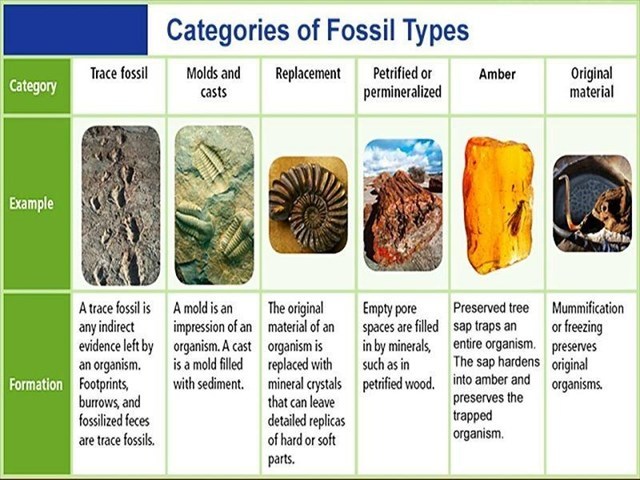
On EarthCache location, you can find not only nice example of sedimentary rock sandstone, but also nice examples of fossils. Well, they are anything that provides evidence of life in past ages. That evidence of life in past ages can come in two types. It can be either direct evidence or indirect evidence of past life:
Direct evidence of life are fossils of hard body parts of organisms. They can be fossilized bones or shells in case of animals. Or it can be fossilized wood or leaves in case of plants. In some cases, the entire organism can be fossilized, together with both soft and hard parts. Example of such fossils are insects trapped in amber or mammoths frozen in ice.
Indirect evidence of life are trace fossils. They are various footprints, trails, marks that were left by organisms and then fossilized. Coprolites is also one example of trace fossils. Another example of trace fossils are chemical fossils that represent organic compounds that survive in the form of oil, gas or bitumen.
Fossils in sandstone - In certain conditions, and over a very long period of time, sediment becomes compacted and cemented into sedimentary rock. Fossils are more common in some kinds of sedimentary rocks than others. There are many factors that can contribute to the likelihood of an organism being preserved as a fossil. Fossils are most common in limestones. That is because most limestones consist partly or mostly of the shells of organisms. Sometimes, however, the shells are worn so much that they look like sediment grains rather than "real" fossils. Fossils are also common in shales, which form from muds. Excellent imprint fossils can be formed in fine-grained sediments like muds. Only some shales contain fossils, however, because many areas of muddy ocean floor had conditions that were not suitable for animal life. In this case, only swimming or drifting organisms that die and fall into the mud have a chance to become fossilized. Although this does happen, it is a very rare occurrence. Some sandstones contain fossils as well. Most sandstones do not contain fossils, for various reasons. Water currents in the environment might have been too strong for animals to survive. Also, sands are very porous, so water seeping through the sand might have dissolved the shells away long before the sand was buried and changed into sandstone.

How to log this cache:
To log this cache, take a picture of church made from the sandstone at the coordinates. You also need to answer the following questions and answers send me to email in the profile:
1. By observing the sandstone on GC coords find at least one fossil. Describe the shape of fossil and report its measures.
2. What type of fossil according to way of formation can we observe on the coords in sandstone?
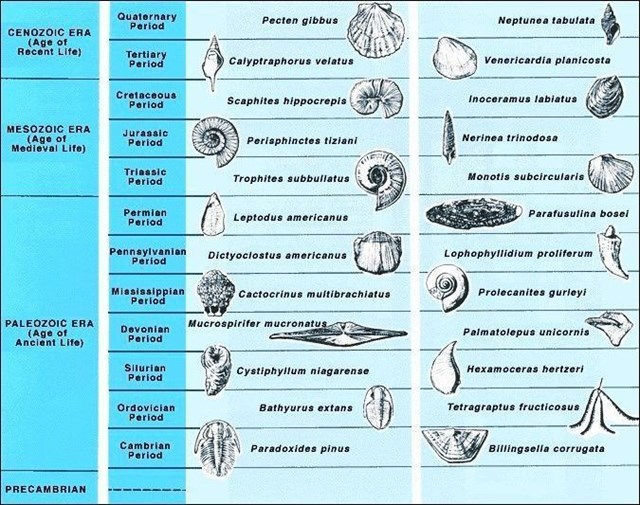
3. According the blue table in listing „Examples of index fossils“ write me the type of fossils you found in sandstone and Historical period.
4. By observing the fossils write me if this is direct evidence or indirect evidence of past life (explain your opinion)?
5. Can you find any other types of fossils here? Describe their shape?
6. Please post a photo of yourself, or GPS with the sandstone.
Feel free to log this cache. You do not need to wait for permission to log. If your answers are not correct, incomplete, I will contact you by e-mail. But if your e-mail is not coming to me within 3 days from your log, I will delete your log without notice.

Како пријавити ову кеш меморију:
Да бисте забележили овај кеш, сликајте споменик направљен од пешчара на координатама. Такође треба да одговорите на следећа питања и одговоре ми пошаљите на мејл у профилу:
1. Посматрањем пешчара на ГЦ координатама пронађите најмање један фосил. Опишите облик фосила и наведите његове мере.
2. Коју врсту фосила према начину формирања можемо уочити на координатама у пешчару?
3. Према плавој табели у листи „Примери индексних фосила“ напишите ми тип фосила које сте пронашли у пешчару и историјском периоду.
4. Посматрајући фосиле, напишите ми да ли је ово директан или индиректан доказ прошлих живота (објасните своје мишљење)?
5. Можете ли овде пронаћи неке друге врсте фосила? Опишите њихов облик?
6. Молимо вас да поставите своју фотографију или ГПС са пешчаром.
Слободно пријавите ову кеш меморију. Не морате да чекате дозволу за пријаву. Уколико Ваши одговори нису тачни, непотпуни, контактираћу Вас мејлом. Али ако ми ваша е-пошта не стигне у року од 3 дана од вашег дневника, избрисаћу ваш дневник без обавештења.
Used source: