Bangor War Memorial (Northern Ireland).
A decorated tapering obelisk of Portland Stone, situated on a stepped stone base set on the top of a grassy mound, with stone steps leading to it. The top of each face of the obelisk has runic/Celtic scrollwork. The upper section of the North-facing side of the obelisk has a bronze lion's head (representing the lion of victory) with elaborate collar, fasces and laurel leaves below. There is a raised inscription below the lion's head. On the lower section a bronze female figure of Erin (Ireland) looks upward bearing a palm frond upwards in one hand and a draped flag in the other. There is a plaque with further inscription below. The lower section of the South-facing side of the obelisk has a bronze shield, decorated with laurel and oak leaves. The names of the WWI dead are inscribed on the shield. On the lower section is a plaque with inscription. there are further plaques on both East and West faces. Located near to the obelisk is a U-Boat gun given to the town of Bangor, with an inscribed plaque. (WMR 9178 commemorating Commander Edward Barry Stewart Bingham VC).

Logging Requirements (Questions to Answer)
In order to log a find against this EarthCache, you will need to visit GZ and make some observations and then answer some questions and send answers to me via my Geocaching profile or through the Messenger Centre.
You won't need a magnifying glass or anything like that to complete the earthcache but if you have one, or ideally a hand lens or even a magnifying app on your smartphone, you'll be able to see the makeup of the rock and any fossils it includes in much greater detail.
Take a look at the stone the memorial is made of, in particular any visible fossils.
1. Describe the shell you see behind the blue square on the north face of the obelisk. What is it's shape and size.
2. Describe the shell you see behind the red square on the west face of the obelisk. What is it's shape and size.
3. Using the information you have gained from tasks 1 & 2. Which bed was the stone formed in?
4. What stage of the Jurassic period was the stone formed
5. Name a puplic building in Northern Ireland built with Portland Stone
6) Compulsory task: Include in your log a photograph of you, your GPS or another identifiable item near GZ, taking care not to include anything in the photo that may give away your answers.
Portland Stone.
Portland stone is a sedimentary rock formed in shallow, tropical seas during the Tithonian stage of the Jurassic period, roughly 150 million years ago, and is quarried on the Isle of Portland, Dorset. The quarries consist of beds of white-grey limestone separated by chert beds. It has been used extensively as a building stone throughout the British Isles and notably in major public buildings in Northern Ireland such as Belfast City Hall and Stormont Parliament Building.
The name Portland Stone refers to a family of closely related limestone variants with differing characteristics rather than a single, uniform rock type. In some types of Portland stone fossilised sea creatures are abundant while in other types fossils are virtually non-existent.
Portland Freestone is an oolitic limestone with variable shell content. To really appreciate the individual ooids they are best viewed through a hand lens or under some other form of magnfication, although if your eyesight is exceptionally good you might be able to make them out with the naked eye.
The Freestone Member
A freestone is a fine grained stone, typically sandstone or limestone, which can be cut easily in any direction without shattering or splitting, properties which make them particulary suitable for building and for carving.
The Portland Freestone Member forms the upper part of the Portland Limestone Formation and comprises four distinct beds, three of which are extensively used for these purposes:
Roach

The uppermost bed of the Portland Freestone Member is known as Portland Roach. This bed represents a shelly beach dominated by shell fossils. Many of the shells, being formed of aragonite, have been dissolved away by acidic groundwater, leaving behind an empty mould or cast of the shell which was once there.
Whitbed

The fossil content in Portland Whitbed can vary quite considerably, being described as shelly at one end of that spectrum and clean when shells are sparse. Fossil rich varieties tend to be heavy in calcite fossils such as shells of oysters and other bivalves as well as patches of the distinctive reef building alga Solenopora Portlandica.
Basebed

The Basebed is often considered to be the finest quality Portland Stone available.
Typically Basebed has a very clean, homogeneous texture with a negligible shell content making it eminently suitable for carving fine detail in deep relief. It is not quite as durable in exposed locations as Whitbed but makes an unbeatable monumental and carving stone for use on very many prestigious building projects.
Fossils
Fossils are any preserved remains, impression, or trace of any once-living thing from a past geological age. Examples include bones, shells, exoskeletons, stone imprints of animals, hair and petrified wood.
Fossils are found almost exclusively in sedimentary rocks because the sediments are laid down in such a way that they preserve the living organism's remains, or a cast or mould of its shape during lithification (the process of becoming rock).
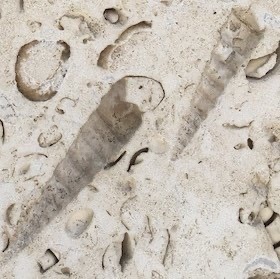
Gastropods - Aptyxiella portlandica - found almost exclusively in the roach and commonly known as portland screws because their spirals make them look a bit like screw threads. The shells of this particular gastropod were made of aragonite. Aragonite usually reverts back to calcite, the more stable polymorph of calcium carbonate, during the fossilisation process, unless lithification occurs relatively quickly in which case there is insufficient time to allow the conversion to take place and the aragonite remains in the rock.
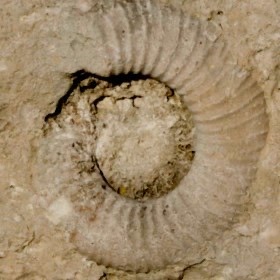
Cephalopods - Ammonites - just about the easiest fossilised sea creature to recognise thanks to their coiled shells. Many Ammonite fossils reveal the inner structure of the shell with its multiple chambers separated by walls known as septa with complicated frilled edges which scientists use to identify which particular type of ammonite they are looking at. The image to the right shows an external view of an ammonite fossil, displaying the numerous ridges on the shell, perpendicular to the shell walls.
Bivalves - Liostrea expansa - is a thick-shelled oyster of medium size that grew in a somewhat cup-shaped form. Although unremarkable in appearance, this oyster is quite striking in the Portland Freestone because, like other oysters, it has a shell of bluish calcite which has survived unaltered due to its robust construction of numerous fine calcite layers.
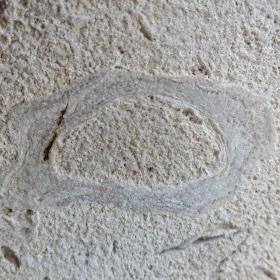
The image to the right shows a cross section through an oyster shell but large collections of shell fragments are quite common in the Whitbed, as shown in the Whitbed example further up this page and in the image at the top of the page.
Corals. Corals are solitary or colonial types with bilateral symmetry. They have a hollow in the top surface (calice) in which the polyp sits, together with numerous tabulae, septa (the major ones being arranged in groups of four), dissepiments and, in some, a central calcareous rod (columella).

Please use the below picture, to aid you in completing his EarthCache, and also for you to specifically look at the correct location.
