LOGGING REQUIREMENTS
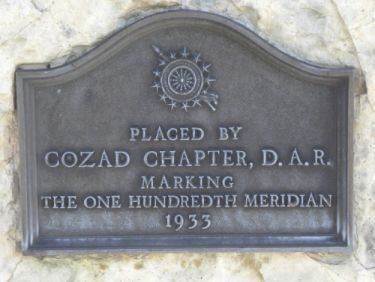
For this EarthCache, you will be visiting a piece of native limestone at the posted coordinates. You are looking for the limestone with this plaque on it from 1933, placed by the Daughters of the American Revolution.
In order to log this EarthCache, send me your answers to the following questions either through email or messaging from my profile page.
1: Describe any fossils you see in the limestone.
2: Based on the fossils you found, do you think this piece of limestone is from the Transgressive or Regressive layer?
3: Post a pic of you or a signature item with anything in the area that says 100th Meridian.
RECENT HISTORY and WHY HERE?
In 1879 John Wesley Powell, U.S. Army, in his report for the Geological Survey recognized the 100th Meridian as the natural demarcation line extending northward from the western shore of the Gulf of Mexico. Evaporation from the gulf waters supplies most of the rainfall east of the Meridian. West of the Meridian precipitation comes largely from the Pacific which is generally insufficient for the agricultural needs without irrigation. Here on the 100th Meridian, Humid East Meets Arid West.
The 100th longitudinal line west of Greenwich was the major goal set by Congress in building the first transcontinental railroad. Construction of the Union Pacific track reached the Meridian on October 5, 1866. To celebrate this record-breaking achievement against terrific odds, appropriate ceremonies were enacted on this ground on October 26, 1866. A “Great Excursion from Wall Street to the 100th Meridian” brought 250 notables including railroad and territorial officials, congressmen, financiers and newspaper men on the first passenger train to run west of the Missouri River. A large signboard proclaiming the “100th Meridian 247 Miles From Omaha” stood for many years close to the track on the Meridian but finally disappeared, and in 1933 was replaced on the original site with this monument of native stone by the Cozad Chapter of the D.A.R.
GEOLOGICAL HISTORY
300 million years ago, Nebraska was fully inundated by shallow seas leading to the deposition of distributed black shales and cyclothem deposits. At 290 million years ago, during the Cisuralian Epoch, limestones were deposited in Nebraska as sea levels fluctuated. Shale, limestone and sandstone mark the Permian rocks of this period along with gypsum and halite deposits that suggest rapid desiccation in an arid climate. Nebraska transitioned to terrestrial conditions by 275 million years ago, with limited marine activity, coal swamps and paleosols preserving the climate of the period. Stratigraphically, an unconformity occurs around 260 Ma, indicating terrestrial erosion conditions.
Lithology (kind of rock) and Morphology (body structure) of Fossils
Geologists who have worked in the late Pennsylvanian and early Permian strata that are exposed throughout the mid-continent have observed that rock sequences are often repetitious. They have attached the name cyclothem to these kinds of deposits. R. C. Moore in Kansas, T. Mylan Stout in Nebraska and Philip Heckel in Iowa have all worked with these rocks. Cyclothems are usually named for the thick, regressive limestone contained within them. The names for these units that Heckel proposed are used below. The limestone beds alternate with shale beds and these are called from bottom to top:
Nearshore shale
These may include continental deposits near the base and marine deposits near the top. This shows an encroaching sea. The invertebrate fossils found in this unit are large and have thick, ornamented shells.
Transgressive limestone
This unit is a thin, dense limestone that was deposited nearer the shore toward its base and farther offshore near its top. The fossils found near the top of the transgressive limestone are usually small and have thin shells, suggesting they lived in deep, cold water. The richest fossil populations are often found at the contact between the transgressive limestone below and the offshore shale above.
Offshore shale
The offshore shale is usually a dark gray near its base and it grades upward into a black, fissile shale. It was deposited in deep, poorly oxygenated water and there was insufficient sunlight to algae to produce carbonates for limestone. The fossils in the dark gray shale are small and have thin, unornamented shells. The black shale usually contains few fossils that mostly of organisms that sunk to the substrate when they died. These fossils include abundant microscopic conodonts and some spectacular fish remains.
Regressive Limestone
The regressive limestone is very similar in lithology and fossil to the transgressive limestone near its base as the water column was still deep and cold as the sea withdrew. The limestone becomes less dense and more coarsely crystalline nearer the top and the fossils are larger, have thicker shells and more ornamentation that suggests they lived in warmer, shallower water.
references
https://snr.unl.edu/
https://en.wikipedia.org/
https://history.nebraska.gov/
I have earned GSA's highest level:
 |