To log a find on this EarthCache please head to the listed coordinates and complete the tasks below. Send the answer to your questions via the message center/email to The Cachekeepers. If you don't complete the tasks your find will be deleted.
1. Look at the stones and material forming the soil around the gateway at the listed coordinates. Describe the size, shape and colour of the material.
2. Based on your observations and what you have learned from the cache page description, explain what rock type you think is exposed here.
3. Looking through the gateway, how would you describe the surrounding landscape in comparison to where you are standing? Why do you think it looks this way?
4. Please take a photo of yourself, or a personal items, with the view from the gateway that shows the landscape to the north of The Ridgeway.
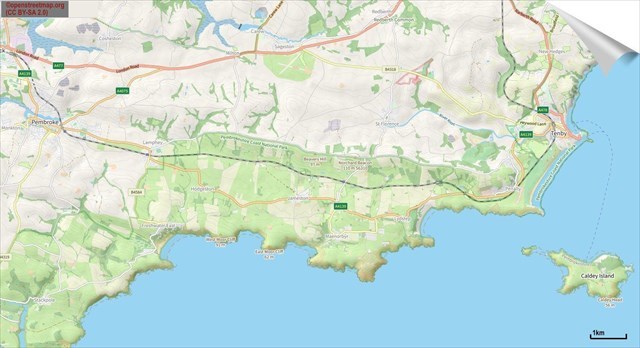
Map showing the Ridgeway
The Ridgeway is a band of higher land running from Penally towards Pembroke. This prominent ridge forms a significant landscape feature. In earlier times this would have formed a busy highway for travellers and drovers to and from the local ports.
The highest point of The Ridgeway is 108m above sea level. It is marked by a triangulation point (trig point) that stands on top of the road bank. This point, also called Norchard Beacon is marked as a waypoint. At this point The Ridgeway boasts views 50+ metres above the surrounding land.
The Ridgeway is made up of Old Red Sandstone. Either side of the Ridgeway, lie bands of Carboniferous Limestone.
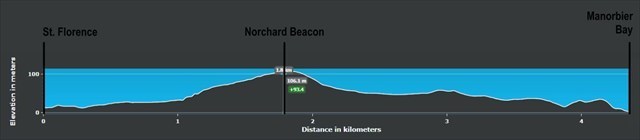
Cross-section of landscape from St. Florence to Manorbier
As you make your way along The Ridgeway towards Norchard Beacon, you will be able to spot the rich red soils in gateways and fields. These red soils are the results of The Old Red Sandstone bedrock eroding. These red soils can also often be found in UK supermarkets, on unwashed Pembrokeshire new potatoes. Samples of broken Old Red Sandstone can be found beside the road. The Pierhead building in Cardiff is an example of this sandstone being used as a building material.
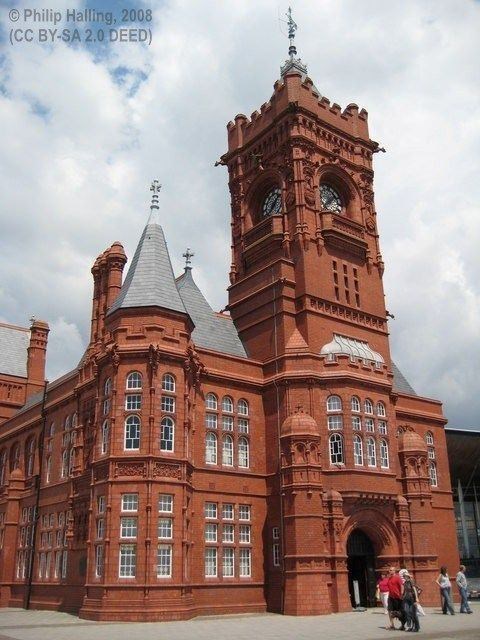
Pierhead Building, Cardiff Bay
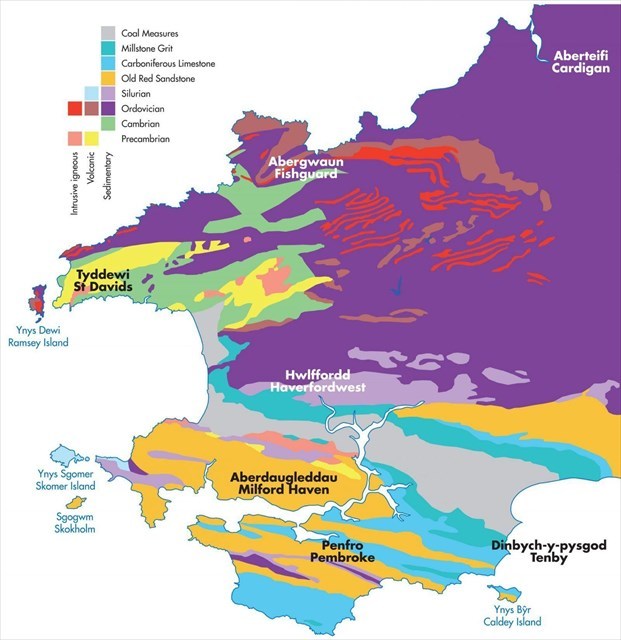
Geological map of Pembrokeshire
As can be seen on the geological map above, in South Pembrokeshire there are bands of different types of rock lying South-East to North-West.
Old Red Sandstone has distinct properties and is made up from sedimentary rocks. Sedimentry rocks form at, or near the earth’s surface. They result from the weathering and erosion of pre-existing rocks. Weathering is the physical breakup of rocks by rainfall and temperatue changes. Erosion is the transportation of the sediment, which wears away other rock surfaces as it is carried by moving water and wind. The weathered and eroded rocks produce grains of different sizes, such as, sand, silt, minerals and clay. These sediments, over thousands of years then become compacted (usually by the vast weight of the sea above them). So much so that they solidify.
Old Red Sandstone was formed during the Silurian and Devonian ages which were approximately 427-358 million years ago. At this time, the British Isles were situated at a latitude of 15-30 degrees south of the equator, as opposed to the 50+ degrees north of the equator it is at present. Sedimentary rocks often exhibit layers which result from the different periods of layering over time. They can give an idea of the earth during each layer. The Old Red Sandstone (as do other sedimentary rocks) preserves in its fossils evidence of plants, fish and amphibians. Showing that it was once probably laying below the sea. As it weathers it breaks up into relatively large, sand-like grains (from 0.062mm - 2mm in size).
The red colour arises from the presence of iron oxide. However, not all Old Red Sandstone is red. The colours can range from grey and green, to red and purple.
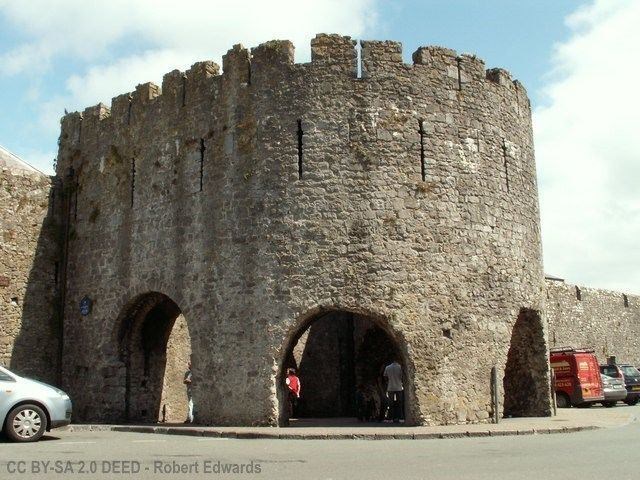
The Five Arches, Tenby
The surrounding Carboniferous Limestone is light grey in colour on its weathered surface. Tenby's town walls and many of the surrounding castles have been built from Carboniferous Limestone.
It is a sedimentary rock made largely of calcium carbonate from the shells and hard parts of sea creatures in those warm equatorial waters millions of years ago. Although considered a relatively hard rock, it forms with distinct hortizontal layers and vertical joints that allow water to pass through. That water can, over time wash away the rock. This means that caves often form in Carboniferous Limestone (Like Hoyle's Mouth cave, Penally). It weathers down to far smaller grains than the Old Red Sandstone, (approximately 0.004mm) creating a silty/clay soil.
Both Old Red Sandstone and Carboniferous Limestone, also make up half each of both Caldey Island and St. Catherine's Island near Tenby.
Since the formation of the rocks all that time ago, the movement of tectonic plates (land masses) resulted in the sedimentary bed layers folding, tilting, faulting and shattering. This formed different geological features, including ridges and valleys.
The Ridgeway, being made up of Old Red Sandstone, has over millions of years resisted weathering and erosion better than the Carboniferous Limestone rocks which lie either side. There are many factors affecting erosion speed between rocks and is dependent on the actual composition of the different rocks found locally. The estimated rate of erosion of The Ridgeway's Old Red Sandstone is generally less than 1 cm a year. Whereas, its limestone neighbour erodes at approximately 1 cm a year. This might not sound like a great difference in speed, but measured over millions of years it all adds up.
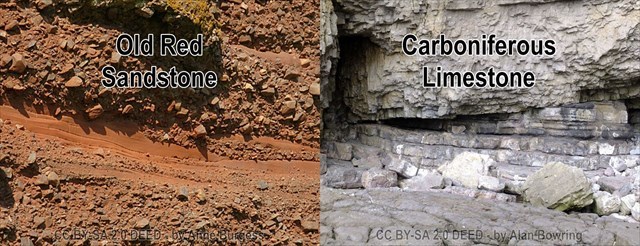
Comparison of Old Red Sandstone and Carboniferous Limestone
A joint FTF in stunning weather by JessPack4, GratYag87 & NorseTyr