Required Questions and Photograph:
Waypoint A: (N40° 18.306’ W079° 59.797’)
Question 1: Using the information from the reading below and observing the rain garden and porous parking lot at the above waypoint, is this helping with stormwater remediation? Does the rain garden and the parking lot help preserve the nearby hill, that goes down to the track below and if so, how?
Waypoint B: (N40° 18.182’ W079 59.806’)
Question 2: You should be standing on the edge of the driveway, looking down into an open field. Looking down the hill from the parking lot, what is happening here? Without any controls being put in place, will conditions in the runoff area improve any or will they get worse as time goes by?
Question 3: In your opinion was the money that was spent to put in the parking lot and rain gardens at waypoint A worth it when looking at what is happening at waypoint B?
Photo Requirement: At the listed coordinates, you will see a sign that the county has put up. You must post a picture with a sign with your caching name on it and the sign in the background. You do not need to include your face in this picture. This picture must be on your log!
All answers to the above questions must be sent to me via either the messenger system or through the website’s email system. If I do not receive your answers within 72 hours, I will delete your find. If you are sending in the answers for a group, you MUST list all members of the group. If someone is not listed in your group and they log this cache, they will need to send me their own answers or their find will be deleted. NO EXCEPTIONS!
Terminology:
These are the key terms that you will be learning about by reading up and doing this EarthCache.
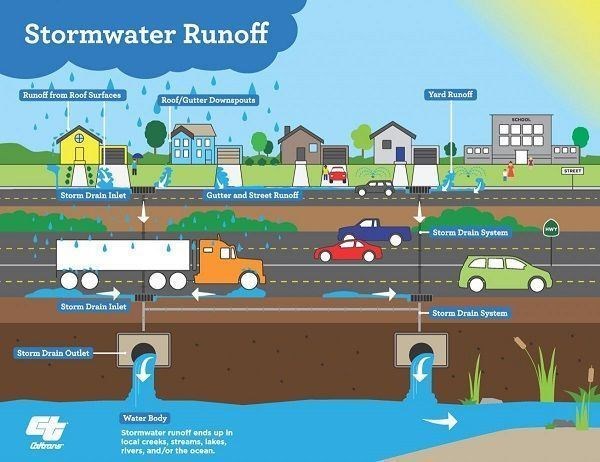
Stormwater: This is water from rain and snowstorms that flows over streets, parking lots, and roofs that does not soak into the ground but flows directly into a water body or a storm drain. Stormwater runoff is often worsened by activities that are caused by humans. Stormwater runoff can contain nitrogen and phosphorous pollutants from fertilizers, pets, and yard waste.
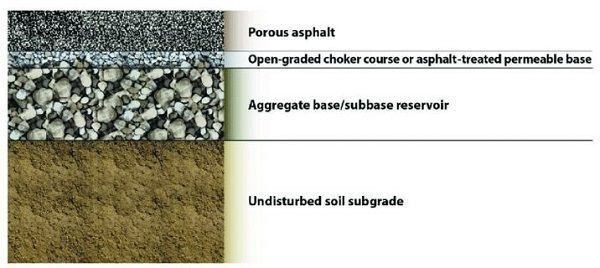
Porous/Permeable Pavement: This type of pavement is constructed in a way that allows water to flow into the surface easily because the material used in the pavement is not tightly compressed together. These pavements allow for stormwater to infiltrate into the ground and as the water flows through the ground, it goes through different types of soils that will remove pollutants and impurities from the water, allowing a clean water to re-enter the water system when it finishes going through the soils.
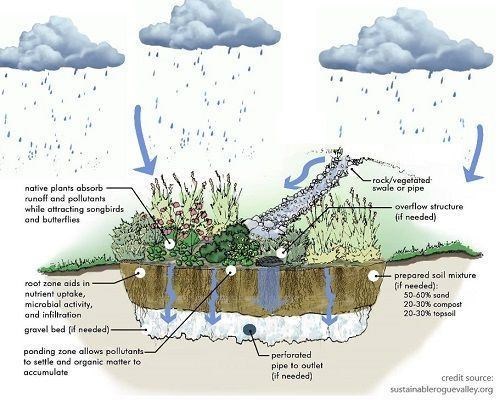
Rain Gardens: A rain garden is a depressed area in the landscaping that collects rain and snowmelt from roofs, roads, and parking lots. These areas allow for the stormwater to soak into the ground at a much slower rate. Rain gardens also help with filtering out pollutants that are collected from stormwater runoff.
South Park Oval’s Green Parking Lot:
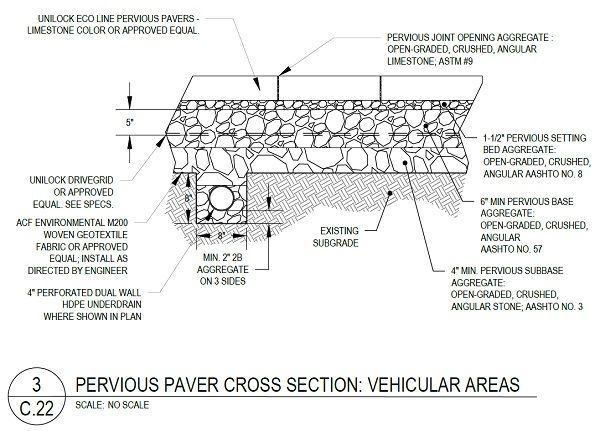
Constructed in 2021, South Park Oval’s Green Parking Lot was constructed to help with stormwater remediation. The old blacktop parking lot that was here before sent stormwater directly into nearby Catfish Run. The new parking lot is now a complex system that contains pervious pavers for the parking surface and rain gardens in strategic areas that will take stormwater from the nearby hills and from Brownsville Road that runs along the length of the parking lot and filters the stormwater down into the ground in a way that can help reduce environmental concerns. When walking through the parking lot and along the walkways, one just needs to look down and see that this new area is designed to help the local environment. With different spacing between each of the pavers and small pieces of crushed up limestone as filler, water is now able to be absorbed into the ground while not running directly off. As stormwater filters through the various layers of material pollutants and impurities being removed, cleaning the stormwater. If there is too much precipitation falling or coming off the nearby hills and road at one time, water is guided to the different rain gardens that you see around the parking lot. Water will gather in these rain gardens and slowly be absorbed into the ground, going through the same processes that the water goes through from the parking lot. The diagram below, obtained from the architect of this project, shows the many different layers the stormwater will travel through as it gets absorbed back into the ground.
When you walk over to waypoint B, you will see a completely different situation taking place. Here, you will see that stormwater would flow freely downhill over the non-porous blacktop roadway. At the end of the blacktop, the runoff is directed towards Catfish Run. There is less time for runoff (and contaminants like oil and gas) to be absorbed into the ground, and the runoff goes directly into the stream.
To get a better understanding between the porous parking lot and the rest of the pavement in the area let me demonstrate for you what I am talking about. With me, I brought two bottles of water.
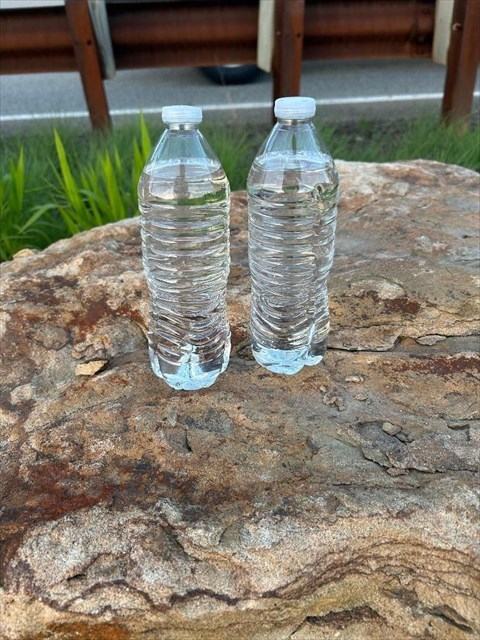
I took one of the bottles of water and emptied it on the porous parking lot. Notice in the picture how the water did not run across the parking lot but instead was absorbed into the ground.
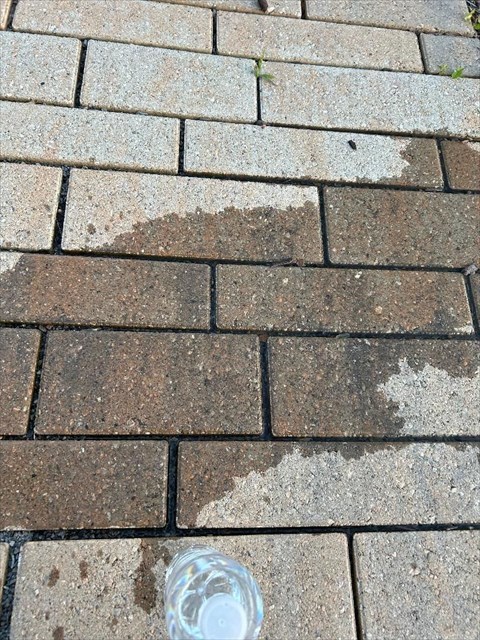
I then went over to regular pavement that is close to Waypoint B. I emptied the second bottle of water on the ground. Notice in this picture, how the water ran across the parking lot and not get absorbed into the ground as easily.
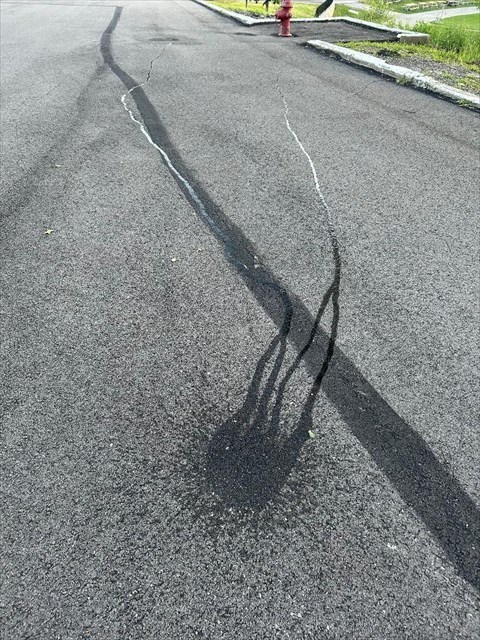
Now, imagine this happening during a rain or thunderstorm. All that stormwater falling on the porous parking lot, slowly absorbing into the ground, where just 100 to 200 feet away in the parking lot across Brownsville Road or down by Waypoint B or anywhere else, and that water is just flowing towards the area of less resistance and not being able to enter the ground in a easier fashion.
If you want to see this first hand, bring along a couple of bottles of water with you and perform this experiment at the porous parking lot and then anywhere that you have the regular pavement. And if you come to do this EarthCache on a rainy day, you will really get to see the difference between both areas.
Credits:
Stormwater Photo: https://www.cccleanwater.org/community/watersheds/what-is-stormwater
Porous Pavement Photo: https://www.researchgate.net/figure/Typical-porous-asphalt-system-cross-section_fig8_323075139
Rain Garden Photo: https://www.thebeatnews.org/BeatTeam/rain-gardens/
Terminology: https://www.epa.gov/green-infrastructure/what-green-infrastructure
Pervious Paver Cross Section Diagram: Permission granted by Damon Weiss, Principal of Ethos Collaborative