Hyaloklastite
Yes, in this place, where you are standing, was a sea shore and a lava stream flowed directly into it from the north. A few stones remained here after him, and we will talk about them now.
When hot lava comes into contact with water, the water immediately evaporates and the lava solidifies. However, it solidifies so quickly that the ions in the melt do not have time to move to the "correct places" and crystallize, instead an amorphous, glass-like mass is formed. In addition, the decrease in temperature results in a decrease in the total volume of the lava, so it disintegrates into fragments of various sizes and shapes.
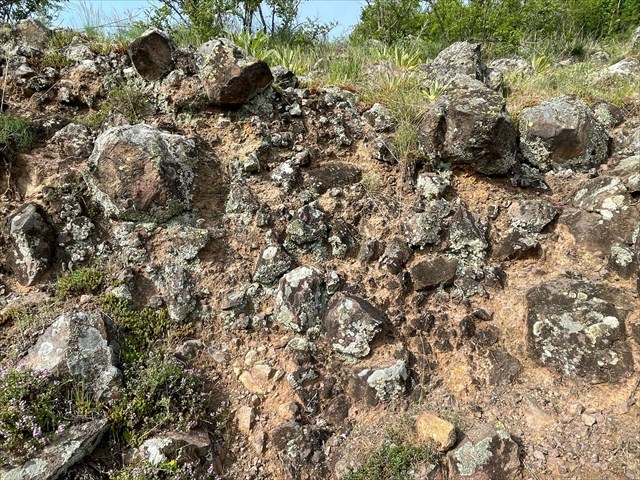
Lava breccia in the Horša valley.
This rock is called hyaloclastite, from the Greek hyalus (glass) + klastos (fragment) and is classified as a volcanic glass. Individual fragments have different sizes and shapes. In contrast to classic glass, the mass is almost opaque, only on fresh (unweathered) surfaces it retains glass luster.
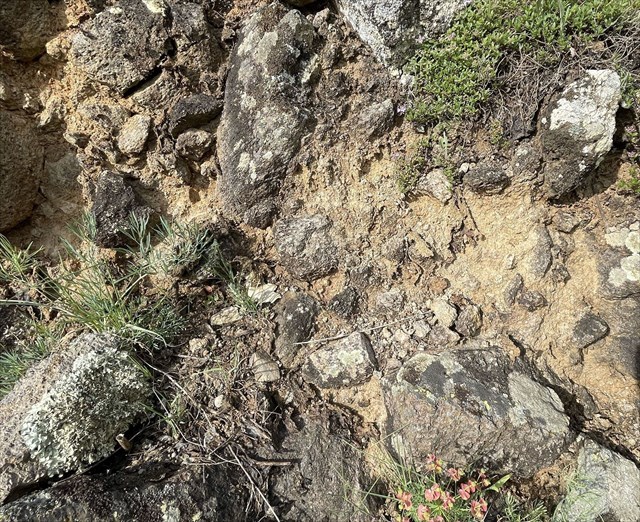
Spaces (matrix) between hyaloclastite fragments is filled by palagonite.
The spaces between the fragments is filled by a fine-grained material called palagonite. It is also a type of volcanic glass - a light (yellow) colored, fine grained rock, which is created by the reaction of water vapor and small fragments of lava.
Baďan formation
Hyaloclastites in the Horša valley were created by the contact of lava with seawater. The crater, which was the source of the lava, was located somewhere around the village of Baďan, and the whole formation is named after the village as Baďan formation. The formation extends on the southern slopes of Štiavnické vrchy mountains, from Hronský Beňadik, along the river Hron to the village of the Ipeľský Sokolec. On the east side it is bordered by the line Dudince - Ladzany and on the north by the Baďan and Pukanec line.
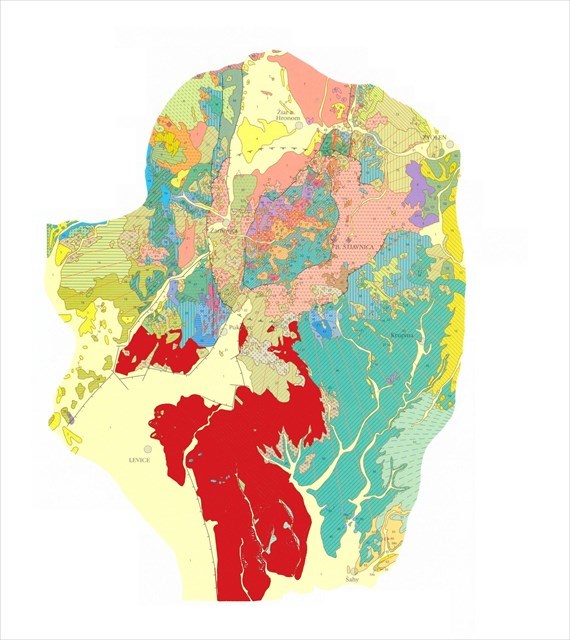
Geological map of the Štiavnické vrchy mountains with Baďan formation marked by red color.
In the northern parts of the formation, on the slopes of the volcano, prevails lava flows with a thickness of 15-25 m. Towards the south, as the lavas reached the foothills and flat relief, they accumulate and form a lava plateau with an area of about 100 km2. In the vicinity of the villages of Krškany, Žemberovce, Pečenice and Ladzany, volcanic products came into direct contact with the marine environment, and in several places there are positions of hyaloclastites, or secondary displaced fragments of andesites and volcanic ash (epiclastics).
The rock composition of the formation is dominated by andesites, their age is estimated at 12.9 to 12.0 million years.
Indonesia in the central Europe
Baďan formation is only one of the episodes in the long history of volcanic activity in central Slovakia in the Tertiary. She left here mountain ranges as Kremnické and Štiavnické vrchy, Vtáčnik, Poľana, Javorie and Krupinská planina; in the south of Slovakia Cerová vchovina and in the east Vihorlat, Slanské and Zemplínske hills. The climate at that time was warmer than today, and a chain of active volcanoes on the coast of shallow, warm subtropical seas resembles today's Southeast Asia - Indonesia, or the Philippines.
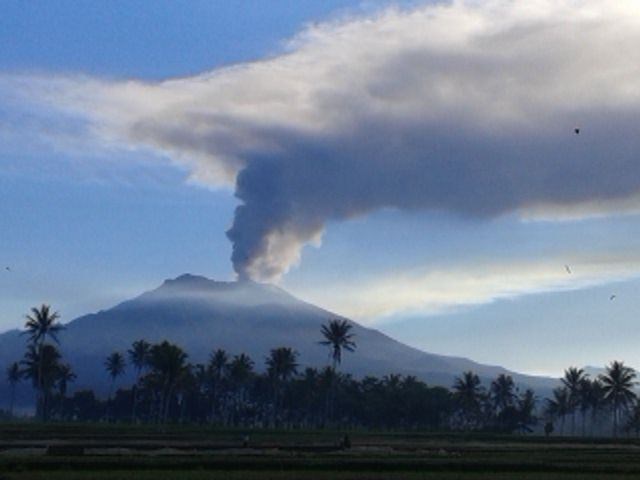
The eruption of the Raung volcano in Indonesia. The situation is similar to the Slovakia territory in the Tertiary - tropical islands and a chain of active volcanoes.
The Štiavnica stratovolcano stands out from the volcanoes that erupted lava and ash at that time. This volcano was the largest in the wide-far vicinity. A surface area was approximately 2000 km2 and the height of the volcano was about 4 kilometers. Its development was complicated, and the total time it was active is estimated at six million years (from 16.5 to 7 million years ago).