


click
on the flag to reach the translation
Orari
:
Aperto venerdì, sabato e lunedì dalle 10:00 alle
17:00 e domenica dalle 13:00 alle 17:00.
Chiuso martedì, mercoledì e giovedì, 1
gennaio, Pasqua, 1 maggio, 15 agosto, 25 dicembre.
La messa della domenica
mattina è a ingresso libero
Schedules
:
Open Friday, Saturday and Monday from 10:00 a.m. to 5:00 p.m. and
Sunday from 1:00 p.m. to 5:00 p.m.
Closed Tuesday, Wednesday and Thursday, January 1, Easter, May 1,
August 15, December 25.
Admission is free for
mass on Sunday morning
Horaires
: Ouvert le vendredi, samedi et lundi de 10h00 à 17h00 et le
dimanche de 13h00 à 17h00.
Fermé le mardi, mercredi et jeudi, 1er janvier,
Pâques, 1er mai, 15 août, 25 décembre.
L'entrée est
libre pour la messe le dimanche matin
Una
Earthcache
Questa non è una cache fisica. Per
accedere a questa cache, devi prima leggere la sua descrizione
didattica della geologia, quindi osservare il sito in cui ti trovi e
infine rispondere alle domande che verranno poste. Un livello di
difficoltà Earthcache più alto
richiederà risposte più avanzate.
Potrai quindi accedere a "Trovato" senza aspettare, ma devi inviarmi
contemporaneamente le tue risposte contattandomi tramite e-mail nel mio
profilo o tramite la messaggistica di geocaching.com (Centro messaggi),
e io ti contatterò in caso di problemi. I log registrati
senza risposte o senza foto verranno eliminati.

Introduzione:
Informazioni sul marmo
In geologia il marmo è una roccia metamorfica derivata dal
calcare e costituita principalmente da cristalli di calcite. In
architettura, scultura e lavorazione del marmo questo termine
può designare qualsiasi pietra (pietra di marmo) difficile
da tagliare e capace di prendere una bella lucidatura, i più
comuni dei quali sono i marmi “veri” (in senso
geologico).
I marmi geologici presentano una grande diversità di colori,
sebbene il colore base della calcite sia il bianco. Qui si trovano
spesso vene chiamate marmorizzazioni. Le venature ed i colori sono
generalmente dovuti ad inclusioni di ossidi metallici. Alcuni tipi di
marmo hanno nomi particolari, come vedremo in seguito.
Per gli scienziati il
marmo è una roccia
metamorfica
derivata da calcare o dolomite sedimentaria essendo stata
generalmente
trasformata mediante metamorfismo regionale o più raramente
mediante metamorfismo di contatto. In questo processo di trasformazione
della roccia originaria, le strutture sedimentarie vengono cancellate e
la roccia carbonatica si ricristallizza in una massa di cristalli di
calcite e/o dolomite intrecciati di dimensioni millimetriche e
centimetriche. Le intercalazioni di argilla, minerali detritici o
ossidi minerali presenti nel carbonato originario conferiscono poi al
marmo varie colorazioni e venature policrome di grande effetto estetico.
Negli studi archeologici e storico-artistici rientrano tra i
“marmi” anche altre rocce che non sono dal punto di
vista geologico e chimico, come i graniti e i porfidi, le dioriti, i
basalti (tutti di origine magmatica o vulcanica), gli alabastri (di
origine chimica sedimentaria origine) o calcari particolarmente duri ma
che non hanno subito un processo di ricristallizzazione (detti anche
“pietre di marmo”).
Dalla
roccia al marmo
La maggior parte dei marmi sono rocce calcaree o di origine calcarea.
Il diagramma in Figura 1 descrive la modalità di formazione
del calcare sul fondo del mare, quindi il modo in cui esso
può essere coinvolto nella formazione di una catena
montuosa. Il calcare si forma sul fondo del mare in condizioni di basse
temperature e pressioni (a).
Nella crosta terrestre, più si scende in
profondità, più aumentano la temperatura e la
pressione. Il fenomeno è amplificato all’interno
di una catena montuosa. I calcari formati sulla superficie e sepolti
subiscono temperature e pressioni più elevate quanto
più profondamente vengono trasportati nella crosta
terrestre. Successivamente si deformano più o meno, i loro
minerali si trasformano, i loro colori possono evolversi e i disegni
della roccia riflettono le pressioni applicate.
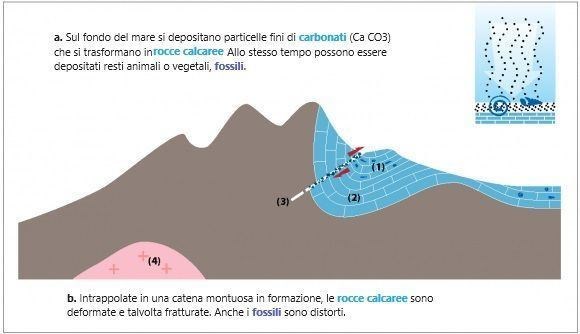
Figura 1 :
Schema di una catena montuosa con ubicazione di diversi tipi di marmo;
a.
Formazione di una roccia calcarea
b.
Formazione di una catena montuosa: (1) calcari debolmente deformati
detti “epimetamorfici”, (2) calcari fortemente
deformati marmi in senso stretto, (3) calcari fratturati e brecce
associate, (4) rocce parzialmente fuse e ricristallizzate in granito
A profondità basse (fig. 1b (1)), i minerali
possono ricristallizzarsi debolmente. I cristalli di rocca sono
invisibili a occhio nudo, i colori sono intensi e i disegni precisi.
Allo stesso tempo, la struttura della roccia può cambiare a
causa della pressione. Otteniamo un marmo cosiddetto
“epimetamorfico”. È questa leggera
“ricottura” che conferisce alla roccia, tra le
altre caratteristiche, la sua compattezza e la sua idoneità
alla lucidatura.
A profondità maggiori (fig. 1b (2)), temperature di
diverse centinaia di gradi e pressioni elevate provocano la
ricristallizzazione in grandi cristalli visibili ad occhio nudo. Le
rocce sono bianche o hanno sfumature fuse in arabeschi ed i disegni non
sono molto precisi. La nuova roccia è un marmo nel senso dei
geologi. È il caso del marmo (fig. 2b).
Durante la genesi di una montagna, le alte pressioni possono fratturare
le rocce e causare movimenti del terreno su entrambi i lati delle
fratture. Durante questi movimenti, nella zona di frattura, la roccia
viene frantumata in frammenti di varie dimensioni (fig. 1b (3), fig.
2c). Nello spazio lasciato libero tra i frammenti può
circolare acqua ricca di minerali disciolti e depositare cristalli che
cementano i frammenti di roccia. Si crea così una nuova
roccia chiamata breccia di faglia.
Più in profondità la temperatura raggiunge il
punto di fusione delle rocce (fig.1b (4)). Quando il terreno si solleva
e si raffredda, si forma una nuova roccia: come il granito (fig.2d).
Quando le rocce superficiali della catena montuosa vengono distrutte
dall'erosione, gradualmente, sono le rocce formatesi in
profondità ad affiorare e diventare. accessibile agli esseri
umani.
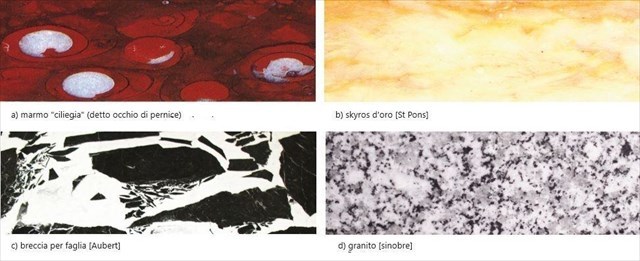
Figura 2
: esempi
di marmi così formati
Alcune
differenziazioni dei marmi
♦ La struttura
“marmorizzata” della roccia
Individuare un marmo è difficile perché non
è una roccia perfettamente omogenea. Esistono migliaia di
carriere sul pianeta e in ogni carriera puoi trovare strutture
"marmorizzate" totalmente diverse in associazione ai colori.
La struttura visibile della roccia può essere descritta come
segue (vedi foto per esempi):
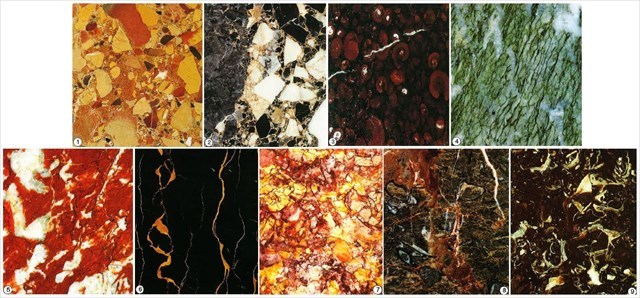
- Le brecce
sono rocce costituite da elementi spigolosi, spesso di vario colore e
cementate da calcite. Esempio: la breccia di Aleppo(1) o la breccia di
Baixas(2).
- Le amarene
sono delle brecce molto particolari, derivanti dallo scoppio di banchi
calcarei che conferiscono loro una struttura nodulare. Esempio: la
rossa Morello (3) e la verde Campan (4).
- Le concrezioni
sono marmi con grandi macchie bianche su fondo rosso. Esempio: Turquin
Incarnato(5).
- I marmi venati
presentano venature varie su un fondo uniforme ma il cui disegno
presenta una certa irregolarità. Esempio: Porto(6).
- I broccatelli
sono agglomerati di conchiglie in frammenti appena
riconoscibili. Esempio: Broccatello viola (7).
- Lumachelle
o conchiglie, in cui sono presenti in abbondanza conchiglie
identificabili. Esempio: Lumachelle de Lourdes(8) e Coquillé
de Bilbao(9).
- I marmi
monocolore compatti sono praticamente limitati al bianco e
nero. Esempio: il nero Mazy, molto utilizzato per gli orologi nel XIX
secolo, e il bianco Carrara.
- I marmi
cristallini saccaroidi sono marmi bianchi, come Paros in
Grecia, Carrara in Italia o Saint Béat nei Pirenei.
♦ Bonus: Marmi
"antichi"
Tradizionalmente si parla di “marmi antichi” in
contrapposizione a “marmi moderni”, a seconda
dell'origine greco-romana o meno delle cave da cui venivano estratti. I
marmi antichi sono di composizione molto varia, comprendono anche rocce
silicatiche. I marmi moderni, quelli utilizzati fin dal Rinascimento,
si riferiscono essenzialmente a rocce calcaree (metamorfiche e non).
I Romani, che condividevano la passione per questo materiale,
sistematizzarono le ricerche e svilupparono tecniche di estrazione e
trasformazione. Il marmo era allora uno dei tesori riportati dai
generali vittoriosi dalle province appena conquistate, insieme a
metalli preziosi, spezie e schiavi. L'aura di prestigio,
esclusività e lusso non abbandona più questo
materiale che è illustrato nelle più
significative realizzazioni architettoniche e artistiche della storia
umana.
Iniziò poi l'importazione di alcune varietà di
marmi colorati, tra i più diffusi, “giallo
antico” (1), “africano” (2),
“frigia” (3), “cipolin” (4),
che furono utilizzato, prima in frammenti inseriti in mosaici, e poi in
grandi lastre, per rivestire pareti e pavimenti degli interni di ricche
residenze patrizie.
Nell'osservazione che farai, potrai osservare anche altre biglie
colorate.
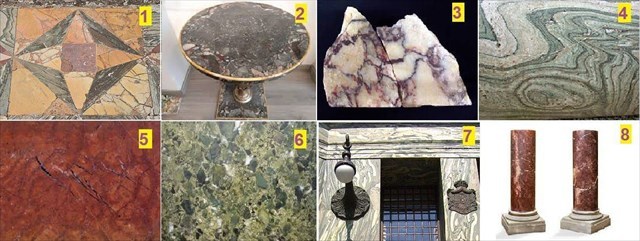
- Marmo giallo antico: È un marmo di colore giallo
uniforme, che varia dal giallo intenso a tonalità
più chiare, quasi bianche, con venature giallo scuro, oppure
rossastre o brune, e clasti angolosi di dimensioni e colori variabili
(toni di giallo, rosso, Marrone rossastro).
- Marmo africano: È un marmo brecciato con fondo
scuro, generalmente nero, e clasti di dimensioni variabili, di colore
biancastro e sfumature rosate, oppure rosso, o anche nero e grigio.
Esiste una varietà a fondo verde scuro (“verde
africano”) oppure a fondo grigio venato di macchie bianche e
rossastre (“grigio africano”).
- Marmo Pavonazzetto o marmo figio, detto anche frigio:
è un marmo micritico brecciato a grana molto fine. Il suo
colore di fondo bianco o avorio con macchie e venature di colore
variabile rosso, violaceo, verde o azzurro, ricorda il colore del
pavone:
- Marmo Cipolin: Si tratta di un marmo dal fondo
bianco-verde, percorso da fitte venature ondulate di colore verde,
tendente al bluastro e attraversate da spessi strati di mica.
- Marmo rosso antico: È un marmo ematite impuro,
con un fondo che va dal rosso scuro al rosso vivo, venato di nero con
alcune macchie o piccole venature bianche di calcite.
- Marmo verde antico: È un marmo serpentino dal
colore di fondo verde chiaro con macchie di un verde più
scuro, a volte quasi nero, misto a macchie bianche
- Marmo breccia vergine o seme santo o breccia Sciro: Roccia
sedimentaria, una breccia a grana fine dal colore malva con inclusioni
bianche, rosse, fulve e giallastre che risaltano nettamente una accanto
all'altra
- Marmo breccia rossa o breccia corallina: Si tratta di una
breccia calcarea con ematite, con cemento rosso corallo e frammento
color avorio

Domande
Un'attenta lettura della descrizione della cache,
così
come l'osservazione delle caratteristiche del terreno e una piccola
deduzione sono normalmente sufficienti per rispondere alle domande in
questa EarthCache. I log registrati senza risposte o senza foto
verranno eliminati. Un livello di difficoltà Earthcache
più alto richiederà risposte più
avanzate.
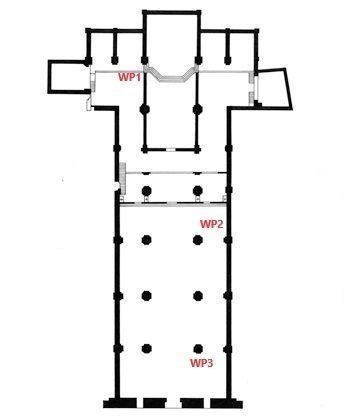
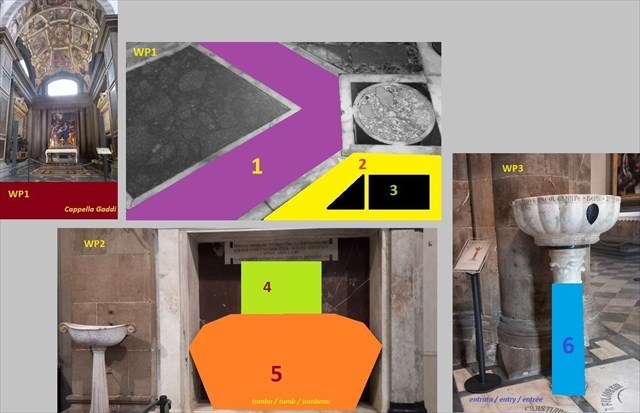
Domanda
0 - Scatta una
foto di te, o del tuo oggetto geocacher distintivo, o del tuo nickname
scritto su un foglio di carta o che hai in mano... in
basilica, e allegala al tuo log o alle tue risposte
Osserva ogni area
numerata da 1 a 6 sulle foto dei 3 waypoint.
Domanda
1 - Descrivi il marmo in ogni area - forma,
contorno (preciso?), colore (intenso?), consistenza (fusa?), cristallo
(visibile?)....- quindi specifica la struttura marmorizzata della
roccia (vedi descrizione del cache).
Domanda 2
- Spiega con parole tue come la profondità di formazione del
marmo, durante la formazione di una catena montuosa, ne
modificherà la struttura “marmorizzata”.
Fare riferimento alla
parte associata della descrizione.
Domanda 3 - Raggruppare i marmi
qui osservati secondo la stessa struttura "marmorizzata" (esempio:
concrezioni da un lato, brecciati dall'altro, ecc.) quindi ordinarli
secondo la loro profondità di formazione (da bassa ad alta
profondità, esempio: i marmi formati a le maggiori
profondità sono...).
Domanda 4 -
(facoltativo) Tra questi marmi, quali possono essere associati ai marmi
"antichi"?
An
Earthcache
It is not a physical cache. To log this cache, you
must first
learn about its educational description in geology, then observe the
site on which you are, and finally answer the questions that will be
asked. A higher difficulty rating of the earthcache will require more
advanced answers.
You can then log in "Found it" without waiting but you must send me
your answers at the same time by contacting me either by mail in my
profile, or via the messaging geocaching.com (Message Center), and I
will contact you in case of problem. Saved logs without answers nor
photo will be deleted.
Introduction
: about marble
In geology,
marble is a metamorphic rock derived from limestone and composed mainly
of calcite crystals. In architecture, sculpture and marbling, this term
can refer to any stone (marble stone) that is difficult to carve and
capable of taking on a beautiful polish, the most common of which are
the “real” marbles (geological).
The marbles of geology have a wide variety of colours, although the
basic colour of calcite is white. Veins called marbling are frequently
found there. Veins and colours are usually due to inclusions of metal
oxides. Some types of marble have particular names, as we will see
later.
For scientists, marble
is a metamorphic rock derived from a limestone
or sedimentary dolomite that has been transformed generally by regional
metamorphism or more rarely by contact metamorphism. In this process of
transformation of the original rock, the sedimentary structures are
erased and the carbonate rock recrystallized into a cluster of calcite
and/or dolomite crystals engrained from millimeter to centimetric
dimensions. The clay intercalations, detritus minerals or mineral
oxides present in the original carbonate give to the marble
various colorations and polychrome veins of the greatest aesthetic
effect.
In archaeological and art history studies are included, among the
"marbles", other rocks which are not geological and chemical, such as
granites and porphyry, diorites, basalt (all of magmatic or volcanic
origin), alabaster (of chemical sedimentary origin) or calcareous
particularly hard but not having undergone a process of
re-crystallization (also called "marble stones").
From
rock to marble
The majority of marbles are limestone rocks or of limestone origin. The
diagram in figure 1 describes the mode of formation of limestone at the
bottom of the sea, then the way in which it can be involved in the
formation of a mountain range. A limestone forms at the bottom of the
sea under conditions of low temperatures and pressures (a).
In the earth's crust, the deeper you go, the more the temperature and
the pressure increase. The phenomenon is amplified inside a mountain
range. The limestones formed on the surface and buried undergo
temperatures and pressures all the higher as they are drawn deeper into
the earth's crust. They are then more or less deformed, their minerals
are transformed, their colors can evolve and the drawings of the rock
reflect the pressures applied.
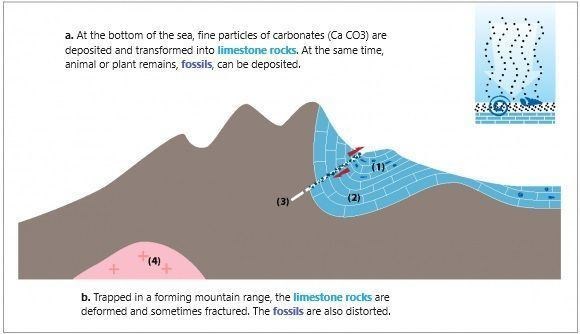
Figure 1:
Diagram of a mountain range with location of the different types of
marbles;
a. Formation of a limestone rock
b. Formation of a mountain range: (1) weakly deformed limestones called
"epi-metamorphic", (2) strongly deformed limestones marbles strictly
speaking, (3) fractured limestones and associated breccias, (4) rocks
partially melted and recrystallized in granite
At lower depths (fig. 1b (1)), minerals may recrystallize
weakly.
The rock crystals are invisible to the naked eye, the colors are
intense and the outlines precise. At the same time, the texture of the
rock can change due to pressure. A so-called
“epimetamorphic” marble is obtained. It is this
slight "reheating" that gives the rock, among other
characteristics, its compactness and its ability to polish.
At greater depths (fig. 1b (2)), temperatures of several
hundred
degrees and high pressures cause recrystallization into large crystals
visible to the naked eye. The rocks are white or with shades melted
into arabesques and the designs imprecise. The new rock is a marble in
the sense of geologists. This is the case of the marble
(fig. 2b).
During the genesis of a mountain, the strong pressures can fracture the
rocks and cause ground movements on either side of the fractures.
During these movements, in the fracture zone, the rock is crushed into
fragments of varying sizes (fig. 1b (3), fig. 2c). In the space left
free between the fragments, water rich in dissolved minerals can
circulate and deposit crystals which cement the rock fragments. A new
rock called fault breccia is thus created.
Deeper down, the temperature reaches the melting point of the rocks
(fig.1b (4)). When the ground rises and cools, a new rock is formed: a
granite like (fig.2d). When the superficial rocks of
the mountain range are gradually destroyed by erosion, this are rocks
formed at depth that appear on the surface and become accessible to
humans.
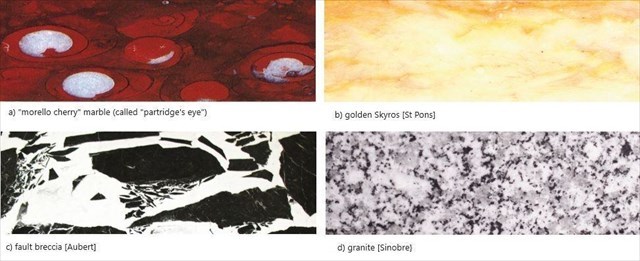
Figure 2 :
examples of marbles thus formed
Some
marble differentiation
♦ The "marbled"
structure of the rock
Identifying a marble is difficult because it is not a perfectly
homogeneous rock. There are thousands of careers on the planet and in
every career you can find totally different "marbled" structures in
association to colors.
The visible structure of the rock can be described as follows (see
photos for examples):
- Breccias are
rocks formed by angular elements, often of varying colors and cemented
by calcite. Example: the Aleppo breach (1) or the Baixas breach (2).
- Morello cherries are
rather specific breaches resulting from the bursting of limestone bands
which gives them a nodular structure. Example: the red Morello cherry
(3) and the green Campan (4).
- Concretions are
marbles with large white spots on a red background. Example: the
Incarnat Turquin (5).
- Veined marbles have
various veins on a uniform background, but the design presents a
certain irregularity. Example: the Portor (6).
- Brocatelles are
agglomerated shells in barely recognizable fragments. Example: violet
Brocatelle (7).
- Lumachelles or shells ,
in which identifiable shells are present in abundance. Example:
Lumachelle de Lourdes (8) and Coquillé de Bilbao (9).
- Compact single-color marbles are
roughly limited to black and white. Example: Mazy black, widely used
for clocks in the 19th century, and Carrara white.
- Saccharoid crystalline marbles are
white marbles, such as Paros in Greece, Carrara in Italy or Saint
Beatus in the Pyrenees.
♦ Bonus: "ancient"
marbles
Traditionally,
we speak of "ancient marbles" as opposed to "modern marbles", depending
on the Greco-Roman origin or not the quarries from which they were
extracted. The ancient marbles are of very varied composition, they
also include silicate rocks. Modern marbles, those used from the
Renaissance onwards, are essentially limestone rocks (whether
metamorphic or not).
The Romans, who share the enthusiasm for this material, systematize its
research, and develop extraction and processing techniques. Marble was
then one of the treasures brought back by the victorious generals of
the newly conquered provinces in the same way as precious metals,
spices or slaves. The aura of prestige, exclusivity and luxury no
longer leaves this subject which is illustrated in the most striking
architectural and artistic achievements of human history.
Then began the importation of some varieties of coloured marbles, among
the most diffuse, the "ancient yellow" (1), the "African" (2), the
"Phrygia" (3), the "cipolin" (4), which were used, first in fragments
inserted in the mosaics, and then in large plates, for the wall and
floor coverings of the interiors of the rich patrician mansions.
In the observation you will make, you will also be able to observe
other color marbles.
- Ancient yellow marble: This is a marble of uniform yellow
color, which ranges from intense yellow to lighter, almost white, with
dark yellow, or reddish or brown veins, and angular clastes of varying
sizes and colors (tones of yellow, red, reddish, brown).
- African marble: It is a breach marble with a dark
background, usually black, and clasts of varying dimensions, whitish
color and pinkish shades, or red, or also black and grey. There is a
variety with a dark green background ("african green") or with a grey
background with white veins and reddish spots ("african grey").
- Pavonazzetto marble or marble figio, also called phrygian:
it is a micritic marble breach with very fine grain. Its white or ivory
background colour with spots and veins of variable color red, purplish,
green or azure, recalls the color of the peacock:
- Cipolin marble: It is a marble with a white-green
background, covered by thick green wavy ribs, tending to bluish and
crossed by thick layers of mica.
- Ancient red marble: It is an impure marble with
hematite,
with a background ranging from a dark red to a perennial red, veined
with black with some specks or small white veins of calcite.
- Ancient green marble: It is a serpentine marble of
pale
green background color with spots of a darker green, sometimes almost
black, mixed with white spots
- Virgin breach or seme santo breach or Sciro breach marble:
Sedimentary rock, a fine-grained breach with a mauve color with white,
red, fawn and yellowish inclusions that sharply slice one beside the
other
- Red breach or coralline breach marble : This is a
limestone breach with hematite, with coral red cement and
ivory-coloured fragment
Questions
Careful reading of the description of the cache, as
well as an observation of the terrain features and a little deduction
are normally sufficient to answer the questions of this EarthCache.
Logs recorded without answers or without a photo will be deleted. A
higher difficulty rating of an earthcache will require more advanced
answers.
Question
0 - Take a photo of you, or your distinctive
geocacher object, or your nickname written on a sheet of paper or in
your hand... in
the basilica, and attach it to your log or your answers
Observe each area
numbered from 1 to 6 on the photos of the 3 waypoints.
Question
1 - Describe the marble in each area - shape,
outline (precise?), color (intense?), texture (melt?), crystal
(visible?)....- then
specify the marbled structure of the rock (see description of the
cache).
Question 2 - Explain in
your own words how the depth of formation of the marble, during the
formation of a mountain range, will modify its
“marbled” structure. Refer to the associated part of
the description.
Question 3 - Group the
marbles observed here according to the same "marbled" structure
(example: concretions on one side, brecciated on the other, etc.) then
order them according to their formation depth (from shallow to high
depth, example: the marbles formed at the greatest depth
are...).
Question 4 - (optional) Among
these marbles, which ones can be associated to "ancient"
marble ?
Une
Earthcache
Il ne s’agit pas d’une cache
physique. Pour loguer
cette cache, vous devez dans un premier temps prendre connaissance de
sa description éducative en matière de
géologie,
puis d’observer le site sur lequel vous êtes, et
enfin de
répondre aux questions qui vous seront posées.
Une
cotation plus élevée de la difficulté
de
l'earthcache nécessitera des réponses plus
avancées.
Vous pourrez alors loguer en "Found it" sans attendre mais vous devez
me faire parvenir vos réponses en même temps en me
contactant soit par mail dans mon profil, soit via la messagerie
geocaching.com (Message Center), et je vous contacterai en cas de
problème. Les logs enregistrés sans
réponses ou
sans photo seront supprimés.
Introduction
: à propos du marbre
En géologie, le marbre est une roche
métamorphique dérivée du calcaire et
constituée principalement de cristaux de calcite. En
architecture, sculpture et marbrerie ce terme peut désigner
n'importe quelle pierre (pierre marbrière) difficile
à tailler et capable de prendre un beau poli, dont les plus
courantes sont les « vrais » marbres (au sens
géologique).
Les marbres de la géologie présentent une grande
diversité de coloris, bien que la couleur de base de la
calcite soit le blanc. On y trouve fréquemment des veines
appelées marbrures. Les veines et les coloris sont
généralement dus à des inclusions
d'oxydes métalliques. Certains types de marbre portent des
noms particuliers, comme nous allons le voir par la suite.
Pour les scientifiques, un
marbre est une roche
métamorphique
dérivant d'un calcaire ou d'une dolomie
sédimentaire ayant été
transformée généralement par
métamorphisme régional ou plus rarement par
métamorphisme de contact. Dans ce processus de
transformation de la roche originelle, les structures
sédimentaires sont effacées et la roche
carbonatée recristallise en un amas de cristaux de calcite
et/ou de dolomie engrenés de dimensions
millimétriques à centimétriques. Les
intercalations argileuses, les minéraux
détritiques ou les oxydes minéraux
présents dans le carbonate originel donnent alors au marbre
diverses colorations et veinages polychromes du plus grand effet
esthétique.
Dans les études archéologiques et de l'histoire
de l'art sont comprises, parmi les "marbres", d’autres roches
qui n’en sont pas du point de vue géologique et
chimique, telles que les granits et porphyres, les diorites, les
basaltes (tous d'origine magmatique ou volcanique), les
albâtres (d'origine sédimentaire chimique) ou les
calcaires particulièrement durs mais n'ayant pas subi de
processus de re-cristallisation (aussi dénommées
"pierres marbrières").
De
la roche au marbre
La majorité des marbres sont des roches calcaires ou
d’origine calcaire. Sur le schéma de la figure 1
est décrit le mode de formation d’un calcaire au
fond de la mer, puis la façon dont il peut être
impliqué dans la formation d’une chaîne
de montagne. Un calcaire se forme au fond de la mer dans des conditions
de températures et de pressions faibles (a).
Dans la croûte terrestre, plus on va vers la profondeur, plus
la température et la pression augmentent. Le
phénomène s’amplifie à
l’intérieur d’une chaîne de
montagne. Les calcaires formés en surface et enfouis
subissent des températures et des pressions
d’autant plus élevées qu’ils
sont entraînés plus profond dans la
croûte terrestre. Ils sont alors plus ou moins
déformés, leurs minéraux se
transforment, leurs couleurs peuvent évoluer et les dessins
de la roche reflètent les pressions appliquées.
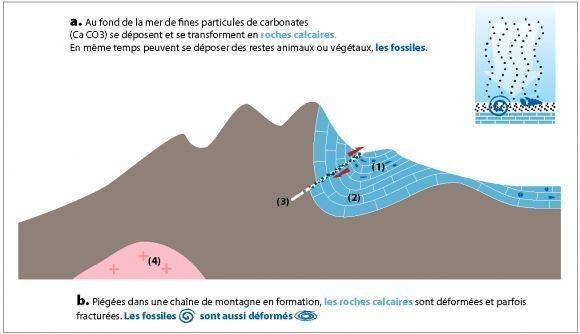
Figure 1 :
Schéma d’une chaîne de montagne avec
localisation des différents types de marbres ;
a.
Formation
d’une roche calcaire
b.
Formation d’une chaîne de montagne : (1) calcaires
faiblement déformés
dits « épi-métamorphiques »,
(2) calcaires fortement déformés marbres
sensu stricto, (3) calcaires fracturés et brèches
associées, (4) roches
partiellement fondues et recristallisées en granite
À faible profondeur (fig. 1b (1)), les
minéraux peuvent recristalliser
faiblement. Les cristaux de la roche sont invisibles à
l’œil nu, les
couleurs sont intenses et les dessins précis.
Parallèlement, la texture
de la roche peut évoluer à cause de la pression.
On obtient un marbre
dit « épimétamorphique ».
C’est ce
léger « recuit »
qui confère à la roche, entre autres
caractères, sa compacité et son
aptitude au polissage.
À plus grande profondeur (fig. 1b (2)), des
températures de plusieurs centaines de degrés et
des pressions élevées provoquent une
recristallisation en gros cristaux visibles à
l’œil nu. Les roches sont blanches ou à
teintes fondues en arabesques et les dessins peu précis. La
nouvelle roche est un marbre au sens des géologues.
C’est le cas du marbre (fig. 2b).
Au cours de la genèse d’une montagne, les fortes
pressions peuvent fracturer les roches et provoquer des mouvements de
terrain de part et d’autre des fractures. Au cours de ces
mouvements, dans la zone de fracture, la roche est broyée en
fragments de tailles variées (fig. 1b (3), fig. 2c). Dans
l’espace laissé libre entre les fragments, une eau
riche en minéraux dissous peut circuler et
déposer des cristaux qui cimentent les fragments de roche.
Une nouvelle roche appelée brèche de faille est
ainsi créée.
Plus profondément, la température atteint le
point de fusion des roches (fig.1b (4)). Lors de la remontée
des terrains et du refroidissement une nouvelle roche se forme : comme
un
granite (fig.2d).Quand les roches superficielles de la
chaîne de
montagne sont détruites par l’érosion,
progressivement, ce sont les roches formées en profondeur
qui apparaissent à la surface et deviennent accessibles
à l’homme.
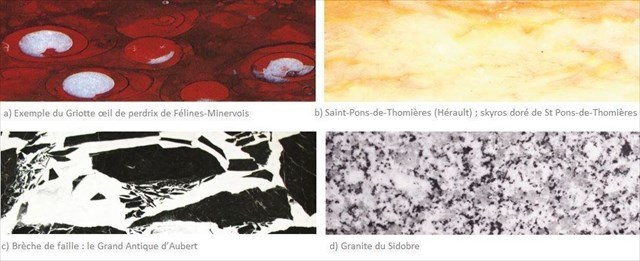
Figure 2
: exemples
de marbres ainsi formés
Quelques
différenciation des marbres
♦ La structure
"marbrée" de la roche
L’identification
d’un marbre est difficile, car ce n’est pas une
roche parfaitement homogène. Il existe des milliers de
carrières sur la planète et, dans chaque
carrière, on peut trouver des effets marbrés avec
des couleurs totalement
différentes.
La structure visible de la roche peut être décrite
de la façon suivante (voir photos pour les exemples):
- Les brèches sont
des roches formées
d’éléments anguleux, de couleurs
souvent variées et cimentées par de la calcite.
Exemple : la brèche d’Alep(1) ou la
brèche de Baixas(2).
- Les griottes sont
des brèches assez particulières provenant de
l’éclatement de bans calcaires qui leur donne une
structure noduleuse. Exemple : la Griotte rouge(3) et le Campan vert(4).
- Les concrétionnés sont
des marbres comportant de larges taches blanches sur fond rouge.
Exemple : l’Incarnat Turquin(5).
- Les marbres veinés comportent
des veines variées sur un fond uniforme mais dont le dessin
présente une certaine irrégularité.
Exemple : le Portor(6).
- Les brocatelles sont
des agglomérés de coquilles en fragments
à peine reconnaissables. Exemple : la Brocatelle violette(7).
- Les lumachelles ou coquillés,
dans lesquels les coquilles identifiables sont présentes en
abondance. Exemple : le Lumachelle de Lourdes(8) et le
Coquillé de Bilbao(9).
- Les marbres unicolores compacts sont
à peu près limités au noir et au
blanc. Exemple : le noir de Mazy, très utilisé
pour les pendules au XIXe siècle, et le blanc de Carrare.
- Les marbres cristallins saccharoïdes sont
des marbres blancs, tels que le Paros en Grèce, le Carrare
en Italie ou le Saint Béat dans les
Pyrénées.
♦ Bonus: Les
marbres
"antiques"
On parle traditionnellement de "marbres antiques" par opposition aux
"marbres modernes", selon l'origine greco-romaine ou pas des
carrières desquelles ils ont été
extraits. Les marbres antiques sont de composition très
variée, ils comprennent également des roches
silicatées. Les marbres modernes, ceux que l'on utilise
à partir de la Renaissance, désignent
essentiellement des roches calcaires (qu'ils soient
métamorphiques ou non).
Les Romains, qui partagent l'engouement pour ce matériau, en
systématisent la recherche, et développent les
techniques d'extraction et de transformation. Le marbre fait alors
partie des trésors que ramènent les
généraux victorieux des provinces nouvellement
conquises au même titre que les métaux
précieux, les épices ou les esclaves. L'aura de
prestige, d'exclusivité et de luxe ne quitte
désormais plus cette matière qui s'illustre dans
les réalisations architecturales et artistiques les plus
marquantes de l'histoire humaine.
Débuta alors l'importation de quelques
variétés de marbres de couleur, parmi les plus
diffus, le "jaune antique" (1), l’"africain" (2), le
"Phrygie" (3), le "cipolin" (4), qui furent utilisés,
d'abord en fragments insérés dans les
mosaïques, et ensuite en grandes plaques, pour les
revêtements des murs et des sols des intérieurs
des riches demeures patriciennes.
Dans l'observation que vous allez faire, vous pourrez
également observer d'autres marbres de couleurs.
- Marbre jaune antique: Il s’agit d’un
marbre de couleur jaune uniforme, qui varie du jaune intense
à des teintes plus claires, presque blanches, avec veines
jaune foncé, ou rougeâtre ou brune, et clastes
anguleuses de dimensions et couleurs variables (tonalités de
jaune, rouge, rougeâtre, brun).
- Marbre africain: Il s'agit d’un marbre
brèché avec un fond sombre, en
général noir, et clastes de dimensions variables,
de couleur blanchâtre et nuances rosâtres, ou
rouge, ou aussi noir et gris. Il existe une
variété avec fond vert foncé
("africain vert") ou avec fond gris veiné de blanc et taches
rougeâtres ("africain gris").
- Marbre pavonazzetto ou marbre figio, appelé
aussi phrygien: c’est un marbre micritique
brèché à grain très fin. Sa
couleur de fond blanc ou ivoire avec des taches et veines de couleur
variable rouge, violacée, verte ou azur, rappelle la couleur
du paon:
- Marbre cipolin: Il s'agit d'un marbre avec un fond
blanc-vert, parcouru par d’épaisses nervures
ondulées vert, tendant au bleuté et
traversé par d'épaisses couches de mica.
- Marbre rouge antique: C’est un marbre impur
à hématite, avec un fond allant d’un
rouge foncé à rouge vivace, veiné de
noir avec quelques taches ou petites veines blanches de calcite.
- Marbre vert antique: C’est un marbre serpentineux
de couleur de fond vert pâle avec des taches d’un
vert plus foncé, parfois presque noir,
mélangés à des taches blanches
- Marbre brèche vierge ou seme santo ou
brèche de Sciro: Roche sédimentaire, une
brèche à grains fins avec une couleur mauve avec
des inclusions blanches, rouges, fauve et jaunâtres qui
tranchent fortement les unes à côté des
autres
- Marbre brèche rouge ou brèche
coralline: Il s’agit d’une brèche
calcaire avec hématite, avec ciment rouge corail et fragment
de couleur
ivoire
Questions
La lecture attentive du descriptif de la cache,
ainsi qu'une observation des éléments de terrain
et un peu de déduction sont normalement suffisants pour
répondre aux questions de cette EarthCache. Les logs
enregistrés sans réponses ou sans photo seront
supprimés. Une cotation plus élevée de
la difficulté d'une earthcache nécessitera des
réponses plus avancées.
Question
0 - Prenez une photo de vous, ou de votre objet
distinctif de géocacheur, ou de votre pseudo
écrit sur une feuille de papier ou dans votre main... dans la basilique,
et
joignez-là à votre log ou
à vos réponses
Observez chaque zone
numérotée de 1 à 6 sur les photos des
3 waypoints.
Question
1 - Décrire le marbre dans chaque
zone - forme, contour (précis ?), couleur (intense ?),
texture (fondre ?), cristal (visible ?)....- puis préciser
la structure marbrée de la roche (voir description du cache).
Question 2 - Expliquez
avec vos mots en quoi la profondeur de formation du marbre, au cours de
la formation d'une chaîne de montagne, va venir modifier sa
structure "marbrée". Vous
référer à la partie
associée de la description.
Question 3 - Regroupez
les marbres observés ici selon une même structure
"marbrée" (exemple: les concrétionnés
d'un côté, les bréchés de
l'autre etc...) puis ordonnez-les selon leur profondeur
formation (de faible à forte profondeur, exemple:
les marbres formés à la plus forte profondeur
sont...).
Question 4 -
(facultatif) Parmi ces marbres, lesquels peuvent être
associés aux marbres « anciens » ?