

click
on the flag to reach the translation
Une
Earthcache
Il ne s’agit pas d’une cache
physique. Pour loguer cette cache, vous devez dans un premier temps
prendre connaissance de sa description éducative en
matière de géologie, puis d’observer le
site sur lequel vous êtes, et enfin de répondre
aux questions qui vous seront posées.
Vous pourrez alors loguer en "Found it" sans attendre mais vous devez
me faire parvenir vos réponses en même temps en me
contactant soit par mail dans mon profil, soit via la messagerie
geocaching.com (Message Center), et je vous contacterai en cas de
problème. Les
logs enregistrés sans
réponses, sans photo, seront supprimés.

Le
site
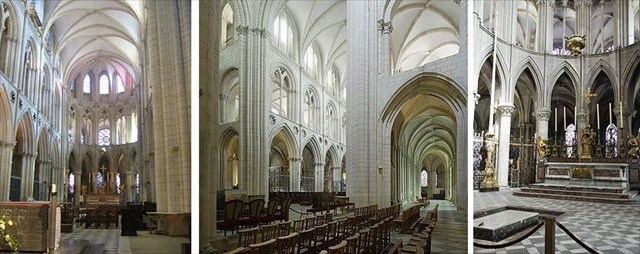
L'abbaye aux Hommes, ou abbaye Saint-Étienne de Caen, est
une des deux grandes abbayes, avec l'abbaye aux Dames,
fondées par Guillaume de Normandie le futur
conquérant, vers 10601, à Caen.
Les ducs de Normandie sont marqués par un profond besoin
spirituel et Guillaume le Conquérant dans son programme
politico-financier choisit Caen comme deuxième capitale de
son duché. Il s'engage avec sa femme à y fonder
deux monastères qui vont être
déterminant pour l'architecture normande. À sa
mort il a construit dix-sept couvents de moines et six de religieuses.
Il veut que les édifices auxquels il attache son nom
surpassent en magnificence ceux qui s'élèvent de
tous côtés. Il meurt le 9 septembre 1087
à Saint-Gervais de Rouen et choisit d'être
inhumé dans le chœur de son église
Saint-Étienne de Caen.
L'ancienne église abbatiale Saint-Étienne est
devenue église paroissiale après la
Révolution. Les bâtiments conventuels
transformés en lycée au xixe siècle
abritent depuis les années 1960 l'hôtel de ville.
L'abbaye offre un très bel ensemble architectural construit
entre les xie et xviiie siècles et l'impact de
l'église Saint-Étienne de Caen est essentiel sur
l'histoire de l'art en Normandie et en Angleterre. L'église
est classée au titre des monuments historiques sur la liste
de 1840, le cloître et les bâtiments conventuels en
1911 et les autres constructions inscrites en 1927 et 1928.
L'accès à l'église est
libre.
Du lundi au vendredi :
9h - 18h
Samedi : 10h - 18h
Dimanche : 14h - 18h
Un
peu de géologie
Crédits:
Fafahakkai,
dont certaines earth caches m'ont inspiré pour
compléter la description des différents types de
marbres
♦
Le marbre
En géologie, le marbre est une roche
métamorphique dérivée du calcaire et
constituée principalement de cristaux de calcite. En
architecture, sculpture et marbrerie ce terme peut désigner
n'importe quelle pierre (pierre marbrière) difficile
à tailler et capable de prendre un beau poli, dont les plus
courantes sont les « vrais » marbres (au sens
géologique).
Les marbres de la géologie présentent une grande
diversité de coloris, bien que la couleur de base de la
calcite soit le blanc. On y trouve fréquemment des veines
appelées marbrures. Les veines et les coloris sont
généralement dus à des inclusions
d'oxydes métalliques. Certains types de marbre portent des
noms particuliers, comme nous allons le voir par la suite.
Pour les scientifiques, un marbre est une roche métamorphique
dérivant d'un calcaire ou d'une dolomie
sédimentaire ayant été
transformée généralement par
métamorphisme régional ou plus rarement par
métamorphisme de contact. Dans ce processus de
transformation de la roche originelle, les structures
sédimentaires sont effacées et la roche
carbonatée recristallise en un amas de cristaux de calcite
et/ou de dolomie engrenés de dimensions
millimétriques à centimétriques. Les
intercalations argileuses, les minéraux
détritiques ou les oxydes minéraux
présents dans le carbonate originel donnent alors au marbre
diverses colorations et veinages polychromes du plus grand effet
esthétique.
Dans les études archéologiques et de l'histoire
de l'art sont comprises, parmi les "marbres", d’autres roches
qui n’en sont pas du point de vue géologique et
chimique, telles que les granits et porphyres, les diorites, les
basaltes (tous d'origine magmatique ou volcanique), les
albâtres (d'origine sédimentaire chimique) ou les
calcaires particulièrement durs mais n'ayant pas subi de
processus de re-cristallisation (aussi dénommées
"pierres marbrières").
♦
"Faux" marbre ou marbre véritable, je suis perdu
Soyons concret:
- Le "faux" marbre plutonique: souvent
granitique, il se caractérise par : sa structure
entièrement cristalline et grenue; sa dureté, du
fait qu'il principalement constitué de quartz (non rayable
avec une lame métallique); une absence complète
d'orientation des cristaux entre eux (pas de foliation, pli ou
déformation); une absence de trace de fossiles
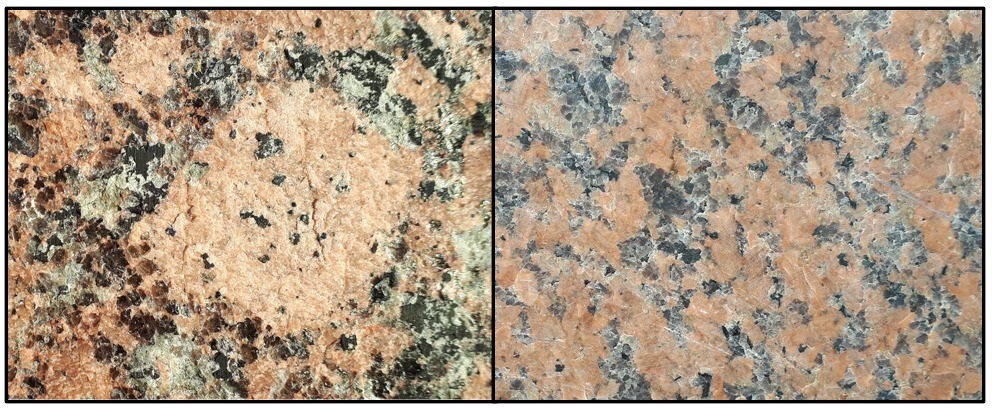
- Le "faux" marbre gneissique ou migmatitique
: il est issu de de la métamorphisation d'une roche claire,
acide, riche en quartz, ce qui le rend très dur, sans trace
de fossiles. Il présente en plus des foliations,
appelées rubanements, de minéraux sombres ou
claires.

- Le marbre véritable (pour le
géologue): il s'agit donc d'une roche
métamorphique dérivant d'un calcaire
où les structures sont effacées et la roche
carbonatée recristallise en cristaux de calcite. Cela donne
une roche brillante pouvant être veinée,
brèchique ou riche en fossiles.

♦
La structure "marbrée" de la roche
L’identification d’un marbre est difficile, car ce
n’est pas une roche parfaitement homogène. Il
existe des milliers de carrières sur la planète
et, dans chaque carrière, on peut trouver des couleurs
totalement différentes.
La structure visible de la roche peut être décrite
de la façon suivante (voir photos pour les exemples):
- Les brèches sont des roches
formées d’éléments anguleux,
de couleurs souvent variées et cimentées par de
la calcite. Exemple : la brèche d’Alep(1) ou la
brèche de Baixas(2).
- Les griottes sont des brèches
assez particulières provenant de
l’éclatement de bans calcaires qui leur donne une
structure noduleuse. Exemple : la Griotte rouge(3) et le Campan vert(4).
- Les concrétionnés
sont des marbres comportant de larges taches blanches sur fond rouge.
Exemple : l’Incarnat Turquin(5).
- Les marbres veinés comportent
des veines variées sur un fond uniforme mais dont le dessin
présente une certaine irrégularité.
Exemple : le Portor(6).
- Les brocatelles sont des
agglomérés de coquilles en fragments à
peine reconnaissables. Exemple : la Brocatelle violette(7).
- Les lumachelles ou coquillés,
dans lesquels les coquilles identifiables sont présentes en
abondance. Exemple : le Lumachelle de Lourdes(8) et le
Coquillé de Bilbao(9).
- Les marbres unicolores compacts sont
à peu près limités au noir et au
blanc. Exemple : le noir de Mazy, très utilisé
pour les pendules au XIXe siècle, et le blanc de Carrare.
- Les marbres cristallins saccharoïdes
sont des marbres blancs, tels que le Paros en Grèce, le
Carrare en Italie ou le Saint Béat dans les
Pyrénées.

♦
Le porphyre
On appelle porphyre, toute roche magmatique filonienne qui
présente une texture caractérisée par
de grands cristaux de feldspath noyés dans une
pâte aphanitique (sans cristaux visibles)..
Ces roches font souvent partie du groupe des andésites
(L'andésite est la roche volcanique la plus courante
après le basalte).
On dit aussi d'une roche qu'elle a une texture porphyrique lorsque des
phénocristaux de feldspath sont notablement plus grands que
les autres cristaux qui les entourent.
Certaines variétés de porphyres sont
utilisées depuis l'Antiquité comme pierre
ornementale pour des sculptures, colonnes, vasques, plaques
d'ornements, etc.
Du grec ancien
πορφύρα /
porphýra, terme désignant la pourpre, c'est
à l'origine le nom d'un coquillage, le pourprier,
d'où l'on tire celle-ci. Par métonymie, le terme
de porphyre désigne la variété rouge
de cette roche, qui était la plus connue. Quant au mot
pourpre, il vient du latin purpura, nom de ce coquillage.
Deux variétés ayant été
particulièrement utilisées dans l'histoire,
notamment dans la Rome antique, sont classés dans les
« marbres antiques » :
- Le porphyre rouge antique (lapis porphyrites, pierre
pourpre) qui est une andésite à faciès
paléovolcanique dont les feldspaths et la pâte
sont colorés par de l'épidote rose
(piémontite). Les carrières se trouvent sur le
djebel Dokhan (nom ancien : Mons Porphyrites ou Mons Igneus), une
chaîne montagneuse située à
l’ouest de Hurghada, en plein désert oriental
égyptien. Il fut essentiellement connu et
exploité durant la période romaine où
il était une roche très prestigieuse, on en fit
de grandes vasques, des sculptures, des colonnes monumentales, des
sarcophages impériaux et des décors de placage.
- Le porphyre vert antique ou serpentin (lapis lacedaemonius,
pierre de Lacédémone), qui est une
andésite à faciès
paléovolcanique à pâte vert
foncé, avec de nombreux grands cristaux de labradorite
pseudomorphosés par de l'épidote vert pistache,
et de rares pyroxènes noirs. Il est issu des
carrières de Lacédémone (aussi connue
sous le nom de Sparte, dans le Péloponnèse en
Grèce), il était déjà
exploité aux époques minoenne (1700 av. J.-C.) et
mycénienne, il connut une grande diffusion à Rome
à l’époque Flavii et il
était recherché au Moyen Âge et
à la Renaissance. Sa disponibilité en petits
blocs le destinait plutôt vers de petites colonnes, vases,
plaques de revêtement (opus sectile) et mosaïques.
Résumé
comparatif : Nous avons vu qu'un marbre
géologique est une roche métamorphique
non-foliée composée de carbonate
recristallisé qui se forme lorsque le calcaire est
exposé à des températures et des
pressions élevées sur une longue
période. Le
porphyre quant à lui est une roche magmatique
(ou ignée) souvent d'un brun rougeâtre au violet,
contenant de grands phénocristaux de divers
minéraux noyées dans une matrice à
grains fins.

Questions
La lecture de la description de cette earthcache est
normalement suffisante pour vous permettre de réaliser les
observations demandées et de répondre aux
questions posées.
Une cotation difficulté plus élevée de
l'earthcache demandera des observations et des réponses plus
élaborées.
Pour information, au-delà du
repérage réalisé sur place, la
conception d'une earthcache prend en moyenne 1/2 journée
(voire 1 jour pour les plus techniques avec la recherche des
informations géologiques). Merci de respecter ce travail.
Question 0:
Prenez une photo de vous, ou de votre objet distinctif de
géocacheur, ou de votre surnom écrit sur une
feuille de papier ou à la main... dans l'église,
et joignez-la à votre log ou à vos
réponses
Question 1: Le porphyre
est-il un marbre au sens géologique du terme ? Si oui,
précisez 2 à 3 éléments qui
permettent de le
distinguer / Si non, indiquez 2 à 3
léments de
différenciation.
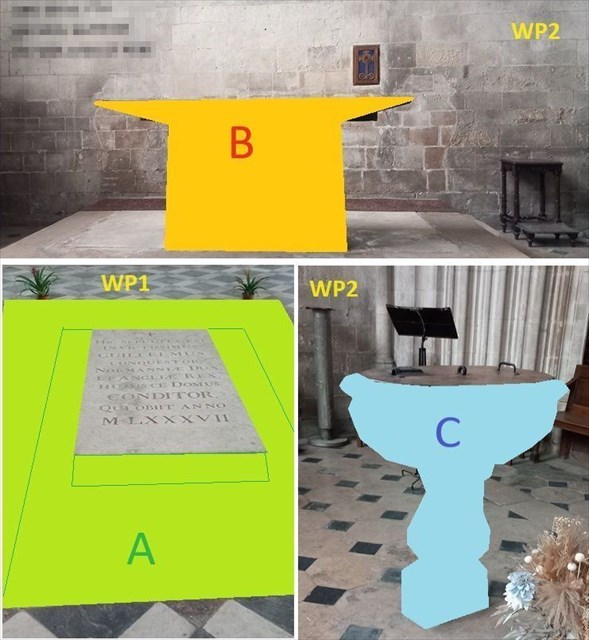
Vous
allez observer successivement les zones A puis B et C respectivement au
niveau de
WP1: pourtour
de l'Epitaphe de Guillaume le Conquérant "Ici a
été enterré Guillaume le
Conquérant jamais vaincu, Duc de Normandie et Roi
d'Angleterre, et fondateur de cette Abbaye, qui mourut en l'an 1087"
WP2: la
Chapelle Halbout (autel et baptistère)
Question 2:
Décrivez la roche pour chacune des zones A, B et C.
Question 3:
Indiquez pour chacune quelle est la "structure marbrée" ou
si c'est un porphyre.
An
Earthcache
This is not a physical cache. To log this cache, you
must first read its educational description of geology, then observe
the site on which you are, and finally answer the questions that will
be asked.
You can then log in to "Found it" immediately but you must send me your
answers at the same time by contacting me either by email in my profile
or via geocaching.com (Message Center) messaging, and I will contact
you in case of any problems.
Logs saved without answers, without photo,
will be deleted.
The
site
The Abbaye aux Hommes, or Saint-Étienne Abbey of Caen, is
one of the two great abbeys, with the Abbaye aux Dames, founded by
William of Normandy the future conqueror, around 10601, in Caen.
The dukes of Normandy were marked by a deep spiritual need and William
the Conqueror in his political-financial program chose Caen as the
second capital of his duchy. He undertook with his wife to found two
monasteries there which would be decisive for Norman architecture. At
his death he built seventeen convents for monks and six for nuns. He
wants the buildings to which he attaches his name to surpass in
magnificence those which rise on all sides. He died on September 9,
1087 in Saint-Gervais de Rouen and chose to be buried in the choir of
his church Saint-Étienne de Caen.
The old Saint-Étienne abbey church became a parish church
after the Revolution. The convent buildings transformed into a high
school in the 19th century have housed the town hall since the 1960s.
The abbey offers a very beautiful architectural ensemble built between
the 11th and 18th centuries and the impact of the
Saint-Étienne de Caen church is essential on the history of
art in Normandy and England. The church is classified as a historic
monument on the 1840 list, the cloister and the convent buildings in
1911 and the other buildings listed in 1927 and 1928.
Access to the church is free.
Monday to Friday: 9 a.m.
- 6 p.m.
Saturday: 10 a.m. - 6 p.m.
Sunday: 2 p.m. - 6 p.m.
A
little bit of geology
♦ Marble
In geology, marble is a metamorphic rock derived from limestone and
composed mainly of calcite crystals. In architecture, sculpture and
marbling, this term can refer to any stone (marble stone) that is
difficult to carve and capable of taking on a beautiful polish, the
most common of which are the “real” marbles
(geological).
The marbles of geology have a wide variety of colours, although the
basic colour of calcite is white. Veins called marbling are frequently
found there. Veins and colours are usually due to inclusions of metal
oxides. Some types of marble have particular names, as we will see
later.
For scientists, marble is a metamorphic rock derived from a limestone
or sedimentary dolomite that has been transformed generally by regional
metamorphism or more rarely by contact metamorphism. In this process of
transformation of the original rock, the sedimentary structures are
erased and the carbonate rock recrystallized into a cluster of calcite
and/or dolomite crystals engrained from millimetre to centimetric
dimensions. The clay intercalations, detritus minerals or mineral
oxides present in the original carbonate then give to the marble
various colorations and polychrome veins of the greatest aesthetic
effect.
In archaeological and art history studies are included, among the
"marbles", other rocks which are not geological and chemical, such as
granites and porphyry, diorites, basalt (all of magmatic or volcanic
origin), albâtres (of chemical sedimentary origin) or
calcareous particularly hard but not having undergone a process of
re-crystallization (also called "marble stones").
♦ "False"
marble or real marble, I'm lost
Let's be concrete:
- The "false" plutonic marble: often
granitic, it is characterized by: its entirely crystalline and grainy
structure; its hardness, due to the fact that it mainly consists of
quartz (not scratchable with a metal blade); a complete absence of
orientation of the crystals between themselves (no foliation, fold or
deformation); no trace of fossils
- The "false" gneissic or migmatitic marble:
it comes from the metamorphosis of a clear, acidic rock, rich in
quartz, which makes it very hard, without trace of fossils. It also has
foliations, called bandements, of dark or light minerals.
- Real marble (for the geologist): it is
therefore a metamorphic rock derived from limestone where the
structures are obliterated and the carbonated rock recrystallizes into
calcite crystals. This results in bright rock that can be veined,
brecciated, or rich in fossils.
♦ The
"marbled" structure of the rock
Identifying a marble is difficult because it is not a perfectly
homogeneous rock. There are thousands of careers on the planet and in
every career you can find totally different colors.
The visible structure of the rock can be described as follows (see
photos for examples):
- Breccias are rocks formed by angular
elements, often of varying colors and cemented by calcite. Example: the
Aleppo breach (1) or the Baixas breach (2).
- Morello cherries are rather specific
breaches resulting from the bursting of limestone bands which gives
them a nodular structure. Example: the red Morello cherry (3) and the
green Campan (4).
- Concretions are marbles with large white
spots on a red background. Example: the Incarnat Turquin (5).
- Veined marbles have various veins on a
uniform background, but the design presents a certain irregularity.
Example: the Portor (6).
- Brocatelles are agglomerated shells in
barely recognizable fragments. Example: violet Brocatelle (7).
- Lumachelles or shells , in which
identifiable shells are present in abundance. Example: Lumachelle de
Lourdes (8) and Coquillé de Bilbao (9).
- Compact single-color marbles are roughly
limited to black and white. Example: Mazy black, widely used for clocks
in the 19th century, and Carrara white.
- Saccharoid crystalline marbles are white
marbles, such as Paros in Greece, Carrara in Italy or Saint Beatus in
the Pyrenees.
♦
Porphyry
Porphyry is any magmatic vein rock which has a texture characterized by
large feldspar crystals embedded in an aphanitic paste (without visible
crystals).
These rocks are often part of the andesite group (Andesite is the most
common volcanic rock after basalt).
A rock is also said to have a porphyritic texture when feldspar
phenocrysts are notably larger than the other crystals surrounding them.
Certain varieties of porphyry have been used since Antiquity as
ornamental stone for sculptures, columns, basins, ornamental plaques,
etc.
From the ancient Greek
πορφύρα /
porphýra, a term designating purple, it is originally the
name of a shell, the purprier, from which it comes. By metonymy, the
term porphyry designates the red variety of this rock, which was the
best known. As for the word purple, it comes from the Latin purpura,
the name of this shell.
Two varieties having been particularly used in history, notably in
ancient Rome, are classified as “antique marbles”:
- Ancient red porphyry (lapis porphyrites, purple stone)
which is an andesite with paleovolcanic facies whose feldspars and
paste are colored by pink epidote (piemontite). The quarries are
located on Jebel Dokhan (old name: Mons Porphyrites or Mons Igneus), a
mountain range located west of Hurghada, in the middle of the Egyptian
eastern desert. It was mainly known and exploited during the Roman
period when it was a very prestigious rock; large basins, sculptures,
monumental columns, imperial sarcophagi and veneer decorations were
made from it.
- Ancient green or serpentine porphyry (lapis lacedaemonius,
Lacedaemon stone), which is an andesite with paleovolcanic facies with
dark green paste, with numerous large labradorite crystals
pseudomorphosed by pistachio green epidote, and rare black pyroxenes.
It comes from the quarries of Lacedaemon (also known as Sparta, in the
Peloponnese in Greece), it was already exploited in the Minoan (1700
BC) and Mycenaean periods, it was widely distributed in Rome in the
Flavii era and it was sought after in the Middle Ages and the
Renaissance. Its availability in small blocks made it more suitable for
small columns, vases, covering plates (opus sectile) and mosaics.
Comparative
summary : We have seen that a geological marble
is a non-foliated metamorphic
rock composed of recrystallized carbonate that forms when limestone is
exposed to high temperatures and pressures over a long period of time.
The porphyry on the other hand is an magmatic
(or igneous) rock often reddish brown to purple, containing large
phenocrysts of various minerals embedded in a fine-grained matrix.
Questions
Reading the description of this earthcache is
normally sufficient to allow you to make the requested observations and
answer the questions asked.
A higher difficulty rating of the earthcache will require more
elaborate observations and responses.
For information, beyond the identification carried
out on site, the design of an earthcache takes on average 1/2 day (or
even 1 day for the most technical with the search for geological
information). Thank you
for respecting this work.
Question 0:
Take a photo of you, or your distinctive geocacher object, or your
nickname written on a piece of paper or by hand... in the church, and
attach it to your log or answers
Question 1: Is porphyry
a marble in the geological sense of the term? If yes, specify 2 to 3
elements that allow it to be distinguished / If no, indicate 2 to 3
elements of differentiation.
You
will successively observe zones A then B and C respectively at the
level of
WP1: perimeter of the
Epitaph of William the Conqueror "Here was buried William the Conqueror
never defeated, Duke of Normandy and King of England, and founder of
this Abbey, who died in the year 1087"
WP2: Halbout Chapel (altar and baptistery)
Question 2:
Describe the rock for each of areas A, B and C.
Question 3:
Indicate for each what the “marble structure” is or
if it is a porphyry.