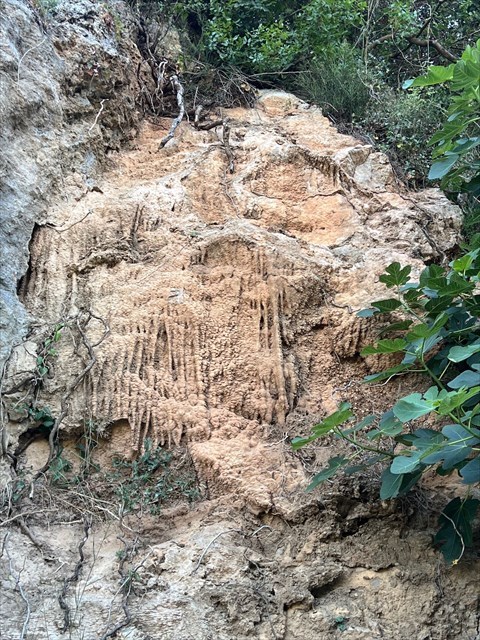
Bei einer meiner vielen Wanderungen und Erkundungen auf dieser wunderschönen Insel bin ich auf diesen offen liegenden Tropfstein gestoßen.
Tropfsteine sind generell Steine, die als Sinter durch tropfendes Wasser entstehen.
Fälschlicherweise wird manchmal angenommen, das Tropfsteine Lebewesen sind. Dem ist nicht so.
Entstehung der Tropfsteine:
Tropfsteine entstehen durch das Tropfen von Wasser. Entscheidend ist dabei, dass es sich nicht um reines Wasser handelt. Die Wassertropfen enthalten Kalk, der sich aus dem Kalkstein der Umgebung gelöst hat. Wenn das mit Kalk gesättigte Wasser verdunstet, bleiben Kalkreste zurück. Ähnliche Kalkspuren kennen wir aus Gebieten, in denen „hartes Wasser“, also Wasser mit hohem Kalkgehalt, aus dem Hahn fließt. Dort setzen sich am Spülbecken oder am Boden eines Wasserkochers Kalkreste ab. Doch was dort häßliche Flecken verursacht, schafft in den Höhlen fantastische Formen:
Ganz langsam und allmählich wachsen die Kalkablagerungen als feucht glänzende Zapfen von der Decke herab: die Tropfsteine oder Stalaktiten.
Wenn von den Stalaktiten kalkhaltiges Wasser herabtropft, bilden sich direkt unter ihnen wie in einem Spiegelbild ebenfalls Tropfsteine: die Stalagmiten. Sind Stalaktiten und Stalagmiten groß genug, wachsen sie zusammen und bilden eine Säule. Neben den Tropfsteinen gibt es noch andere interessante Gebilde in einer solchen Höhle. Dort, wo Wasser an der Decke entlang rinnt, bleiben Kalkspuren zurück, die so ähnlich aussehen wie Vorhänge. Man nennt sie deshalb auch „steinerne Gardinen“.
Faktoren, die das Wachstum von Stalagmiten beeinflussen
Das Wachstum von Stalagmiten wird von verschiedenen Faktoren beeinflusst, einschließlich der Verfügbarkeit von Calciumcarbonat (CaCO3), der Menge an gelöstem CO2
im Wasser, der Temperatur und der Feuchtigkeit innerhalb der Höhle.
Verfügbarkeit von CaCO3
: Das Wachstum von Stalagmiten ist stark abhängig von der Menge an CaCO3
, die im Grundwasser gelöst ist. Ohne eine ausreichende Menge an diesem Mineral können Stalagmiten nicht entstehen.
Kohlendioxidgehalt: CO2
ist ein wichtiger Faktor bei der Ausfällung von CaCO3
aus dem Grundwasser. Wenn das CO2
aus den Wassertropfen entweicht, sinkt ihre Fähigkeit, CaCO3
zu lösen, was zur Bildung von Stalagmiten führt.
Temperatur und Feuchtigkeit: In wärmeren und feuchteren Höhlenatmosphären können Stalagmiten schneller wachsen, da mehr Wasser verdunstet und mehr CO2
entweicht. Dadurch kann sich mehr CaCO3 ablagern.
Im Durchschnitt wachsen Tropfsteine etwa einen Millimeter in zehn Jahren.
Kalkstein besteht überwiegend aus den Mineralen Calcit und Aragonit, zwei Kristallisationsformen von Calciumcarbonat (kohlensaures Calcium CaCO3). In unterschiedlichen Anteilen können andere Minerale wie Tonminerale, Dolomit (CaMg(CO3)2), Quarz oder Gips beteiligt sein.
Kalksteine sind dichte Gesteine und hauptsächlich hell, grau, gelblich bis beige. Charakteristisch ist das Vorhandensein von Muscheln oder fossilen Einschlüssen.
Jetzt zu den Fragen.
1. Was denkt ihr, warum hier offen liegende Tropfsteine zu sehen sind?
2. Wie hoch befindet sich das offen liegende Tropfsteinfeld von eurem Standpunkt aus und welche größe hat es ca.?
3. Wenn ihr zum Referenzpunkt geht, fallen euch weitere Tropfsteine auf? Wie ist die Farbgebung der Steine / der Steinwand von eurem Standpunkt zum Referenzpunkt?
4. Postet ein Foto von dir, vor dem offen liegenden Tropfstein, das Dich als Ganzes, einen individuell in Szene gesetzten Körperteil von Dir oder einen beliebigen Gegenstand mit Deinem GC-Namen enthält.
Logs ohne Foto werden gelöscht.(Nach den Richtlinien ist dies wieder zulässig und es wird auch so umgesetzt).
Schreibt mir die Antworten und ihr dürft sofort loggen. Wenn etwas nicht passen sollte, werde ich mich melden.
Beste Grüße und viel Spaß Michael (pargada)
Quellen: www.Wikipedia.de, https://www.planet-schule.de und / https://www.studysmarter.de
During one of my many hikes and explorations on this beautiful island, I came across this exposed stalactite.
Dripstones are generally stones that are formed as sinter by dripping water.
It is sometimes incorrectly assumed that stalactites are living creatures. It is not so.
Formation of the stalactites:
Stalactites are formed by the dripping of water. What is crucial is that it is not pure water. The water drops contain lime that has dissolved from the surrounding limestone. When the water saturated with lime evaporates, lime residue remains. We know similar traces of lime from areas where “hard water”, i.e. water with a high lime content, flows from the tap. Limescale residues collect on the sink or at the bottom of a kettle. But what causes ugly spots there creates fantastic shapes in the caves:
Very slowly and gradually, the lime deposits grow down from the ceiling as moist, shiny cones: the stalactites
When calcareous water drips down from the stalactites, stalactites also form directly beneath them like a mirror image: the stalagmites. If stalactites and stalagmites are large enough, they grow together and form a column. In addition to the stalactites, there are other interesting structures in such a cave. Where water runs along the ceiling, traces of limescale remain that look similar to curtains. That’s why they are also called “stone curtains”.
Factors affecting the growth of stalagmites
The growth of stalagmites is influenced by various factors, including the availability of calcium carbonate (CaCO3), the amount of dissolved CO2
in the water, the temperature and the humidity within the cave.
Availability of CaCO3
: The growth of stalagmites is strongly dependent on the amount of CaCO3
, which is dissolved in groundwater. Without a sufficient amount of this mineral, stalagmites cannot form.
Carbon dioxide content: CO2
is an important factor in the precipitation of CaCO3
from the groundwater. If the CO2
As water drops escape, their ability to produce CaCO3 decreases
to loosen, which leads to the formation of stalagmites.
Temperature and Humidity: In warmer and more humid cave atmospheres, stalagmites can grow faster because more water evaporates and more CO2
escapes. This allows more CaCO3 to be deposited.
On average, stalactites grow about one millimeter in ten years.
Limestone consists predominantly of the minerals calcite and aragonite, two crystallization forms of calcium carbonate (calcium carbonate CaCO3). Other minerals such as clay minerals, dolomite (CaMg(CO3)2), quartz or gypsum may be involved in varying proportions.
Limestones are dense stones and mainly light, gray, yellowish to beige. The presence of shells or fossil inclusions is characteristic.
Now to the questions.
1. Why do you think exposed stalactites can be seen here?
2. How high is the exposed stalactite field from your vantage point and what is its approximate size?
3. When you go to the reference point, do you notice more stalactites? and what is the color of the stones / stone wall from your point of view to the reference point?
4. Post a photo of you in front of the exposed stalactite that contains you as a whole, an individually staged body part of you or any object with your GC name.
Logs without a photo will be deleted. (According to the guidelines, this is permitted again and will be implemented as such).
Write me the answers and you can log immediately. If something doesn't fit, I'll let you know.
Best regards and have fun Michael (pargada)
Katá ti diárkeia mias apó tis pollés pezoporíes kai exerevníseis mou se aftó to ómorfo nisí, synántisa aftón ton ektetheiméno stalaktíti.
Oi stalaktítes eínai geniká pétres pou schimatízontai os pyrosyssomátosi apó ti stálaxi neroú.
Merikés forés esfalména theoreítai óti oi stalaktítes eínai zontaná plásmata. Aftó den ischýei.
Schimatismós stalaktitón:
Oi stalaktítes schimatízontai apó ti stálaxi neroú. Aftó pou eínai krísimo eínai óti den eínai katharó neró. Oi stagónes neroú periéchoun asvésti pou échei dialytheí apó ton perivállonta asvestólitho. Ótan to neró pou eínai koresméno me asvésti exatmízetai, paraménoun ypoleímmata asvésti. Gnorízoume parómoia íchni asvésti apó periochés ópou «skliró neró», diladí neró me ypsilí periektikótita se asvésti, réei apó ti vrýsi. Ta ypoleímmata aláton mazévontai ston nerochýti í sto káto méros enós vrastíra. Allá aftó pou prokaleí áschima simeía ekeí dimiourgeí fantastiká schímata stis spiliés:
Polý argá kai stadiaká, oi enapothéseis asvésti megalónoun apó tin orofí os ygroí, gyalisteroí kónoi: oi stalaktítes í oi stalaktítes.
Ótan stázei asvestolithikó neró apó tous stalaktítes, schimatízontai kai stalaktítes akrivós apó káto tous san kathréftis: oi stalagmítes. Eán oi stalaktítes kai oi stalagmítes eínai arketá megáloi, anaptýssontai mazí kai schimatízoun mia stíli. Ektós apó tous stalaktítes, ypárchoun kai álles endiaférouses kataskevés se éna tétoio spílaio. Ópou to neró tréchei katá míkos tis orofís, paraménoun íchni aláton pou moiázoun me kourtínes. Gi' aftó légontai kai «pétrines kourtínes».
Parágontes pou epireázoun tin anáptyxi ton stalagmitón
I anáptyxi ton stalagmitón epireázetai apó diáforous parágontes, ópos i diathesimótita anthrakikoú asvestíou (CaCO3), i posótita tou dialyménou CO2
sto neró, ti thermokrasía kai tin ygrasía mésa sto spílaio.
Diathesimótita CaCO3
: I anáptyxi ton stalagmitón exartátai se megálo vathmó apó tin posótita tou CaCO3
, to opoío dialýetai sta ypógeia ýdata. Chorís eparkí posótita aftoú tou oryktoú, den boroún na schimatistoún stalagmítes.
Periektikótita se dioxeídio tou ánthraka: CO2
eínai énas simantikós parágontas gia tin kathízisi tou CaCO3
apó ta ypógeia nerá. An to CO2
Kathós oi stagónes neroú diafévgoun, i ikanótitá tous na parágoun CaCO3 meiónetai
na chalarósei, gegonós pou odigeí sto schimatismó stalagmitón.
Thermokrasía kai ygrasía: Se thermóteres kai pio ygrés atmósfaires spilaíon, oi stalagmítes boroún na anaptychthoún pio grígora epeidí exatmízetai perissótero neró kai perissótero CO2
drapetévei. Aftó epitrépei tin enapóthesi perissóterou CaCO3.
Katá méso óro, oi stalaktítes megalónoun perípou éna chiliostó se déka chrónia.
O asvestólithos apoteleítai kyríos apó ta oryktá asvestítis kai aragonítis, dýo morfés krystállosis anthrakikoú asvestíou (anthrakikó asvéstio CaCO3). Álla oryktá ópos oryktá argílou, dolomítis (CaMg(CO3)2), chalazías í gýpsos boreí na emplékontai se poikíles analogíes.
Oi asvestólithoi eínai pyknoí vráchoi kai eínai kyríos anoichtoí, nkrízoi, kitrinopoí éos bez. Charaktiristikí eínai i parousía ostrákon í apolithomáton.
Tóra stis erotíseis.
1. Giatí pistévete óti ypárchoun ektetheiménoi stalaktítes edó?
2. Póso psilá vrísketai to ektetheiméno pedío stalaktíti apó to pleonéktimá sas kai poio eínai katá proséngisi to mégethós tou?
3. Ótan pigaínete sto simeío anaforás, paratireíte perissóterous stalaktítes? kai poio eínai to chróma ton líthon / pétrinou toíchou apó ti dikí sas optikí gonía pros to simeío anaforás?
4. Dimosiéfste mia fotografía sas brostá apó ton ektetheiméno stalaktíti pou sas periéchei os sýnolo, éna memonoméno méros tou sómatós sas í opoiodípote antikeímeno me to ónomá sas GC.
Ta archeía katagrafís chorís fotografía tha diagrafoún (Sýmfona me tis odigíes, aftó epitrépetai xaná kai tha efarmosteí os échei).
Grápste mou tis apantíseis kai boreíte na syndetheíte amésos. An káti den tairiázei, tha sas enimeróso.
Me filikoús chairetismoús kai kalí diaskédasi Michael (pargada)
Quellen: www.Wikipedia.de, https://www.planet-schule.de und / https://www.studysmarter.de
