WELCOME TO KANDOVAN!
Kandovan is a fascinating village in Iran, known for its remarkable geological features. Here’s a comprehensive overview of Kandovan from a geological perspective:
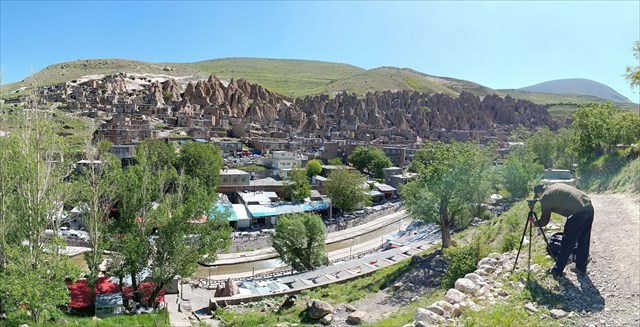
Location and Formation: Kandovan is located in the Sahand Rural District in the Central District of Osku County, East Azerbaijan Province, northwestern Iran. It lies in the foothills of Mount Sahand, near the city of Osku. The village is famous for its troglodyte homes, known locally as Karaans, which are carved inside volcanic rocks. These dwellings are reminiscent of those found in the Turkish region of Cappadocia.
Geological Composition: The rock formations of Kandovan are primarily composed of non-welded ignimbrites, also known as “ash-flow tuffs,” which are a type of pyroclastic deposit. The cone-shaped houses are a result of the erosion of these ignimbrite layers, which consist of porous, round, and angular pumice along with other volcanic particles set in a grey, acidic matrix.
Volcanic Activity: The rocks of Kandovan were formed during the eruption of Sahand, a volcano that has been silent for approximately 140,000 years. Pyroclastic flows from this eruption created the ignimbrite rocks that make up the village. Over time, water erosion sculpted these deposits into the distinctive cone-shaped cliffs seen today.
Weathering and Durability: The physical weathering of rocks is dominant in Kandovan. The XRD analysis on surface rock samples showed no traces of clay minerals, indicating a lack of chemical weathering. The durability of the rocks is assessed based on their physical properties, such as hardness, density, porosity, water absorption, and saturation coefficient1. The high porosity and water absorption, along with low density, are key factors affecting the durability of the rocks against environmental factors.
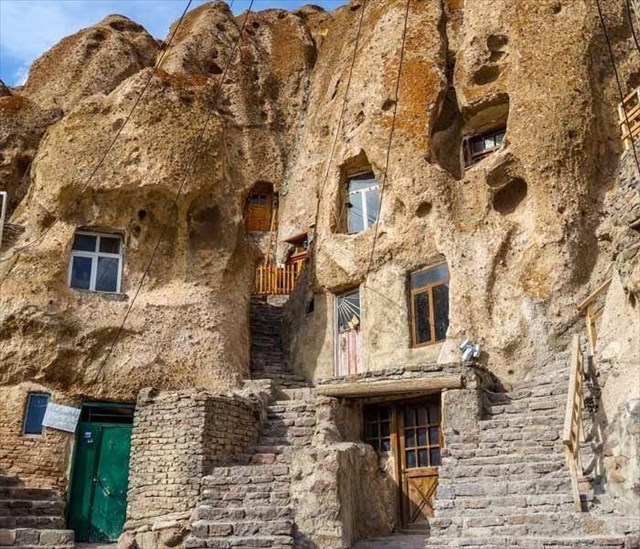
Engineering Geological Properties: The engineering geological properties of Kandovan’s pyroclastic cone-shaped rocky houses have been studied due to their unique formation and the effects of climate conditions on their preservation. The rocks have high porosity and water absorption, making them sensitive to expansion and contraction caused by freezing–thawing and wetting–drying cycles. This sensitivity, along with the physical weathering from environmental impacts, poses a threat to the stability of the rocky houses. The stability of these rocky houses is threatened by ongoing natural processes of weathering and erosion, as well as human activities.
Comparison with Cappadocian Tuffs: A comparison between the physical and mechanical properties of Kandovan’s pyroclastic rocks and the tuffs of Cappadocia shows that Kandovan rocks generally have greater strength, although they also exhibit higher porosity and lower water absorption than Cappadocian rocks.
Cultural and Historical Significance: Beyond its geological significance, Kandovan is also a historical and cultural site. The village’s unique conoid landforms, known as “badgirs” or “kandovans,” have been inhabited for approximately 700 years, with local people carving homes into the ignimbrite rocks.
Kandovan’s geological history is deeply intertwined with the activity of the Sahand volcano, and its rock formations serve as a testament to the dynamic processes that shape our planet. The village is a living example of how humans have adapted to and utilized the geological features of their environment.
QUESTIONS:
The following questions must be answered for the log to be recognized. You can send answers both through the message center and through the profile, or directly to the email routparta@seznam.cz.
1) Describe how the rocks in Kandovan were formed.
2) Look at the rocks in Kandovan and describe their appearance and properties (color, structure, hardness...).
3) Please attach a picture with Kandovan with you or your personal item.