Pick a day with good visibility, you’ll be viewing the subjects from a distance and if you can’t see them you can’t answer the questions.
I was on my way to my soon to be daughter-in-law's hen weekend in Schull, I stopped here for the nearby trad and continued walking to the EIRE 28 sign. The features here meant I spent a lot longer than planned, and earthcaches were born
Walk along the path to the posted coords, make your observations and send me the answers to these questions via the message centre or email . Post the required photo in your log to claim your find.
1. From GZ look towards the cliffs, you’ll see caves there, which of the methods below do you think formed these caves?
2. How do you think these caves will look in several millennia from now! Will they join up to create one big cave, do you think they’ll stay the same as they are or will they have transformed into a different feature?
3. Do you see any evidence that new caves are beginning to form?
4. Look to the left at the rocks sticking out of the sea, do you think these started life as caves?
5. Post a photo of you or your caching name with the caves in the background
How caves are formed
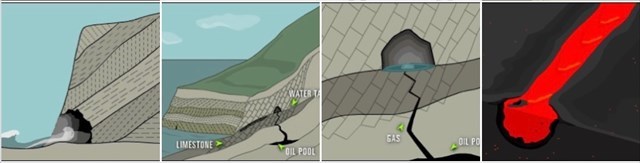
Molten lava, crashing waves, seeping rainwater, and oil-eating bacteria are some of the forces of nature that, over many years, create caves from rock like limestone and sandstone.
Rainwater is slightly acidic, when it seeps through tiny pores or cracks in limestone the rock will begin to dissolve, over time these cracks get larger and can form caves
A lava cave is formed as a result of surface solidification of a lava flow during the last stages of its activity. A frozen crust may form over still mobile and actively flowing liquid rock as a result of surface cooling.
Caves can form along a crack in a rock or an area where the rock is softer. Because the abrasive action of waves is concentrated at the base of the cliff an overhang forms
Bacteria called extremophiles live in extreme conditions, they expel hydrogen sulfide gas. This gas is carried up by groundwater into small cracks in limestone rock. The hydrogen sulfide mixes with oxygen to form sulfuric acid. The corrosive acid eats away at the rock forming caves