INFORMATION : The Revd David Stolton, Minister in pastoral charge of Saint Peters Church, has been informed of the installation of this EarthCache and of the presence of geocachers who will be asked to make observations on the rocks forming this site.
Please be respectful of the site during your observations.
A reminder about EarthCache
ATTENTION, there is no container to look for or logbook to fill in. All you have to do is go to the observation site and complete the validation conditions below.
As the aim of an EarthCache is to put a geology lesson into practice by making observations in the field, we recommend that you read the description to help you answer the questions.
Questions to validate the geological cache
- Question 0 : Take a photo of yourself or your nickname with St Peter's Church in the background without revealing the viewing areas.
You can either send us this photo with your answers or add it to your log.
Here you are in front of St Peter's Church. Look at the blocks around the porch (photo WP1).
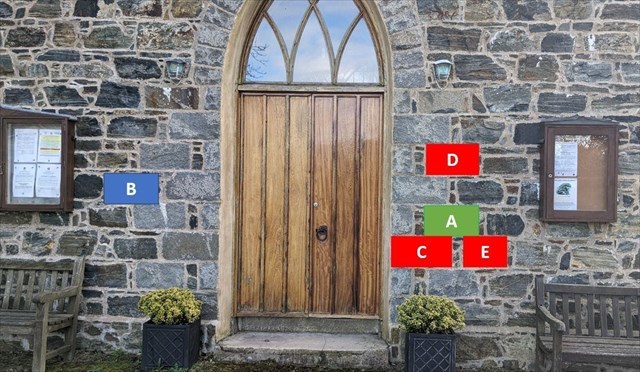
- Question 1 : Describe green block A and blue block B (ignoring veins), both from Sark plutonic formations. Using the Streckeisen diagram, determine their respective nature.
- Question 2 : Describe the veins in Block B and give details of their mineralogical nature and formation conditions.
- Question 3 : Which of the 3 red blocks C, D and E is a gneiss? Describe the bedding and specify the variety of gneiss.
You can log in without waiting for our confirmation, but you must send us the answers at the same time.
by e-mail via our profile (
fafahakkai), or via the geocaching.com messaging system (Message Center).
If there are any problems with your answers, we will let you know.
Logs recorded without any response and photo will be deleted.
What does this mean in theory?
► Local geological context of the two islands of Sark
Sark is part of the same Precambrian basement as Guernsey, combining two sets of rocks.
- Very ancient metamorphic rocks dating from the Penteverian period (over a billion years ago) and forming the central part of the large island of Sark.
- Plutonic formations laid down during the Cadomian orogeny and forming the island of Petite Sark and the northern tip of Grande Sark.
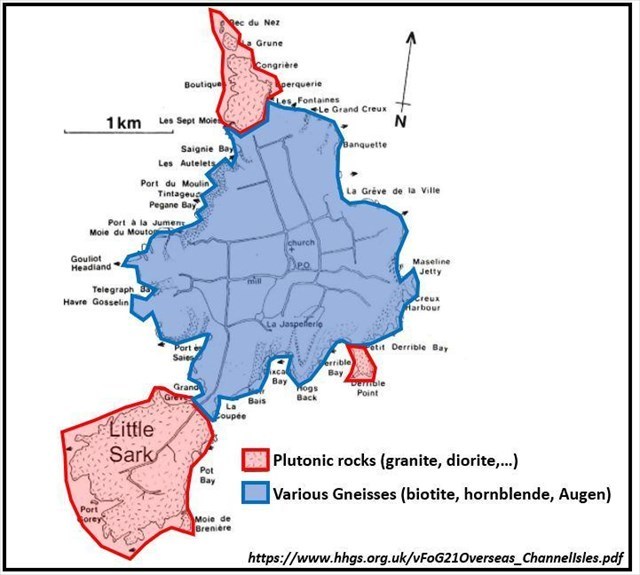
► The Grande Sark Gneisses, metamorphic formations
A metamorphic formation is a secondary rock formed by the recrystallisation of primary rocks under high pressure and/or temperature, generally resulting in stratification.
The crystalline nature of gneiss is similar to that of granite, but here the crystals are arranged in strata.
This foliation consists of alternating light beds of quartz and feldspars and dark levels of ferromagnesian minerals (black micas, etc.).
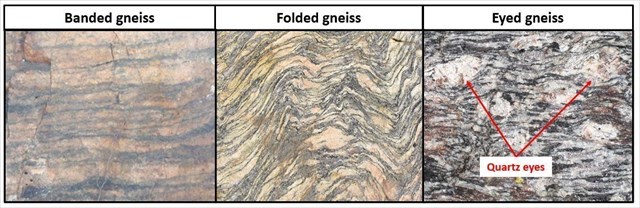
On Sark, different varieties of gneiss can be distinguished:
- Banded gneiss, characterised by a relatively regular bedding visible to the naked eye.
- Eyed gneiss, in which phenocrysts of feldspar and quartz are preserved, forming eyes.
- Folded gneiss showing folds, evidence of the deformations the rock has undergone.
► The plutonic formations of Petite Sark, a history of colouring
The colour of rocks of magmatic origin, whether plutonic or volcanic, depends on the chemical composition of the initial magma.
- The richer the magma is in silicates (acid magma), the lighter the colour of the rock.
- The richer the magma is in ferromagnesium (basic magma), the darker the colour of the rock.
This colour/nature correlation can be used to classify a plutonic rock using the Streckeisen diagram.
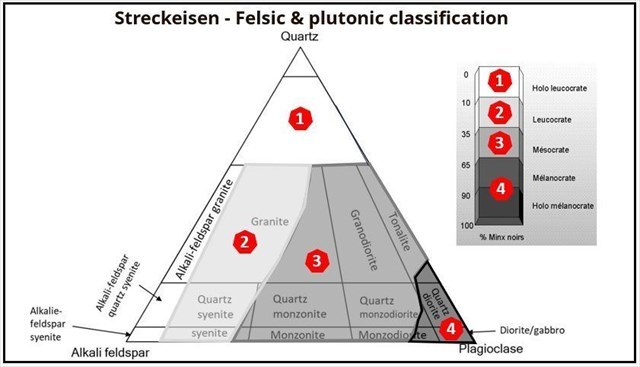
In the case of Sark, there are 3 plutonic rocks according to the Streckeisen diagram:
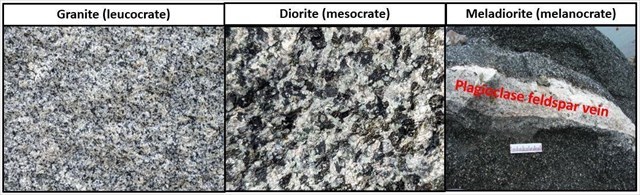
- Granite is mainly composed of quartz and alkaline feldspars, giving a light-coloured rock (leucocrate).
- Diorite with a more balanced proportion of feldspars (silicate crystals) and ferromagnesians, giving an intermediate colour (mesocrate).
- Meladiorite, a particular form of diorite that is very rich in ferromagnesium (close to gabbro) giving a dark rock (melanocrate).
As ferromagnesians have a high crystallisation point, meladiorite crystallised rapidly while residual quartzo-feldspathic magmatic juices were still liquid.
Tectonic stresses fractured the meladiorite, allowing these silicate juices to be injected and crystallise into opaque white veins of plagioclase feldspar.
► Sources bibliographiques / Bibliographical sources