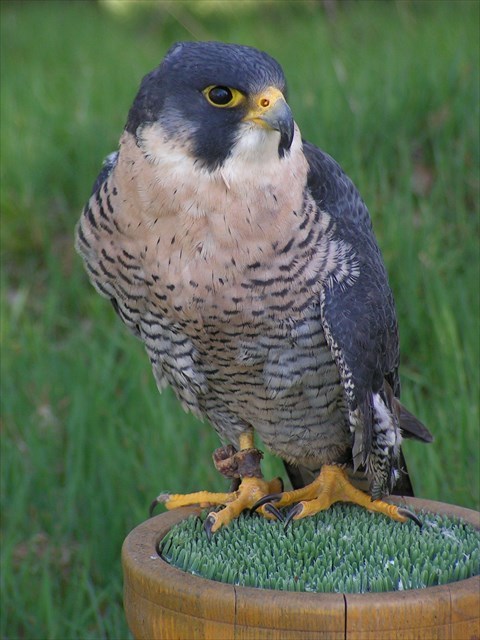
Vandrefalken, med det videnskabelige navn Falco peregrinus, er kendt som verdens hurtigste fugl. Når den dykker efter bytte, kan den nå hastigheder på over 320 km/t, hvilket gør den til en formidabel jæger. Vandrefalken har en bred udbredelse og findes næsten over hele verden, undtagen i de mest ekstreme polare og tropiske regioner. Den er let genkendelig med sin blågrå ryg, mørke hoved, og lysere underside med mørke striber.
Vandrefalkens kost består primært af andre fugle, som den fanger i luften ved hjælp af sin imponerende hastighed og smidighed. Den bruger en kombination af skarpt syn, høj hastighed og præcision til at fange sit bytte midt i luften. Vandrefalken bygger ofte sin rede på klipper eller høje bygninger i byområder, hvor den har en god udsigt og let adgang til bytte.
I løbet af det 20. århundrede oplevede vandrefalken en dramatisk tilbagegang i bestanden på grund af brugen af pesticidet DDT, som forårsagede tyndere æggeskaller og høj dødelighed blandt ungerne. Efter forbuddet mod DDT og omfattende bevaringsindsatser er vandrefalken dog kommet sig, og i dag ses den igen i mange områder, hvor den tidligere var forsvundet.
Vandrefalken er en vigtig del af økosystemet som en topprædator, der hjælper med at kontrollere bestanden af mindre fugle. Den er også et ikon for succesfulde bevaringsinitiativer, da dens genkomst har markeret et vendepunkt i bestræbelserne på at beskytte truede arter. På trods af dette står vandrefalken stadig over for udfordringer som habitatforstyrrelse og forurening, hvilket gør fortsat bevaring nødvendig.
Svar på disse spørgsmål for at få koordinatet til cachen N55 3A.BCD E12 3E.FGH
A: Hvad er vandrefalkens videnskabelige navn?
4 Falco subbuteo
5 Falco columbarius
6 Falco peregrinus
B: Hvad er vandrefalken kendt for?
7 Dens evne til at bygge store reder
3 Dens farverige fjerdragt
5 Dens utrolige hastighed, når den dykker efter bytte
C: Hvilken type bytte jager vandrefalken primært?
4 Fisk
8 Andre fugle
0 Små pattedyr
D: Hvor bygger vandrefalken ofte sine reder?
2 I træer i skovområder
5 På klipper eller høje bygninger
6 På jorden i åbne landskaber
E: Hvad forårsagede tilbagegangen i vandrefalkens bestand i det 20. århundrede?
3 Brug af pesticidet DDT
5 Øget jagt
4 Manglende føde
F: Hvordan har vandrefalkens bestand udviklet sig efter forbuddet mod DDT?
8 Den er fortsat faldet
9 Den er kommet sig
0 Den er forsvundet fra mange områder
G: Hvilken rolle spiller vandrefalken i økosystemet?
1 Som en vigtig bestøver
7 Som en topprædator, der kontrollerer bestanden af mindre fugle
9 Som ådselsæder
H: Hvad er en af de nuværende udfordringer for vandrefalken?
1 Konkurrence fra større rovdyr
4 Habitatforstyrrelse og forurening
7 Manglende ynglesteder
English:
The peregrine falcon, scientifically known as Falco peregrinus, is renowned as the world's fastest bird. When diving for prey, it can reach speeds of over 320 km/h, making it a formidable hunter. The peregrine falcon has a wide distribution and is found almost worldwide, except in the most extreme polar and tropical regions. It is easily recognizable with its blue-gray back, dark head, and lighter underparts with dark streaks.
The peregrine falcon's diet consists primarily of other birds, which it catches mid-air using its impressive speed and agility. It uses a combination of keen eyesight, high speed, and precision to capture its prey in flight. Peregrine falcons often nest on cliffs or tall buildings in urban areas, where they have a good vantage point and easy access to prey.
During the 20th century, the peregrine falcon experienced a dramatic decline in population due to the use of the pesticide DDT, which caused thinner eggshells and high mortality among chicks. After the ban on DDT and extensive conservation efforts, the peregrine falcon has made a recovery, and it is now seen again in many areas where it had previously disappeared.
The peregrine falcon is an important part of the ecosystem as a top predator that helps control the population of smaller birds. It is also an icon of successful conservation initiatives, as its comeback has marked a turning point in efforts to protect endangered species. Despite this, the peregrine falcon still faces challenges such as habitat disruption and pollution, making continued conservation necessary.
Answer these questions to get the coordinates for the cache N55 3A.BCD E12 3E.FGH
A: What is the scientific name of the peregrine falcon?
4 Falco subbuteo
5 Falco columbarius
6 Falco peregrinus
B: What is the peregrine falcon known for?
7 Its ability to build large nests
3 Its colorful plumage
5 Its incredible speed when diving for prey
C: What type of prey does the peregrine falcon primarily hunt?
4 Fish
8 Other birds
0 Small mammals
D: Where does the peregrine falcon often build its nests?
2 In trees in forested areas
5 On cliffs or tall buildings
6 On the ground in open landscapes
E: What caused the decline in the peregrine falcon population in the 20th century?
3 Use of the pesticide DDT
5 Increased hunting
4 Lack of food
F: How has the peregrine falcon population developed after the ban on DDT?
8 It has continued to decline
9 It has recovered
0 It has disappeared from many areas
G: What role does the peregrine falcon play in the ecosystem?
1 As an important pollinator
7 As a top predator controlling the population of smaller birds
9 As a scavenger
H: What is one of the current challenges for the peregrine falcon?
1 Competition from larger predators
4 Habitat disruption and pollution
7 Lack of breeding sites