
St. Colman’s Cathedral is an architectural masterpiece and important religious landmark that rises above the streets of Cobh. This impressive monument dates back to 1868 and took about 47 years to complete. Visit St. Colman’s Cathedral today to appreciate its exquisite architecture, hear its 49-bell carillon and enjoy views over Cork Harbour.
Stand at the entrance to the cathedral and gaze in awe at the façade’s neo-Gothic designs. Look up at the soaring spires and spot gruesome-looking gargoyles. Note the sculptures of saints crowning the doorways and the elaborately decorated windows. The cathedral’s grandeur is the work of the famed church architects Edward Welby Pugin and George Ashlin.
We are here to look at the circular granite pillars on either side of the door at the front of the church.
Logging Requirements (Questions to Answer)
Compulsory tasks in order to log a find against this EarthCache, you will need to visit GZ and make some observations and then answer some questions and send answers to me via my Geocaching profile or through the Messenger Centre.
1. Take a look at any of the pillars and describe what you can see - describe the colour and shape of any crystals you can see
2. Has the rock cooled rapidly or slowly. Give reasons for your answer.
3. What may be present in the feldspar to give it that colour.
4. Counting the pillars from left (1) to right (12). Which one can you see a large Enclave in, also is it at the top, middle or bottom in the pillar.
5. Also include in your log a photograph of you, your GPS or another identifiable item near GZ, taking care not to include anything in the photo that may give away your answers.
Granite
Granite is a common type of igneous rock. Igneous rock is one of the three main rock types , the others being sedimentary and metamorphic. Igneous rock is formed through the cooling and solidification of magma or lava. Igneous rock may form with or without crystallisation either below the surface as intrusive (plutonic) rocks or on the surface as extrusive (volcanic) rocks. Granite can be white, pink, or gray in colour, depending on their mineralogy. Granitic rocks mainly consist of feldspar, quartz, mica and amphibole minerals, which form an interlocking matrix of feldspar and quartz with scattered darker biotite mica and amphibole (often hornblende) peppering the lighter colour minerals. The size of feldspar crystals in granite is directly related to the speed of cooling. When magma cools slowly beneath the Earth's surface, feldspar crystals have more time to grow larger (greater than 2mm in size), resulting in coarse-grained granite. In contrast, rapid cooling at the surface leads to smaller feldspar crystals, producing fine-grained or even glassy rocks like obsidian.
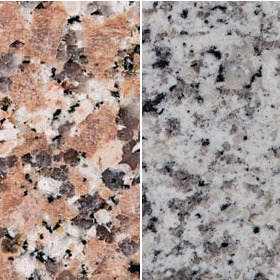
The quartz is typically transparent or translucent - not unlike glass. The mica is often black or brown but sometimes silvery in nature.
The pink colour of feldspar in granite is primarily caused by the presence of a mineral called orthoclase feldspar. Orthoclase feldspar contains small amounts of impurities, such as iron or manganese, which can give it a pink hue. The gray colour of plagioclase feldspar is mainly a result of its mineral composition, which includes a mix of sodium, calcium, and aluminum ions within its structure.

**Enclaves:** Enclaves in granite are foreign rock fragments that become incorporated into the granite magma during its formation. Enclaves can originate from the surrounding country rocks or from previous intrusive events. When the magma body that eventually solidifies into granite assimilates these foreign fragments, the enclaves are surrounded by the granitic material. Enclaves can vary in size, shape, and composition, and their presence can create pockets of contrasting material within the granite.
"The Church Micro IE series is open to everyone; if you have a church you would like to place a cache at then please contact THE_Chris through Geocaching.com. This is to keep track of the numbers of the churches and give you the general format for the cache page. In the UK there are thousands in the series so we have some catching up to do! Also, if you currently have a published cache at a church that you would like to include in the series, get in contact and I can add it."