Memorial in memory of Townsend Blennerhassett late captain Kerry Militia drowned in Castlemaine Bay 20 June 1867. The inscription records that it was erected by his brother officers in testimony of the esteem in which he was held, and to perpetuate the recollection of his heroic actions.
At the post coordinates look at the granite plaque on the front of the memorial.
Logging Requirements (Questions to Answer)
In order to log a find against this EarthCache, you will need to visit GZ and make some observations and then answer some questions and send answers to me via my Geocaching profile or through the Messenger Centre.
1. Take a look at the granite plaque and describe what you can see - describe the colour and shape of any crystals you can see
2. Has the rock cooled rapidly or slowly. Give reasons for your answer.
3. What may be present in the feldspar to give it that colour.
4. Describe any signs of weathering or erosion that you may see or feel.
5. Compulsory task: Take a photograph of you, your GPS or another identifiable item near GZ, taking care not to include anything in the photo that may give away your answers.
Granite
Granite is a common type of igneous rock. Igneous rock is one of the three main rock types , the others being sedimentary and metamorphic. Igneous rock is formed through the cooling and solidification of magma or lava. Igneous rock may form with or without crystallisation either below the surface as intrusive (plutonic) rocks or on the surface as extrusive (volcanic) rocks. Granite can be white, pink, or gray in colour, depending on their mineralogy. Granitic rocks mainly consist of feldspar, quartz, mica and amphibole minerals, which form an interlocking matrix of feldspar and quartz with scattered darker biotite mica and amphibole (often hornblende) peppering the lighter colour minerals. The size of feldspar crystals in granite is directly related to the speed of cooling. When magma cools slowly beneath the Earth's surface, feldspar crystals have more time to grow larger (greater than 2mm in size), resulting in coarse-grained granite. In contrast, rapid cooling at the surface leads to smaller feldspar crystals, producing fine-grained or even glassy rocks like obsidian.
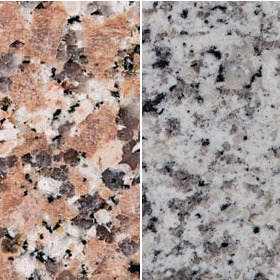
The quartz is typically transparent or translucent - not unlike glass. The mica is often black or brown but sometimes silvery in nature.
The pink colour of feldspar in granite is primarily caused by the presence of a mineral called orthoclase feldspar. Orthoclase feldspar contains small amounts of impurities, such as iron or manganese, which can give it a pink hue. The gray colour of plagioclase feldspar is mainly a result of its mineral composition, which includes a mix of sodium, calcium, and aluminum ions within its structure.
Weathering and erosion.
What is the difference between weathering and erosion?
Weathering is the process of decomposing, breaking up, or changing the colour of rocks. Weathering may be caused by the action of water, air, chemicals, plants or animals.
- Chemical weathering - involves chemical changes in the minerals of the rock, or on the surface of the rock that make the rock change its shape or color. Carbon dioxide, oxygen, water, and acids may all cause chemical weathering.
- Mechanical weathering - is the process of breaking a large rock into smaller pieces without changing the minerals in the rock. Mechanical weathering may be caused by frost, ice, plant roots, running water or heat from the sun..
Once the small pieces of rocks are changed or broken apart by weathering, they may start to be moved by wind, water, or ice. When the smaller rock pieces (now pebbles, sand or soil) are moved by these natural forces, it is called erosion.
So, if a rock is changed or broken but stays where it is, it is called weathering. If the pieces of weathered rock are moved away, it is called erosion.