
Emplacement
Porte Saint-Thomas, Saint-Malo, Bretagne
Un morceau d'histoire de la ville.
Xénolithe - un extraterrestre à l'intérieur de la pierre ?

Xénolithe signifie « roche étrangère » venant de xenos (étranger) et lithos (pierre) en grec ancien. Un xénolithe est un fragment de roche étrangère au sein d’une roche hôte. Les xénolithes sont différents de la roche dans laquelle ils se trouvent. Si elles sont de nature similaire, ces roches sont appelées autolithes ou inclusions apparentées.  Les vrais xénolithes sont toujours plus anciens que leurs roches hôtes car ils devaient déjà exister sous forme de fragment de roche solide lorsque le magma ou la lave qui les entourait se solidifiaient. Ce n’est pas toujours le cas des inclusions apparentées.
Un xénolithe est souvent une roche qui s’est incrustée dans le magma lors de son refroidissement. Le magma est la roche en fusion située sous la croûte terrestre. Si le magma s’élève au-dessus de la surface de la Terre, par exemple lors d’une éruption volcanique, on l’appelle lave. La lave est l'équivalent extrusif du magma.

Les roches ignées se forment à partir de magma et de lave refroidis. Les xénolithes sont différents types de roches souvent noyées dans la roche ignée. En fonction du matériau rocheux étranger, de la composition du magma ou de la lave, des températures, du temps disponible et de nombreux autres facteurs, le xénolithe s'équilibre chimiquement avec la roche hôte à des degrés divers.

Les xénolithes sont généralement faciles à reconnaître car leur composition, leur densité et leur couleur sont souvent visiblement différentes de celles de la roche environnante. Les xénolithes sont généralement de petite taille par rapport à l’ensemble de la roche. Cependant, la taille des xénolithes peut varier depuis des monocristaux (xénocristaux) jusqu'à des fragments de roche de plusieurs mètres. L'inclusion à grande échelle de strates rocheuses étrangères aux marges d'une intrusion ignée est appelée pendant de toit.

Il existe un certain nombre de sources possibles de xénolithes et de xénocristaux trouvés à la surface de la Terre. Le magma peut s'introduire dans des roches préexistantes (parfois appelées roches encaissantes) et, ce faisant, peut ramasser des fragments de cette roche encaissante. Les xénolithes peuvent également être formés à partir de fragments des parois d’une chambre magmatique ou d’un conduit. Les xénolithes peuvent également être captés par la lave lors d’éruptions volcaniques explosives, ou peuvent être captés par la lave lorsqu’elle coule à la surface de la Terre. Ces fragments, piégés dans le magma ou la lave mais ne s'y fondant pas, deviennent des xénolithes.
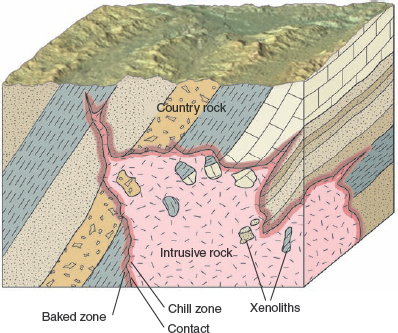
Une représentation visuelle, si cela peut être plus clair !
Lorsque le magma éclate ou s’écoule de la surface de la Terre, il est refroidi par exposition à l’atmosphère ou à l’eau. La lave refroidit assez rapidement et différents types de roches ignées se forment. Les xénolithes et les xénocristaux sont affectés par la température. Un xénolithe peut perdre ses qualités uniques s'il fond dans le magma environnant. En refroidissant, le matériau peut cesser d’être un xénolithe et devenir une roche métamorphique. Les roches métamorphiques sont des roches formées à l'intérieur de la Terre par des changements de température et de pression qui affectent les roches existantes (souvent ignées ou sédimentaires).
Les xénolithes et les xénocristaux sont souvent identifiés par les noms des deux types de roches impliqués. Par exemple, un xénolithe périodite dans une coulée de lave basaltique est un fragment de périodite incrusté dans la roche basaltique.

Xénolithes en granit
Les xénolithes et les xénocristaux fournissent des informations précieuses sur la géologie de la croûte et du manteau terrestre. Les xénolithes peuvent donner des indices sur l'origine et l'évolution de la roche encaissante. Par exemple, lorsqu’une roche ignée contient un xénolithe, les géologues savent qu’à un moment donné, le magma ou la lave qui s’est refroidi pour former cette roche ignée était en contact avec la roche étrangère. Les xénolithes sont également importants car ils permettent aux géologues d’échantillonner et d’étudier des roches difficiles d’accès. Par exemple, la matière du manteau terrestre n’est généralement pas exposée à la surface de la Terre (sauf au niveau des ophiolites), de sorte que les xénolithes peuvent fournir des preuves de la composition du manteau terrestre. Certains xénolithes proviennent des profondeurs de la Terre. Par exemple, les diamants se forment à des pressions et des températures élevées, très profondément dans la Terre, puis sont ramenés à la surface de la Terre sous forme de xénocristaux dans la roche kimberlitique. Grâce aux xénolithes et aux xénocristaux, les géologues peuvent en apprendre davantage sur la température, la pression, la constriction et les mouvements à la surface de la Terre.
Les xénocristaux peuvent également être formés par le mélange de magmas différents, et des matières étrangères peuvent être incorporées tardivement dans le magma avec une contamination minimale. Le devenir des xénocristaux assimilés dépend de leur composition, ainsi que de celui de la roche hôte.

Les xénolithes apparaissent le plus souvent sous forme de fragments de roche étrangère dans des roches ignées. Cependant, les xénolithes peuvent également apparaître dans des roches sédimentaires, voire dans des météorites, qui ont été impliquées dans des collisions en dehors de l’atmosphère terrestre.
La tâche:
1. Ici vous pouvez voir une bordure de lit en granit. Décrivez la couleur et les composants du xénolithe. Quel est le point commun avec la roche environnante ?
2. Mesurez la longueur et la largeur du xénolithe, quelle est sa taille ?
3. À votre avis, qu'est-ce qui est le plus ancien : la roche qui constitue le pilier ou le xénolithe qu'il contient ?
4. Prenez une photo sans spoiler de vous ou de votre GPS avec le monument en arrière-plan et publiez-la avec votre journal de bord.
Loguez cette cache "Found it" et envoyez-moi vos propositions de réponses soit via mon profil, soit via la messagerie geocaching.com (Message Center), et je vous contacterai en cas de problème.

Location
Porte Saint-Thomas, Saint-Malo, Brittany
A piece of city history.
Xenolith - an alien inside stone?
Xenolith means “foreign rock” coming from xenos (foreign) and lithos (stone) in Ancient Greek. A xenolith is a fragment of foreign rock within a host rock. Xenoliths are different from the rock they are found within. If they are similar in nature, then these rocks are called autoliths or cognate inclusions. True xenoliths are always older than their host rocks because they had to already exist as a solid rock fragment when the magma or lava around them solidified. This is not always the case with cognate inclusions.
A xenolith is often a rock that was embedded in magma as it was cooling. Magma is the molten rock beneath the Earth’s crust. If the magma rises above the Earth’s surface, for example during a volcanic eruption, it is referred to as lava. Lava is the extrusive equivalent of magma.
Igneous rocks form from magma and lava that has cooled. Xenoliths are different types of rock that are often embedded in igneous rock. Depending on the foreign rock material, the composition of the magma or lava, the temperatures, available time, and many other factors, the xenolith chemically equilibrates with the host rock to varying degrees.
Xenoliths are usually easy to recognise because they are often visibly different in composition, density and colour from the encompassing rock. Xenoliths are generally small in size, relative to the overall body of rock. However, xenoliths can range in size from single crystals (xenocrysts) to rock fragments of several metres. The large-scale inclusion of foreign rock strata at the margins of an igneous intrusion is called a roof pendant.
There are a number of possible sources for xenoliths and xenocrysts found at the Earth’s surface. Magma can intrude into pre-existing rocks (sometimes called country rocks) and as it does so, might pick up fragments of this country rock. Xenoliths can also be formed from fragments of the walls of a magma chamber or conduit. Xenoliths can also be picked up by lava during explosive volcanic eruptions, or can be picked up by lava as it flows along Earth’s surface. These fragments, trapped in the magma or lava but not melting into it, become xenoliths.
A visual representation, if that makes it any clearer!
As magma erupts or flows from the Earth’s surface, it is cooled by exposure to the atmosphere or water. Lava cools fairly quickly, and different types of igneous rocks are formed. Xenoliths and xenocrysts are affected by temperature. A xenolith may lose its unique qualities if it melts into the surrounding magma. As it cools, the material may cease being a xenolith and instead become a metamorphic rock. Metamorphic rock are rocks are formed inside the Earth by temperature and pressure changes that affect existing rocks, (often igneous or sedimentary.)
Xenoliths and xenocrysts are often identified by the names of the two rock types involved. For example, a periodite xenolith in a basaltic lava flow, is a periodite fragment embedded in basalt rock.
Xenoliths in granite
Xenoliths and xenocrysts provide valuable information about the geology of the Earth’s crust and mantle. Xenoliths can give clues about the origin and evolution of the host rock. For example, when an igneous rock contains a xenolith, geologists know that at some point the magma or lava that cooled to form that igneous rock was in contact with the foreign rock. Xenoliths are also important because they can allow geologists to sample and study rocks which are difficult to access. For example, the material in the Earth’s mantle is not generally exposed at Earth’s surface, (except at ophiolites,) so xenoliths can give evidence about the composition of Earth’s mantle. Some xenoliths come from very deep within the Earth. For example, diamonds are formed at high pressures and temperatures, very deep within the Earth, and are then brought to the Earth’s surface as xenocrysts in kimberlite rock. Through xenoliths and xenocrysts, geologists can learn about temperature, pressure, constriction and movement within the Earth's surface.
Xenocrysts can also be formed by the mixing of dissimilar magmas, and foreign material can be incorporated late into the magma with minimal contamination. The fate of assimilated xenocrysts depend on their composition, as well as that of the host rock.
Xenoliths most often appear as fragments of foreign rock in igneous rocks. However, xenoliths can also appear in sedimentary rocks, or even meteorites, that have been involved in collision events outside of the Earth’s atmosphere.
The task:
1. Here you can see a bed edging made of granite. Describe the color and components of the xenolith. What does it have in common with the surrounding rock?
2. Measure the length and width of the xenolith, how big is it?
3. Which do you think is older, the rock that makes up the pillar or the xenolith within it?
4. Take a spoiler-free picture of you or your GPS with the monument in the background and post it with your log.
Log this cache "Found it" and send me your answer suggestions either through my profile or through the geocaching.com Message Center, and I will contact you if there are any problems.
Sources:
https://de.wikipedia.org/wiki/Xenolith. Aufruf 10.1.2025.
https://www.spektrum.de/lexikon/geowissenschaften/xenolith/18433. Aufruf 10.1.2025.
https://www.mineralienatlas.de/lexikon/index.php/Xenolith?lang=de. Aufruf 10.1.2025.
Grafics: https://www3.nd.edu/~cneal/planetearth/Chapt-6-Marshak.pdf. Aufruf 10.1.2025.