[English version below]
Magmasprickor
Magmasprickor bildas genom geologiska processer som börjar djupt inne i jorden. Manteln består av het, smält sten som kallas magma. När denna magma rör sig på grund av skillnader i tryck och temperatur kan den orsaka sprickor i jordskorpan. Dessa sprickor uppstår ofta i områden där jordskorpan är särskilt tunn eller svag, exempelvis vid tektoniska plattgränser eller över heta punkter.
När magman stiger upp, fyller den de sprickor som har bildats och kyls långsamt ned. I vissa fall når magman jordytan och leder till vulkanutbrott. I andra fall stannar den kvar i sprickorna och bildar underjordiska bergarter. Med tiden kan erosion och andra geologiska processer blottlägga dessa magmasprickor och skapa imponerande landformer.
Slåttdalsskrevan
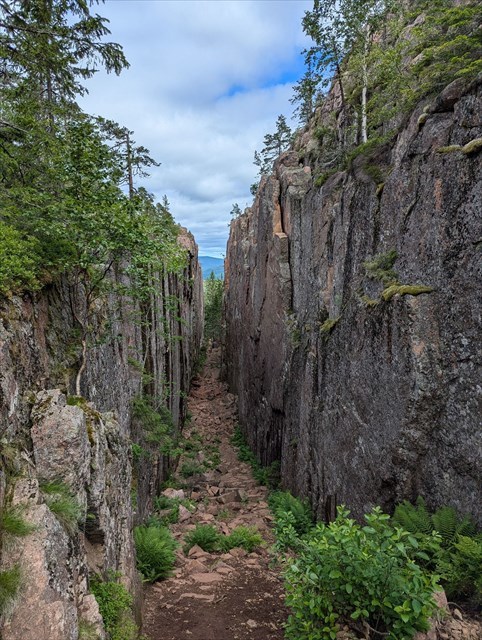
Slåttdalsskrevan, en spektakulär bergsspricka i Skuleskogens nationalpark i Sverige, är ett utmärkt exempel på en sådan geologisk formation. Denna bergsspricka är cirka 200 meter lång, 30 meter djup och bara några meter bred, vilket gör den till en imponerande syn.
Bildandet av Slåttdalsskrevan kan spåras tillbaka till den senaste istiden, då massiva istäcken täckte den skandinaviska halvön. Under denna tid verkade enorma krafter på jordskorpan, vilket orsakade spänningar och sprickor i berget. Slåttdalsskrevan består till största delen av granit, som bildades i djupa magmakammare och svalnade och stelnade långsamt under miljontals år.
När isarna under den senaste istiden började smälta, frigjorde de en enorm erosiv kraft. Vatten- och isrörelser skar in i de redan existerande svagheterna och sprickorna i berget och förstorade dem. Denna process, som kallas glacial erosion, förstärkte de befintliga sprickorna och formade Slåttdalsskrevan till dess nuvarande struktur.
Slåttdalsskrevan är resultatet av en kombination av djupa geologiska processer som började med bildandet av magmasprickor och de yterosionskrafter som utlöstes av de smältande glaciärerna under den senaste istiden.
Följ säkerhetsföreskrifterna vid ravinen när du besöker jordcachen.
För att logga den här cachen måste du utföra följande uppgifter:
- Titta på klipporna på ravinens väggar. Vad tror du, kan ravinen bli ännu bredare? Motivera din gissning.
- Förutom glacial erosion har även andra yttre krafter bidragit till bildandet av Slåttdalsskrevan. Vilka kan dessa krafter vara? Beskriv med dina egna ord.
- Lägg till ett foto av dig (eller någon av dina personliga tillhörigheter) tillsammans med Slåttdalsskrevan i din logg.
För att få tillstånd att logga denna cache, skicka bara dina svar till mig! Du behöver inte vänta på godkännande. Om det skulle uppstå några problem med dina svar kommer jag att kontakta dig!
Magma Fissures
Magma fissures are created through geological processes that begin deep within the Earth. The mantle consists of hot, molten rock known as magma. As this magma moves due to differences in pressure and temperature, it can cause cracks and fissures in the Earth's crust. These cracks often form in areas where the crust is particularly thin or weak, such as at tectonic plate boundaries or over hotspots.
When the magma rises, it fills the cracks that have formed and slowly cools down. In some cases, the magma reaches the Earth's surface and leads to volcanic eruptions. In other cases, it remains trapped in the fissures and forms underground rock bodies. Over time, erosion and other geological processes can expose these magma fissures, creating impressive landforms.
The Slåttdalsskrevan
The Slåttdalsskrevan, a spectacular rock fissure in the Skuleskogen National Park in Sweden, is an excellent example of such a geological formation. This rock fissure is about 200 meters long, 30 meters deep, and only a few meters wide, making it an impressive sight.
The formation of the Slåttdalsskrevan can be traced back to the last Ice Age, when massive ice sheets covered the Scandinavian Peninsula. During this time, enormous forces acted on the Earth's crust, causing tension and fractures in the rock. The rock that makes up the Slåttdalsskrevan is primarily granite, which formed in deep magma chambers and cooled and solidified slowly over millions of years.
As the ice sheets of the last Ice Age began to melt, they released a massive erosive force. Water and ice movements carved into the pre-existing weaknesses and cracks in the rock, enlarging them. This process, known as glacial erosion, intensified the existing fissures and shaped the current structure of the Slåttdalsskrevan.
The Slåttdalsskrevan is the result of a combination of deep geological processes that began with the formation of magma fissures and the surface erosion forces triggered by the melting glaciers of the last Ice Age.
Observe the safety instructions at the gorge when you visit the earth cache.
To log this cache, you have to perform the following task:
- Look at the rock on the walls of the gorge. What do you think, could the gorge become even wider? Give reasons for your guess.
- In addition to glacial erosion also other surface erosion forces contributed to the formation of the Slåttdalsskrevan. What could those forces be? Describe with your own words.
- Add a foto of you (or any of your personal belongings) and the Slåttdalsskrevan to your log.
To get a permission to log this cache, just send me your correct answers! You don't have to wait for approval. In case of any problems with your answer, I will contact you!