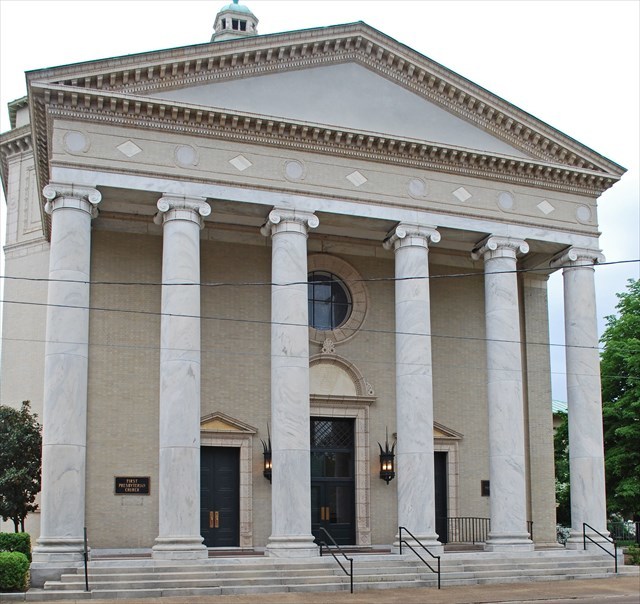
The First Presbyterian Church in Chattanooga, Tennessee, established in 1840, is a historic congregation known for its beautiful Gothic Revival architecture. The current church building, designed by notable architect Stanford White, was built in 1910 at a cost of $152,000. It was listed on the National Register of Historic Places in December 2009. Perhaps the most striking feature are the pillars, which were constructed from Georgia Marble.
Georgia marble, a high-grade metamorphic rock, began its formation 600 million years ago at the bottom of a sea that covered North Georgia. Tiny sea animals, composed of calcium carbonate, lived and died in vast numbers, gradually forming a thick, nearly pure reef of calcium carbonate. This reef was later buried under thousands of feet of sediment and transformed into limestone due to immense pressure. About 450 million years ago, geological upheavals buckled the reef and thrust it deep into the Earth's crust, where heat and pressure metamorphosed it into marble rich with sparkling calcite crystals. Around 60 million years ago, another upheaval brought this vast marble deposit to the Earth's surface, where it was used by the Cherokee and Etowah peoples in native crafts.
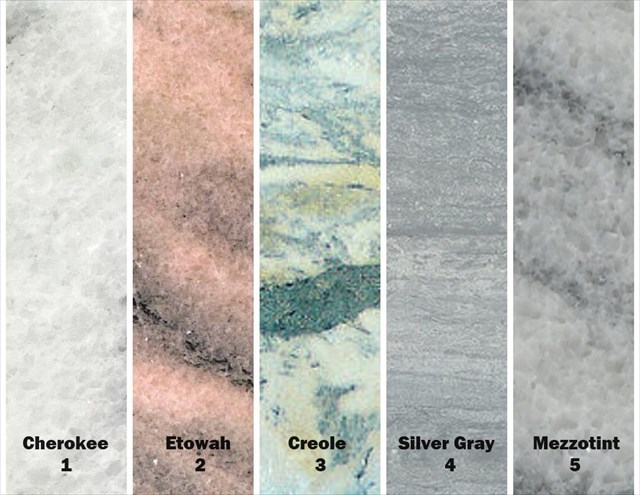
Georgia Marble can be grouped into five major types, which are quarried near Tate, Georgia. In general, they are characteristically medium to coarse grained and vary mainly in their color. First there is Cherokee Marble which ranges from pure white to white with light gray veining. It has been described as having an appearance of 'delicate clouds and veinings on a background of white or light gray'. Next, there is Etowah Marble, which has a distinct pink hue with varying amounts of green veining. Etowah Marble gets its color from the presence of hematite. Then there is Creole Marble which is white with numerous dark gray to bluish black veining. Then there is Silver Gray Marble, which is a uniform gray color. The color particles are evenly distributed and produce a soft silvery gray appearance. This type of Georgia Marble is often used for monuments where a light variety of material is desired. Lastly there is Mezzotint Marble, which is gray with dark gray to black veins. The veining that can be found in marble is caused by slight differences in the chemical composition of the stone. For example, grays and blacks are caused by sulfides and graphite while golden brown colors are a result of phlogopite, while greens are caused by chlorite, biotite, or tremolite.
One other important topic worth mentioning involves veining, which comes in various types: linear, brecciated, and cloud. Linear veins are straight or slightly wavy lines that run parallel through the marble, creating a uniform and structured appearance. Brecciated veins form from fragments of various sizes and shapes that are cemented together, giving the marble a chaotic yet intriguing look with irregular patterns. Cloud veins feature soft, wispy patterns that resemble drifting clouds, providing a gentle and serene appearance. Each type of veining is influenced by different geological processes such as pressure, temperature, and mineral composition.
Logging Requirements:
- Describe the unique characteristics of the columns (color, texture, translucency, veining...etc). How would you categorize the veining visible in the stone (linear, brecciated, or cloud)), and why?
- Based on your observations, which type of Georgia Marble do you think was used for the columns? Why do you think this particular variety of Georgia Marble was used over the others?
- Upload a photo with the First Presbyterian Church. You don't have to be in the photo, though it is strongly encouraged.
Works Cited:
- https://quarriesandbeyond.org/states/ga/pdf/ga-georgia_beauties_no_22_monument_catalog.pdf