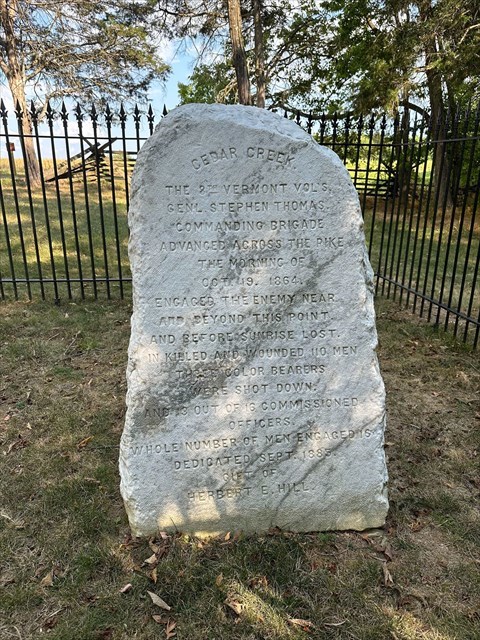
The 8th Vermont Monument is located in Cedar Creek and Belle Grove National Historical Park, and is dedicated to the 8th Vermont Infantry Regiment. It commemorates the regiment's bravery and sacrifice during the Battle of Cedar Creek on October 19, 1864. The 8th Vermont played a crucial role in the Union's defense and eventual victory in this battle, which was one of the last major engagements of the Shenandoah Valley Campaign.
The 8th Vermont Monument is made from Vermont Marble, which is a type of metamorphic rock. Vermont Marble's formation began around 450 million years ago during the Ordovician period, a time when the region that is now Vermont was part of a shallow, warm sea. Over millions of years, marine organisms like corals, shellfish, and other calcium-rich creatures died and accumulated on the seafloor, forming thick layers of limestone. This limestone primarily consisted of calcium carbonate, which is the key ingredient in marble formation. As the Earth's tectonic plates shifted, the ancient oceanic sediments that would become Vermont were gradually pushed upward and compressed. During the Taconic Orogeny, a mountain-building event, these limestone layers were buried deep within the Earth's crust. The immense heat and pressure from this burial caused the calcite crystals in the limestone to recrystallize and grow larger, a process known as metamorphism.
Marble can be classified as either low-grade or high-grade, and they differ primarily in the degree of metamorphism they have undergone which can impact the texture, appearance, and structural qualities of the stone. Low-grade marble is formed under relatively lower temperatures and pressures, and often retains some of the original features of the limestone, such as fossil imprints or slight layering. The recrystallization of calcite in low-grade marble is less complete, which results in a coarser grain and a less uniform appearance, along with more impurities that can lead to a wider variety of colors and patterns. In contrast, high-grade marble has been subjected to much higher temperatures and pressures during metamorphism. This intense metamorphism results in a more complete recrystallization of the calcite, leading to a finer, more uniform grain. High-grade marble is typically purer in composition, giving it a more consistent color, often white or light gray, and is usually fine grained.
Please do not touch the monument, in order to help preserve the site for future generations. All observations can be made from outside of the small perimeter fence that surrounds the monument.
Logging Requirements:
- Describe the color, luster, grain size, and veining of the Vermont Marble. Do you see any color variations, which would indicate impurities or trace minerals within the stone?
- Based on your observations, would you classify Vermont Marble as a high-grade marble, or as a low-grade marble, and why?
- Upload a photo taken with the 8th Vermont Monument. You don't have to be in the photo, though it is strongly encouraged.
Sources:
- https://www.nps.gov/places/8th-vermont-monument.htm