Geological Exploration of Metro Cleveland (GEM-C)
The Geological Exploration of Metro Cleveland tour is a series of Earthcaches which help to illustrate some geology that is hidden within the urban downtown area of Cleveland. These urban earthcaches help to highlight a wide variety of geological topics that are hidden in plain sight - in fact thousands of people walk by these stones every day without so much as a second thought about their origins!

This tour does not need to be done in any particular order and each earthcache is a standalone lesson. As you wander through the streets of Cleveland take a moment to pause and reflect on the lessons you can learn in just a normal city block!
Here, the sea strains to climb up on the land
and the wind blows dust In a single direction.
The trees bend themselves all one way
and volcanoes explode often...
-Excerpt from "A Geology Lesson" by Judy Grahn
As with all earthcaches there is no container to find here, rather you must read through the description below and answer a few questions in order to log this cache as found. Please ensure that you send your answers to the CO via email or message in a timely fashion.
Georgian Marble in Ohio
This Earthcache will take you to two buildings in downtown Cleveland. Our jouney will start at the Cleveland Public Library and end at Federal Reserve Bank - both of which are constructed of marble blocks brought north from the Peach State. These buildings are some of the most iconic in the city which is due in a large part to the marble that was used in their construction!
MARBLE IS A METAMORPHIC ROCK
Marble is a metamorphic rock. These types of rocks start out as some other type of rocks, but have been substantially changed from their original igneous, sedimentary, or earlier metamorphic form. Metamorphic rocks form when rocks are subjected to high heat, high pressure, hot mineral-rich fluids or, or some combination of these factors. During metamorphosis the rock remains completely solid with varying pressure and magnitude. This leads to alternating layers of newly formed minerals.
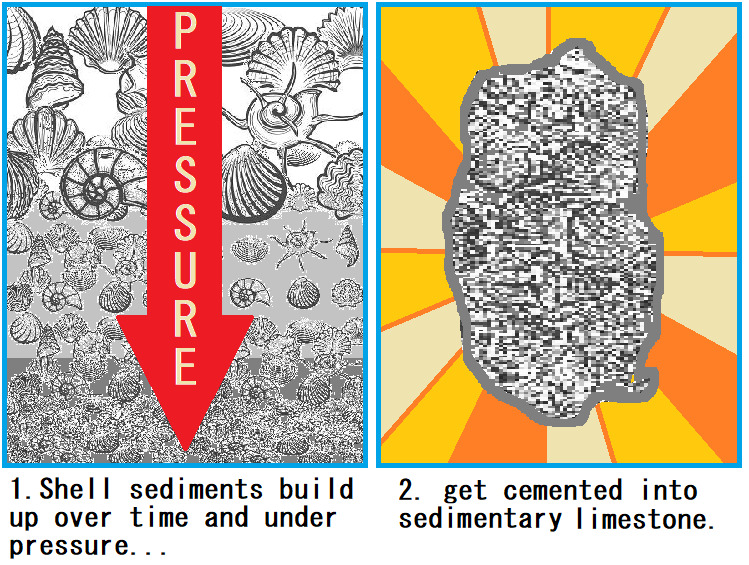
This particular shaft of Georgia marble in front of you was formed millions of years ago from living organisms. These animals had shells made of calcium carbonate that piled up over time when they died. Over many years these sediments became buried. The more layers that were added created more pressure. This pressure cemented these shell fragments together to form a sedentary limestone.
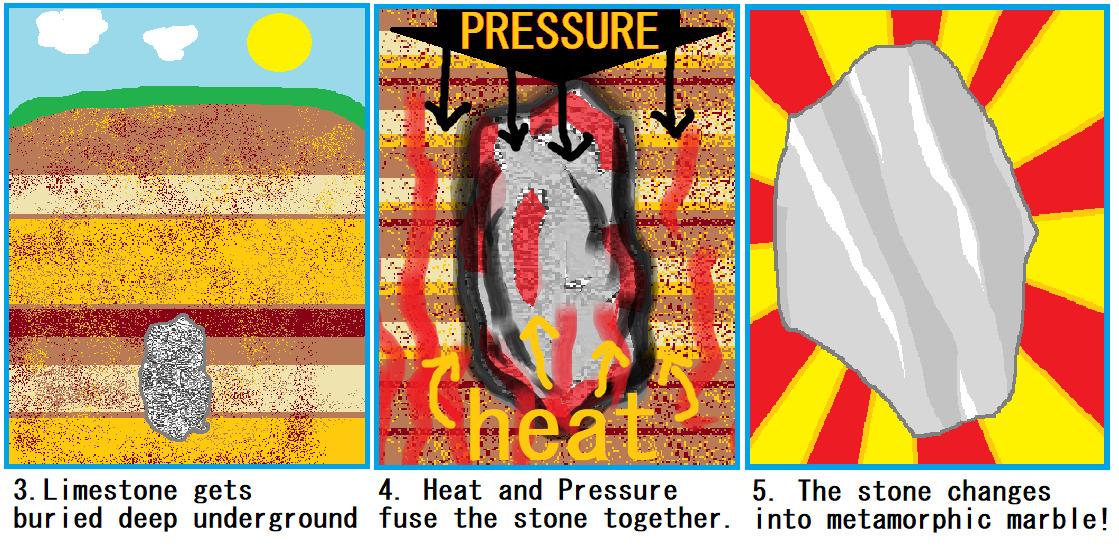
Over time this limestone was buried deep in the earth and became exposed to high pressure and heat which metamorphosized the stones composition from limestone to marble. Millions of years of uplifting and erosion exposed this marble to Georgia's surface, where it was later quarried and sculpted into the shape you see here today!
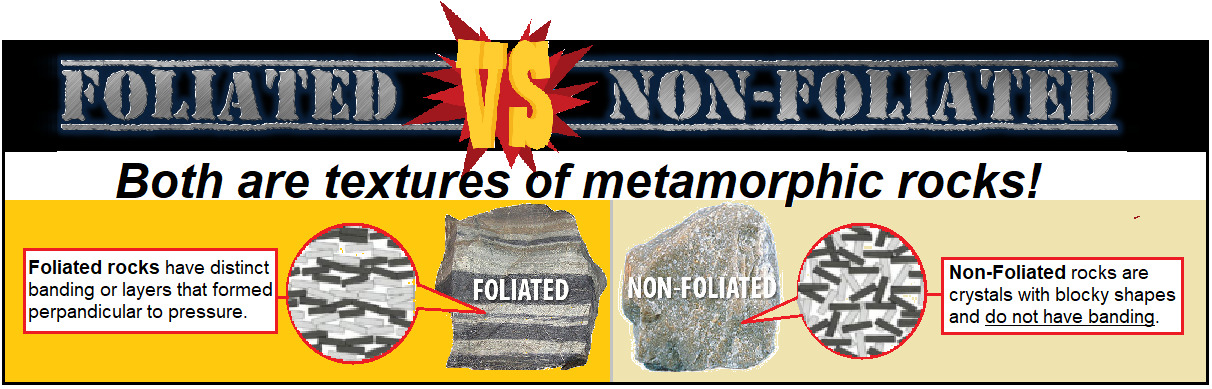
The texture of metamorphic rocks is classified as either foliated or non-foliated. Foliated rock is a type of metamorphic rock having identifiable layers, textures, and patterns. Non-foliated metamorphic rocks do not have a layered or banded appearance.
Marble is usually a light-colored rock. When it is formed from a limestone with very few impurities, it will be white in color. Marble that contains impurities such as clay minerals, iron oxides, or bituminous material can be bluish, gray, pink, yellow, or black in color.
All of the marbles of Georgia occur in the northern part of the state and are confined to a narrow belt, about sixty miles long and one to three miles wide. There are three types of Marble that come from the marble outcrops in Georgia.
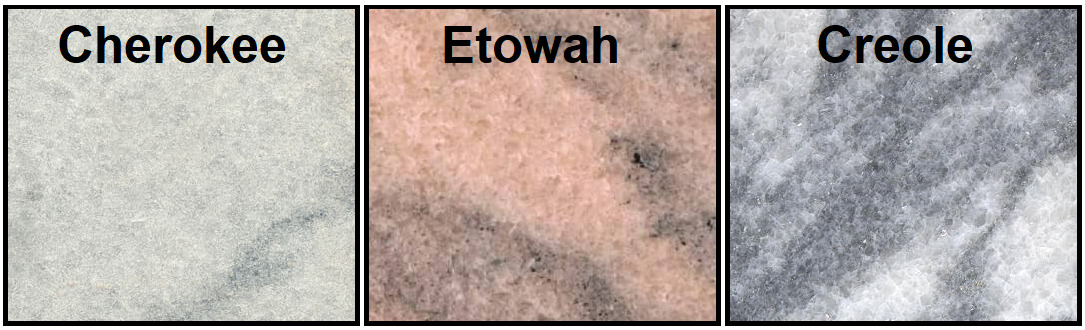
CHEROKEE: This is a light gray marble with white crystals and discreet veins across the surface.
ETOWAH: The fleshy color of the stone is due principally to the presence of iron oxide and graphite.
CREOLE: The gray is from an impurity of clay that mixed with the limestone before it became metamorphized.
As a building marble, the Georgia stone has very few equals in the United States. It’s purity and great strength matched together with its extremely low absorption properties make it perfect for all classes of exterior uses.
Logging Tasks:
QUESTION 1. Where does the Calcium Carbonate come from that makes up marble?
QUESTION 2. At Waypoint 1 you are standing in front of the Cleveland Public Library - what variety of Georgian Marble is used here? What impurity caused its coloration?
QUESTION 3. At Waypoint 2 you are standing on the curb in front of the Federal Reserve Bank Building - what variety of Georgian Marble is used here? What impurity caused its coloration?
QUESTION 4. Are these stones foliated or non-foliated?
Additonal Logging Requirement: Post a photo that readily indicates that you (and anyone else logging the find) are at one of the two waypoints. This photo may be of yourself in front of the buidling, or it may be of a personal item!
References:
1. Georgia Marble, Mark Gelbart, GeorgiaBeforePeople, February 2, 2014, Blog, wordpress.com
2. Mad About Marble: A Geological Look at a Classic Stone, Use Natural Stone, Website, epd.georgia.gov
3. Geology of the Tate Quadrangle, Georgia, W.S. Bailey, Bulletin No. 43, Geological Survey of Georgia, 1928, usenaturalstone.org
A big thank you to Awesnap who graciously allowed me to borrow his reference material in creating this EC page. Visit some of Awesnap's ECs in Virginia and Maryland! This earthcache has been placed with permission!