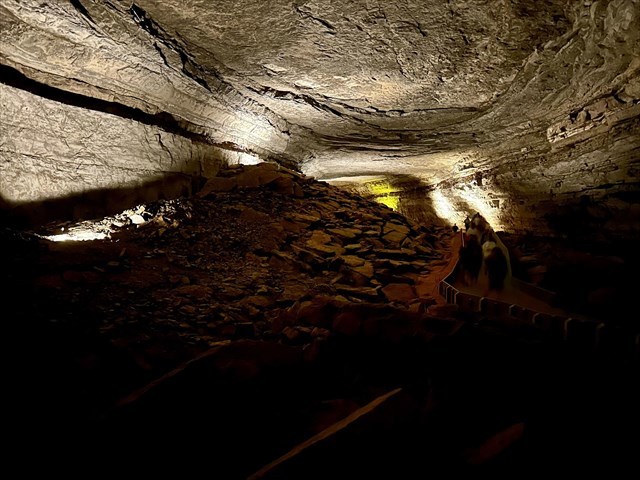
Mammoth Cave National Park is located in central Kentucky and encompasses the Mammoth Cave system and the surrounding landscape. Established in 1941, the park preserves Mammoth Cave which is the longest known cave system in the world. The park's diverse surface environment includes forests, rivers, and sinkholes, contributing to its ecological richness. The park also is recognized as a UNESCO World Heritage Site and an International Biosphere Reserve which reflect its significant geological and ecological value.
Perhaps one of the most studied features is how Mammoth Cave was formed, but probably not that many people stop to wonder how the particular room or passageway they are standing in was formed. Cave passageways can actually be classified based on their morphology, which often reflects the processes that formed them. You may be wondering why this is important? By examining the shape, size, and arrangement of these features, geologists can infer the cave's hydrological history, the nature of the surrounding rock, and the timeline of geological events. For example, the shape of a passageway indicates whether it formed under fully water-filled (phreatic) conditions or partially water-filled (vadose) conditions with free-flowing water. Features like scallops and notches can reveal the direction and velocity of past water flow, while sediment layers or speleothems within a room can indicate periods of flooding, changes in water chemistry, or shifts in the cave’s drainage patterns.
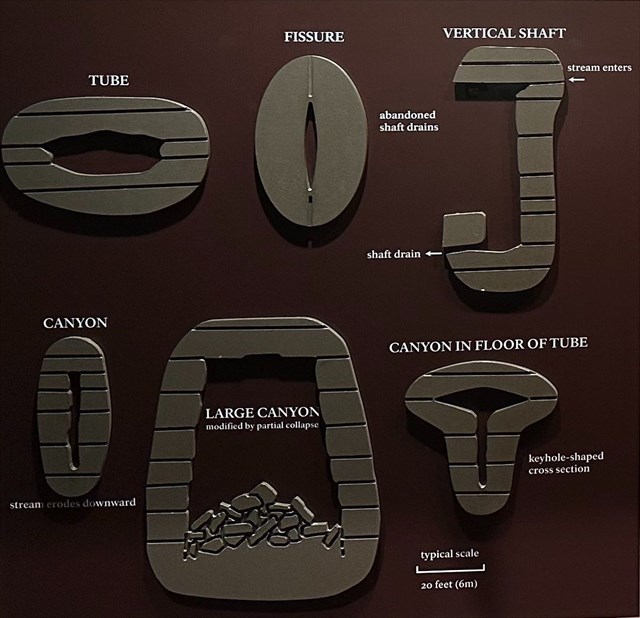
Tubes are typically circular or elliptical in cross-section and form under phreatic conditions, where the cave is completely filled with water. The water's pressure causes dissolution of the surrounding rock, creating smooth, rounded walls. Tubes often indicate a period of stable water levels and can suggest the presence of a former underground river or aquifer. They may also exhibit features like scallops, which can help determine the flow direction and speed of the water that formed them.
Fissures are narrow, vertical passageways that often follow natural fractures or joints in the rock. These passageways form as water exploits these weaknesses, slowly enlarging them through dissolution. Fissures often indicate that the cave developed in response to tectonic forces or stresses that created the initial cracks. They can be quite narrow and tall, and may lead to or connect other types of passageways, acting as conduits for water to move between different levels within the cave system.
Vertical shafts are steep, cylindrical passageways that form from water descending straight down, often through a sinkhole or other vertical entry point. These shafts are characteristic of caves where water has a direct path downward, carving out a nearly vertical channel. Vertical shafts often feature impressive depth, sometimes leading to lower cave levels or joining with horizontal passageways. They can also contain evidence of water flow, such as plunge pools or deposited sediments at their base.
Canyons are narrow, deep passageways with steep walls, formed by water eroding vertically downward in vadose conditions, where the cave is not completely water-filled. The shape of a canyon passage reflects the gradual cutting action of free-flowing water, which tends to erode the floor of the cave, leaving steep walls behind. Canyons often develop along a slope, and their depth can provide clues about the volume and persistence of the water that carved them. They may contain speleothems such as flowstones along their walls, indicating periods of reduced water flow and calcite deposition.
Large canyons are an expanded version of the standard canyon passage, featuring more extensive erosion that creates a broader, deeper profile. These passages indicate significant water flow over an extended period, suggesting a high-energy environment capable of carrying larger sediment loads and causing more extensive rock removal. Large canyons may have multiple levels or terraces, reflecting changes in water flow and erosion rates over time.
Canyons in the floor of a tube represent a complex history of cave development, where an initial phreatic tube was later modified by vadose downcutting. This type of passageway shows a tube-shaped passage with a canyon-like trench carved into its floor, indicating a transition from fully water-filled conditions to a period of partial drainage and erosion by free-flowing water. The presence of both tube and canyon features within the same passageway highlights the cave's evolution through different hydrological stages. These passages often provide valuable information about changes in water levels, flow direction, and the timing of different phases of cave development.
You might wonder how studying individual passageways and rooms differs from analyzing the cave as a whole. Focusing on cave morphology is crucial because it offers a localized, detailed understanding of the cave's formation. This type of analysis enables geologists to reconstruct the sequence of events that shaped the cave, revealing how water, rock, and time interacted on a small scale. In contrast, big-picture analysis looks at the cave system as a whole, considering its place within the broader regional geology and the influence of external factors like climate and tectonics. While the big picture provides a comprehensive overview of the cave's development, examining the morphology of specific passageways and rooms uncovers the unique processes and conditions that might not be apparent on a larger scale.
Logging Requirements:
- At each of these spots, describe the morphology of the passageway/room. How would you classify each one and why? Do you see any scallops (asymmetrical depressions or grooves created by flowing water) in any of these spots? What can this tell us about how each one was formed?
- Giant's Coffin
- Bottomless Pit
- Fat Man's Misery
- River Hall
- Why do you think such a wide variety of passageways/rooms in Mammoth Cave?
- Upload a photo with your favorite spot along the Historic Tour. You don't have to be in the photo, though it is strongly encouraged.