In order to log this EarthCache, send me your answers to the following questions either through email or messaging from my profile page.
1: Of the 4 landforms defined below, how many do you see across from the posted coordinates? What are they?
2: For each landform, estimate it's size based on the following:
2a: cave: Estimate the width, height and depth.
2b: arch: Estimate the width, overall height and thickness of the top.
2c: stack: Estimate the width and height.
2d: stump: Estimate the width and height.
3: Do you think any of the landforms are close to progressing to the next stage? (Is the cave close to becoming an arch; the arch close to becoming a stack; or the stack close to becoming a stump)
4: Post a pic of you or a signature item with the metal post at GZ.
WHY HERE?
This is an interesting location in that you can see many if not all of the erosional landforms defined below. These are Caves, Arches, Stacks and Stumps.
HEADLANDS
Headlands jut out into the sea as they are made from more resistant rock which erodes more slowly than the surrounding rocks. However, they are hit by destructive waves because of wave refraction so they are constantly being re-shaped be erosion. This creates landforms such as caves, sea arches, stacks and stumps.
SEA CAVES
Sea caves are erosional features that form in high energy tidal environments.
SEA ARCHES
A sea arch is a natural arch-shaped formation that occurs when a cave in a headland erodes through the headland and emerges on the other side.
SEA STACK
A sea stack forms when a sea arch continues to be eroded and widened until the rock becomes too weak to support the roof of the sea arch and collapses into the sea. The remaining pillar of rock is known as a sea stack.
SEA STUMP
A sea stump is a remaining piece of rock that was once the base of a sea stack. Sea stumps are formed when a sea stack is eroded and worn down by wind and waves until it's just above the water's surface.
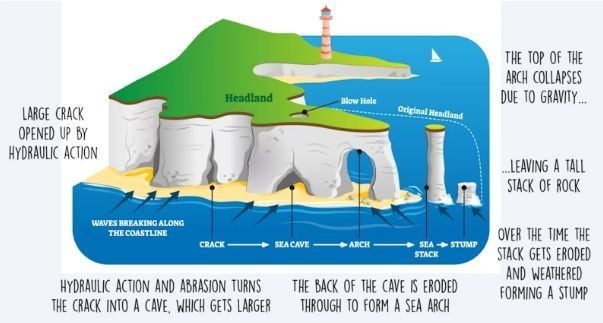
How do caves, arches, stacks and stumps form?
This sequence starts with hydraulic action forcing water into a crack which puts pressure on it causing it to grow larger. The crack will grow into a notch, which will then form into a cave due to the destructive waves that are converging on the headland. Two caves can form on either side of the headland due to wave refraction - over time these caves will get larger through abrasion, and the sea may break through the back of them, turning them into a sea arch. Further hydraulic action and abrasion will widen the base of the arch. The top of the arch will be weakened by weathering, making it less stable so it will eventually collapse, leaving a stack, which is a detached pillar of rock. Erosion will cause notches to form at the base of the stack which makes it unstable, which along with weathering processes, will make the stack topple into the sea, leaving a stump which is usually only visible at low tide.
references
https://www.nps.gov/havo/learn/nature/sea-arches.htm
https://www.tutor2u.net/geography/
I have earned GSA's highest level:
 |