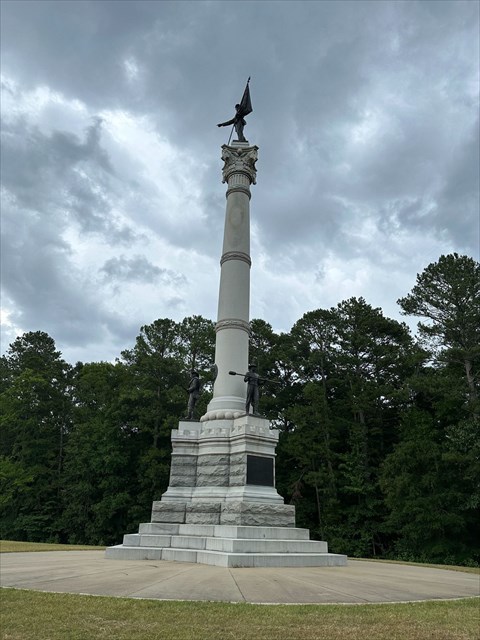
The Georgia Monument, dedicated in 1899, was erected by veterans to commemorate the role of Georgia troops in the Battle of Chickamauga. Standing in Poe Field on the east side of LaFayette Road, it marks the area where these troops were heavily engaged in combat. The monument features a large granite obelisk topped with a bronze statue of a Confederate soldier, with its base inscribed with the names of the Georgia regiments that fought in the battle. This serves as a reflection of Georgia's significant contribution to the Confederate war effort. The Battle of Chickamauga, fought in September 1863, was one of the bloodiest battles of the Civil War, and the monument stands as a lasting tribute to the bravery and sacrifice of those who fought there.
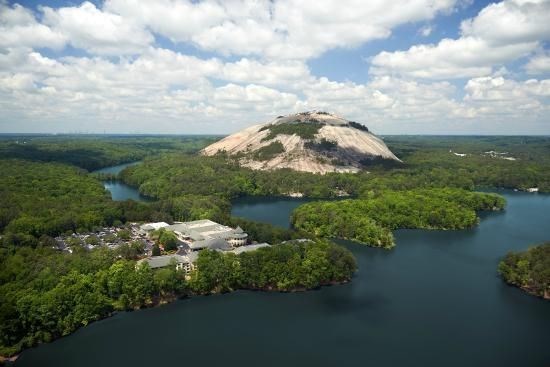
The Georgia Monument is constructed from Stone Mountain Granite, a rock that originates near its namesake, Stone Mountain (pictured above). This granite formed deep within the Earth's crust during the late Paleozoic era, around 300 to 350 million years ago, as a large mass of molten rock, or magma. As the magma slowly cooled and solidified beneath the surface, it created a massive quartz monzonite dome. The granite, primarily composed of minerals such as quartz (glassy and shiny appearance), feldspar (crystalline and pink to white color), and mica (shiny and sheet-like), developed its light gray color with speckled patterns as these minerals crystallized from the cooling magma.
During the Appalachian orogeny, which was a period of intense mountain building, the granite intruded into the surrounding metamorphic rock. Over millions of years, the Earth's crust continued to shift and uplift, while erosion gradually stripped away the overlying material, eventually exposing the dome that is now visible in the area. This dome, characterized by its smooth, rounded shape, is a key feature of Stone Mountain, resulting from the granite's remarkable resistance to weathering and erosion.
What makes Stone Mountain's granite particularly unique is its combination of physical properties. The granite has a fine grain and a high degree of homogeneity, meaning the mineral composition is consistent throughout the rock. This lack of significant fractures or faults contributes to its durability, allowing it to resist weathering more effectively than other rocks. Additionally, the stone contains small amounts of accessory minerals like biotite (dark and flaky) and hornblende (dark, metallic, needle-like appearance), which add subtle variations in texture and appearance.
Logging Requirements:
- Examine the Stone Mountain Granite closely. How would you describe the color, texture, and grain size? Do you see any variations in color or is it consistent?
- Do you see any signs of weathering or deterioration of the stone? Considering its age, how has it stood up to the test of time?
- Upload a photo with the Georgia Monument. You don't have to be in the photo, though it is strongly encouraged.