
Welcome to my Earthcache! An Earthcache is a special type of geocache where there is no container to find - instead you are looking for a unique geological feature of the area and need to answer questions, as well as posting a picture, in order to claim the find.
As with all of my ECs, I am not looking for PhD thesis level responses, but I am hoping that you take some time to enjoy the area and learn something new. Please include a list of all cachers with your answer, if answering for more than one caching name. There is no need to send individual answers.
To claim a 'find' for this Earthcache you must answer the following questions and send your answers in a message or email to the owner using the link at the top of the page. You can log your find with a photo at GZ. Send your answers to the tasks. I will be in contact if there is a problem, no need to wait for a response as long as the required photo is included in your log.
1. Find an example of at least three different types of vugs, veins or nodules at or within a small radius of GZ. Describe what you are seeing and what makes each different one unique. Determine whether it is a vein, vug or nodule and describe what seems to have "grown" to fill the void in the rock.
2. Using the information below (or your own research) please try to identify the three different types of minerals you have found.
3. Standing at the posted coordinates, what is the most common mineral deposit that is visible?
4. MANDATORY - Post a photo of yourself, your signature item, your GPS, at or near the posted coordinates. You do not need to show your face if you are shy. You may include this photo in your log, or send it with your answers but it must be provided as proof that you visited the area.
Earthcache Information:
At GZ, you will find a series of large rocks that are used as a landscaping feature for the side of a parking lot. These rocks are no ordinary rocks - they contain a collection of vugs, iron oxide veins, slate, and other mineral deposits - crystaline structures formed in air pockets or cracks of the rocks. Please take a few moments to look around and then answer the questions provided.
Vugs (also spelled: vugh, or vugg)
A vug is a small to medium-sized cavity inside rock. It may be formed through a variety of processes, but most commonly are cracks and fissures opened by movement (either tectonic or seismic activity), which are partially filled by quartz, calcite, and other minerals. Open spaces within ancient rocks or lava collapse breccias are another important source of vugs. These types of vugs are typically caused by minerals or sediment located within the pockets, which crystalize under intense pressure.
Vugs may also form when crystals or fossils inside a rock are removed through erosion or dissolution processes such as decaying organic matter, leaving behind holes with organic or mineral compounds. The inner surfaces of such vugs are often coated with a crystal druse (a coating of fine crystals on a rock fracture surface, vein or within a vug).

Fine crystals are often found in vugs where the open space allows for the crystals to form. The term vug is not applied to veins and fissures that have become completely filled, but may be applied to any small cavities that are not completely filled. Once they are completely filled, they are called NODULES.
Nodule
In sedimentology and geology, a nodule is small, irregularly rounded knot, mass, or lump of a mineral or mineral aggregate that typically has a contrasting composition, such as a pyrite nodule in coal, a chert nodule in limestone, or a phosphorite nodule in marine shale, from the enclosing sediment or sedimentary rock. Normally, a nodule has a warty or knobby surface and exists as a discrete mass within the host strata. In general, they lack any internal structure except for the preserved remnants of original bedding or fossils. Nodules are closely related to concretions and sometimes these terms are used interchangeably. Minerals that typically form nodules include calcite, chert, apatite (phosphorite), anhydrite, and pyrite. In sedimentology and geology, nodular is used to describe sediment or sedimentary rock composed of scattered to loosely packed nodules in matrix of like or unlike character.
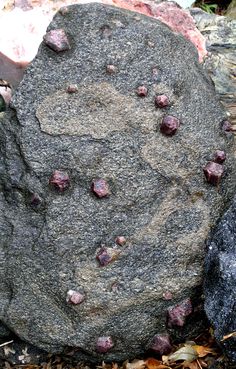
Here are some examples of Nodule's in there natural state.
What is a vein?
In geology, a vein is a sheetlike body of minerals within a rock. Veins form when minerals are carried by fluids within the rock mass and deposited through precipitation. The flow is usually due to the fluid circulation.
What are the types of veins?
There are two main types of veins: open-space filling and crack-seal growth.
Open-space filling is the hallmark of epithermal vein systems. For open space filling to take effect, the confining pressure is generally considered to be below 0.5 GPa of pressure (measure of force per unit area). Veins formed in this way may exhibit a colloform, agate-like habit, of minerals which radiate out from nucleation points on the vein walls and appear to fill up the available open space. Geodes, vugs, and cavities are all examples of open-space filling phenomena in hydrothermal systems.
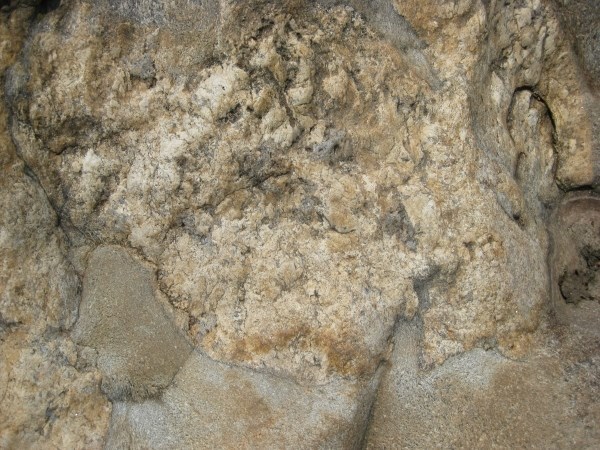
Example of open space filling.
Crack-seal veins are thought to form quite quickly during deformation by precipitation of minerals within incipient fractures. This happens swiftly by geologic standards, because pressures and deformation mean that large open spaces cannot be maintained; generally the space is in the order of millimeters or micrometers. Veins grow in thickness by reopening of the vein fracture and progressive deposition of minerals on the growth surface.
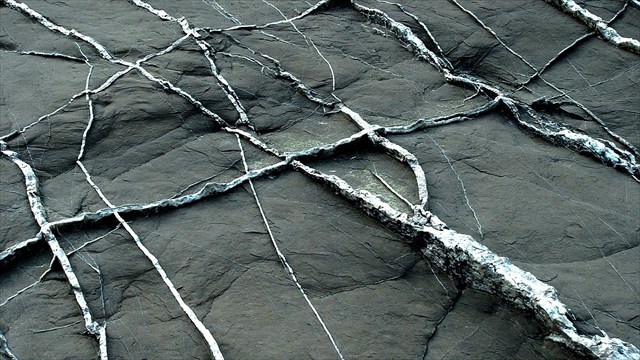
But, what might be lining the vugs? Are there different types of minerals inside of the Vugs?
YES, and that is exactly what this Earthcache will discuss.
Calcite

Possibly the best-known and most abundant mineral is calcite. Calcite forms in a huge (more than 12,000) number of shapes. It has a rhombohedral structure and frequently shows hexagonal crystals. Calcite is relatively soft and Clear crystals usually demonstrate double refraction and other optical properties. Crystals can grow quite large with some several feet in size. Calcite can form by direct precipitation from waters rich in calcium. As concentrations increase or the amount of water decreases crystals of solid calcite crystals form.
Iron Oxide

Red staining is the result of iron oxide or hematite within the rocks. Exposure to the elements will cause iron minerals to oxidize or “rust,” resulting in red, orange, and brown-colored rocks, or streaks along the otherwise grey rock faces.
Quartz

Quartz is a mineral formed of silica, while limestone is a sedimentary rock formed from calcium minerals such as calcium carbonate. Quartz bands in limestone can be formed by processes such as deposition from water passing through cracks in the rock, forming a hydrothermal mineral vein.
Barite

Barite occurs in hydrothermal ore veins (particularly those containing lead and silver), in sedimentary rocks such as limestone, in clay deposits formed by the weathering of limestone, in marine deposits, and in cavities in igneous rock.
You will see at least four different examples at GZ and all along this group of rocks.
Details About this Earthcache
Parking is available right beside the rocks you will be looking at in this area, with plenty of parking for multiple vehciles. This area is available from 24 hours per day, 7 days per week. However, due to the visual nature of earthcaches, I would ask that you please limit your visit to daylight hours.
This earthcache will not be available when there is excessive snow on the ground. Please be respectful and come back when you are able to fully experience this location.
This cache was placed by a PROUD Platinum Earthcache Master.