
The Bennington Battle Monument, the tallest man-made structure in Vermont, commemorates the American victory at the Battle of Bennington on August 16, 1777, a crucial event in the American Revolution. During the battle, the Green Mountain Boys of Vermont, the New Hampshire Militia, and Massachusetts volunteers successfully defended a vital military supply depot from British forces. The monument, which stands on the site of this historic depot, was designed by architect J. Phillip Rinn to honor this decisive moment. Completed in 1889, the 306-foot structure was dedicated on August 19, 1891, in a grand ceremony attended by President Benjamin Harrison.
The Bennington Battle Monument was constructed from Sandy Hill Dolomite, a stone quarried in Kingsbury, NY. It's worth noting that Kingsbury was originally known as Sandy Hill before being renamed Hudson Falls in 1910, which is why the stone may also be referred to as Kingsbury Dolomite. Dolomite typically forms through a process known as dolomitization, where magnesium-rich fluids interact with limestone, replacing calcium with magnesium to form dolomite. This transformation commonly occurs in shallow marine environments, where seawater rich in magnesium circulates through the limestone. During this process, magnesium ions replace some of the calcium ions within the limestone's crystal structure, gradually converting it into dolomite. Factors such as temperature, magnesium concentration, and the presence of organic material can significantly influence the rate and extent of dolomitization. This process can happen shortly after the limestone is deposited (early diagenesis) or much later, when the sediment has been deeply buried (late diagenesis). The result is often a complex alteration that may partially or completely replace the original limestone, creating unique textures and varying porosity that impact the rock's physical properties.
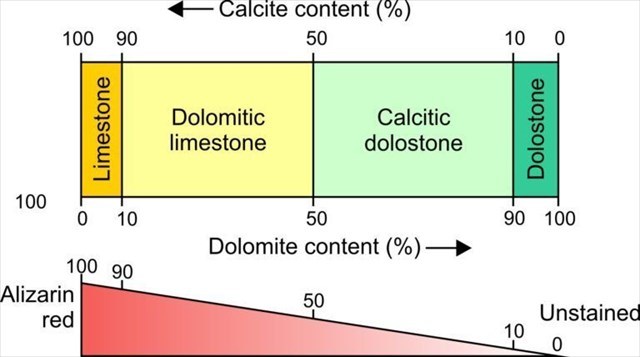
Dolomite can be classified based on the extent to which the original calcite has been replaced by dolomite, with increasing dolomite content moving from limestone to dolomitic limestone to calcitic dolostone and finally to dolostone. Initially, there is limestone which is a sedimentary rock primarily composed of calcite, that is formed from the accumulation of marine organisms shells and skeletons. As dolomite content increases, the rock transitions to dolomitic limestone, which contains both calcite and dolomite, with dolomite replacing some of the calcite and creating a more complex mineral composition. Further replacement results in calcitic dolostone, where dolomite is the dominant mineral but calcite is still present. Finally, when dolomite has largely replaced the original calcite, the rock is classified as dolostone, where dolomite is the predominant mineral. This progression reflects an increasing dolomite content, from limestone with minimal dolomite to dolostone with predominantly dolomite. The bottom of the chart with the Alizarin Red can be ignored, since that is primarily used for laboratory tests to determine an exact percentage. We will however be focusing on visual observations.
Now lets go over how to distinguish dolomite from calcite. Visually distinguishing dolomite from calcite involves observing several key features. Dolomite crystals are typically smaller and more tightly packed compared to calcite, which often forms larger and more elongated crystals. Dolomite often has a granular or sugary texture on its surface, while calcite usually appears smoother and more glassy. Color can also provide a clue: although both minerals can be white, gray, or pink, dolomite tends to have more muted or earthy tones, whereas calcite may exhibit brighter and more translucent hues. Additionally, dolomite usually presents a pearly or dull luster, while calcite is characterized by a more vitreous or glassy luster.
One other way to distinguish calcite from dolomite involved their chemical properties. Chemically calcite reacts more vigorously with acid compared to dolomite. In the presence of acid rain, calcite dissolves more readily, leading to more noticeable weathering and erosion. Therefore, rocks containing both minerals will show more pronounced weathering of the calcite, making it appear more degraded than the dolomite. Over time, this differential reaction results in calcite appearing significantly more weathered than dolomite.
Logging Requirements:
- Describe the color, texture, and crystal size of the Sandy Hill Dolomite.
- Are you able to distinguish the dolomite crystals from the calcite crystals? If so, estimate the proportion of each, and how would you classify it?
- Upload a photo with the Bennington Battle Monument. You don't have to be in the photo, though it is strongly encouraged.
Sources:
- https://www.kingsburyny.gov/pdfs/hist/Town%20Historian.pdf
- https://historicsites.vermont.gov/bennington-monument#:~:text=The%20exterior%20of%20the%20stone,monument%20weighs%20approximately%2019%2C000%2C000%20pounds.
- https://geologyistheway.com/sedimentary/dolostone/