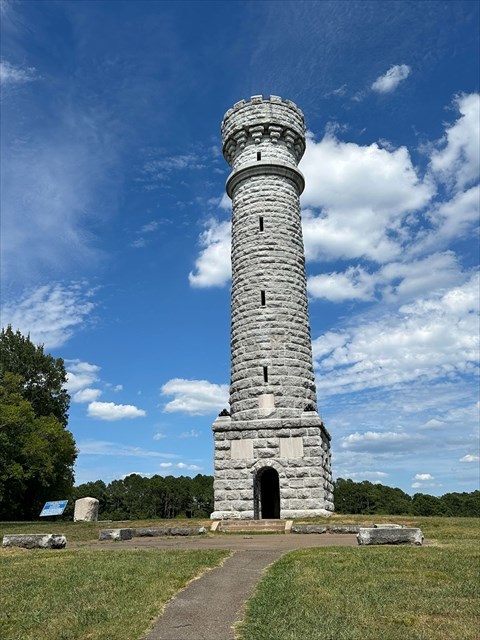
The Wilder Brigade Monument at Chickamauga Battlefield commemorates the Lightning Brigade, which was a unique Union unit of mounted infantry led by Colonel John T. Wilder. Unlike typical cavalry, the Lightning Brigade rode on horseback but fought dismounted as infantry, using their deadly seven-shot Spencer Repeating Rifles. The Battle of Chickamauga took place on September 19-20, 1863 and was one of the bloodiest engagements of the American Civil War, marked by fierce fighting between the Army of the Cumberland and the Army of Tennessee. The monument, constructed from Chickamauga Limestone, stands 85 feet tall from its base to the top of the stonework and was dedicated on September 20, 1899.
Chickamauga Limestone was formed during the Late Ordovician period, roughly 450 million years ago. It originated from the accumulation of marine sediments in shallow, warm seas that covered what is now the southeastern United States. As geological processes continued, layers of these sediments built up and exerted pressure on the layers below. This pressure, along with the chemical action of mineral rich groundwater, caused the sediments to compact and cement together, forming solid limestone. It is worth noting that these sediments are primarily composed of calcium carbonate from shells, coral, and other marine organisms.
Logging Requirements:
- Examine the Chickamauga Limestone closely. Describe the color, texture, and grain size.
- Do you see any fossil fragments within the limestone? If so, describe what you see.
- Upload a photo with the Wilder Brigade Monument. You don't have to be in the photo, though it is strongly encouraged.
Sources:
- https://www.tn.gov/content/dam/tn/environment/geology/documents/geology_report-investigations-24.pdf