There may be some, very limited, disabled car parking on the High Street near the church, otherwise there is a new and hideous multistorey carpark behind the High Street, down St John's Road (off the mini-roundabout nexxt to the church), first right into Baker Lane and follow that around to the unmissable metal ziggurat.
St John's Church Epping also has a multi-cache looking at the church, so this EarthCache is looking at the stone used to build it. The GPS brings cachers to the outside of the east wall on the High Street, where there is evidence of the type of stone being used to build the church and some of the issues. There are waypoints to the main door off St John's Road and the Tower, near the stairs into the tower.
First the geology - rocks are usually categorised into three types, sedimentary, metamorphic and igneous.
Sedimentary rocks are formed by particles of minerals and/or organic matter accumulating and becoming cemented together into to form a rock. This often happens on seabeds, and the way these rocks form mean that they can often contain visible fossils or evidence of the living things that were part of the accumulation. These rocks form in layers or strata and are often rough and almost powdery to the touch as the grains can separate. Common sedimentary rocks are chalk, limestone and sandstone.
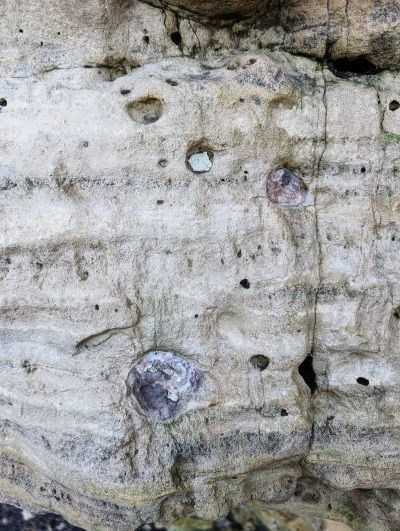
The photograph here is from Hartlepool sea wall. It shows layers of sediment and inclusions including shells in the formation of the blocks.
The mineral particles that make up sedimentary rock are often formed from eroded or weathered rock fragments, this is part of the rock cycle. These fragments are blown or carried by ice or water to collect in sediments. These sediments become deposited in mineral beds - for example at the bottom of a lake or sea. At its simplest, as the layers build up, the older underlying layers of sediment become compacted and cemented together - becoming stone - lithification - in various ways, depending on how much pressure is exerted by the layers above. Biological detritus, such as the shells in the layers here, become incorporated, with the grains of rock fragments surrounding them and encasing them. If the biological part decomposes, this can leave holes in the rock.
The grains of rock making up sedimentary rocks varies, from the very fine mud making up shales, the larger grains making up sandstone and the even larger fragments in breccias.
These sedimentary rocks are relatively soft, and susceptible to weathering, as can be seen by the bums and curves in the blocks in the photograph, which as a sea wall is subject to wind and sea weathering. The layers may also weather unevenly, as show here, where the ridges are formed from layers less prone to weathering remaining, while the softer layers are more weathered and are forming the dips.
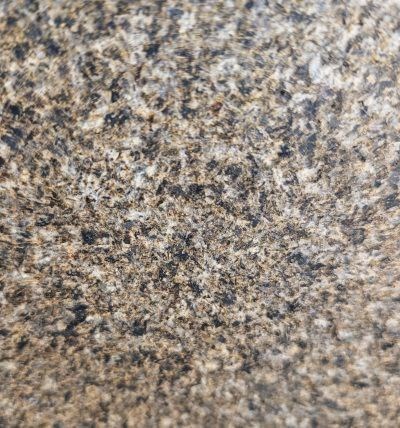 Igneous rocks are formed when magma or lava cools, so from volcanoes or the molten rock in the core or crust of the Earth. These rocks are often crystalline or grained, showing the different minerals found in the rock formation but the rocks feel hard and smooth (unless pitted) or full of bubbles when formed (like pumice). Examples of igneous rocks are granite (like the water fountain in the High Street nearby) obsidian and pumice.
This rock is granite, showing the grains of different minerals in the rock. This comes from a headstone on the coast at Hartlepool at the graveyard at Spion Kop. These stones stood out as far less weathered than the surrounding sandstone headstones.
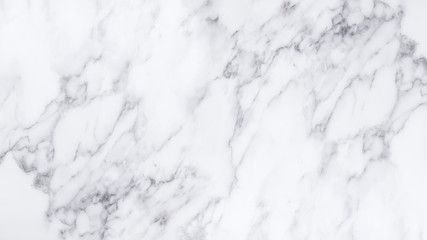
Metamorphic rocks are formed when existing rocks are changed by heat and/or pressure - examples are marble from limestone, slate from shale (both sedimentary rocks) and gneiss from granite (an igneous rock). The chemical and physical changes that reform the rocks also alter the crystalline structure so that, for example, the fine crystals of limestone become the larger crystals of marble, so the rock becomes smoother to the touch and any fossils or inclusions become streaks of colour, rather than obvious fossils.
The photograph shows the veining in marble when impurities are chemically altered into coloured streaks, as here.
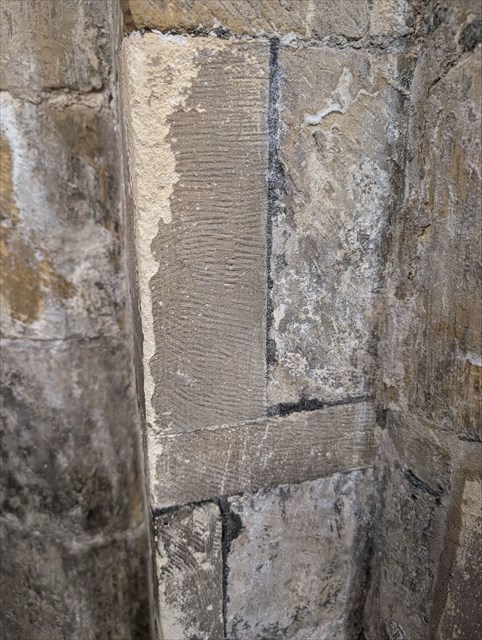
The softness of sedimentary rocks has pluses and minuses for construction. A benefit of using sedimentary rocks are that they are easier to carve into shapes and designs. A negative of using these softer rocks is that they are more prone to weathering as their structure is not chemically formed into a rock as happens for metamorphic and igneous rocks.
Weathering of rocks:
Rocks can be weathered:
Physically - by the wind or grains being blown into the rock, or machinery wearing it down, or by water seeping into cracks and freezing. In deserts wind and sand grains weather rocks into incredible shapes, as does water flowing through river beds, tumbling rocks along, and there are ruts in the old cart tracks on that have been physically worn away.
Chemically - by acid from pollution in rain and water dissolving rock away
Biologically - by plants or animal action (piddocks in stones, ivy growing into walls)
Questions:
Please send your answers by message through the Geocaching app or the email options.
- From your observations, do you think the blocks (ashlars) of stone in the walls of St John's church are formed of sedimentary, metamorphic or igneous rock?
- What makes you believe that?
- On the east wall of the church, there are signs of repairs to the wall - what do you think is happening here and why do you think this type of rock might require repairing?
- If you stand by the church doors or the tower you can see odd grey coloured part blocks in the honey coloured stone - these are repairs carried out in the 1970s, using a plastic stone replacement, that now needs replacing again. By observation, can you spot any of these blocks? Can you describe where these are to be found?
- There are paler sections to the porch where repairs have been carried out - why do you think these areas are being replaced with the same original stone, unlike the blocks on the High Street?
- Optional extra, include a photograph in your post showing you or your name at near the church.
Also on the tower, just above the stairs, there is a memorial carved into the wall - it's easier to see the cross above the words:
W. T.
DiED MAY 19
1908
AGED 79
RIP
According to contemporaneous records, WT was one of the workers building the tower, possibly the foreman, who had a seizure / heart attack and fell from the tower.